QUESTION IMAGE
Question
do now:
- how do you think poverty affects the brain?
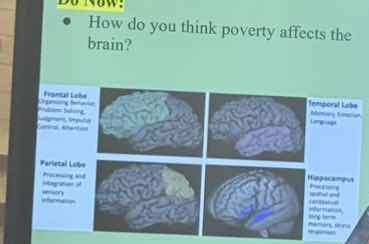
frontal lobe:
organizing, behavior, planning, decision-making
parietal lobe:
sensory and spatial integration of memory
temporal lobe:
regulating emotions, language
hippocampus:
memory formation, stress regulation
Brief Explanations
Poverty impacts the brain through multiple interconnected pathways:
- Chronic Stress & Hippocampus: Persistent financial scarcity triggers chronic stress, elevating cortisol levels. Over time, this damages the hippocampus, which is critical for memory formation and emotional regulation, reducing its volume and impairing these functions.
- Prefrontal Cortex Impairment: The prefrontal lobe, responsible for decision-making, impulse control, and future planning, is compromised. Poverty often forces constant trade-offs (e.g., choosing between food and rent) that deplete cognitive resources, leading to reduced executive function and difficulty with long-term goal setting.
- Parietal Lobe Limitations: The parietal lobe, involved in sensory integration and numerical reasoning, can be underdeveloped due to limited access to educational resources, enrichment activities, and nutrition in childhood. This hinders skills like financial literacy and spatial reasoning.
- Temporal Lobe Effects: Limited exposure to language-rich environments (common in low-income households) can slow the development of the temporal lobe, which supports language processing and auditory memory, creating gaps in communication and learning abilities.
- Neuroplasticity & Opportunity Gaps: Poverty restricts access to quality education, healthcare, and safe living conditions, limiting the brain's ability to form positive neural connections. This creates a cycle where reduced cognitive function further barriers to escaping poverty.

Snap & solve any problem in the app
Get step-by-step solutions on Sovi AI
Photo-based solutions with guided steps
Explore more problems and detailed explanations
Poverty affects the brain by:
- Damaging the hippocampus via chronic stress, impairing memory and emotional regulation.
- Reducing prefrontal lobe function, hindering decision-making and long-term planning.
- Limiting parietal lobe development, weakening numerical and sensory integration skills.
- Slowing temporal lobe growth, creating language and learning gaps from limited environmental enrichment.
- Restricting neuroplasticity through limited access to resources, perpetuating a cycle of cognitive disadvantage.