QUESTION IMAGE
Question
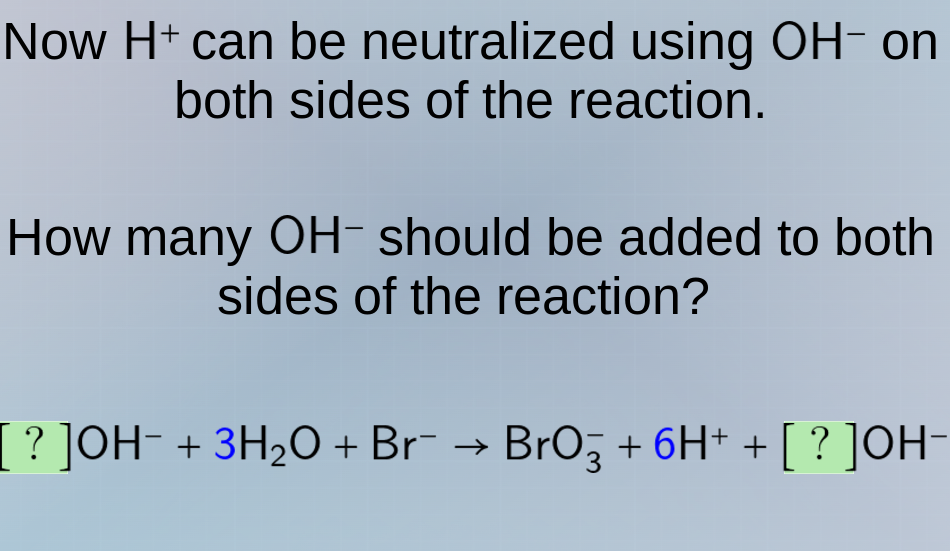
now h⁺ can be neutralized using oh⁻ on both sides of the reaction. how many oh⁻ should be added to both sides of the reaction? ?oh⁻ + 3h₂o + br⁻ → bro₃⁻ + 6h⁺ + ?oh⁻
Step1: Identify $H^+$ ions to neutralize
There are $6$ $H^+$ ions on the right - hand side of the reaction: $\ce{3H_2O + Br^- \to BrO_3^- + 6H^+ + [?]OH^-}$ (and we are adding $\ce{OH^-}$ to both sides). To neutralize $H^+$, we know that the reaction between $\ce{H^+}$ and $\ce{OH^-}$ is $\ce{H^+ + OH^- \to H_2O}$. So, for each $\ce{H^+}$ ion, we need one $\ce{OH^-}$ ion.
Step2: Determine the number of $\ce{OH^-}$ to add
Since there are $6$ $\ce{H^+}$ ions on the right - hand side, we need to add $6$ $\ce{OH^-}$ ions to both sides of the reaction. When we add $6$ $\ce{OH^-}$ to the left - hand side and $6$ $\ce{OH^-}$ to the right - hand side, the $\ce{H^+}$ and $\ce{OH^-}$ on the right will react to form $\ce{H_2O}$ ( $\ce{6H^+ + 6OH^- \to 6H_2O}$), and we can then simplify the equation further if needed, but for the purpose of neutralizing the $\ce{H^+}$ ions, the number of $\ce{OH^-}$ to add to both sides is equal to the number of $\ce{H^+}$ ions present.

Snap & solve any problem in the app
Get step-by-step solutions on Sovi AI
Photo-based solutions with guided steps
Explore more problems and detailed explanations
6 (We add 6 $\ce{OH^-}$ to both sides of the reaction)