QUESTION IMAGE
Question
now try these:
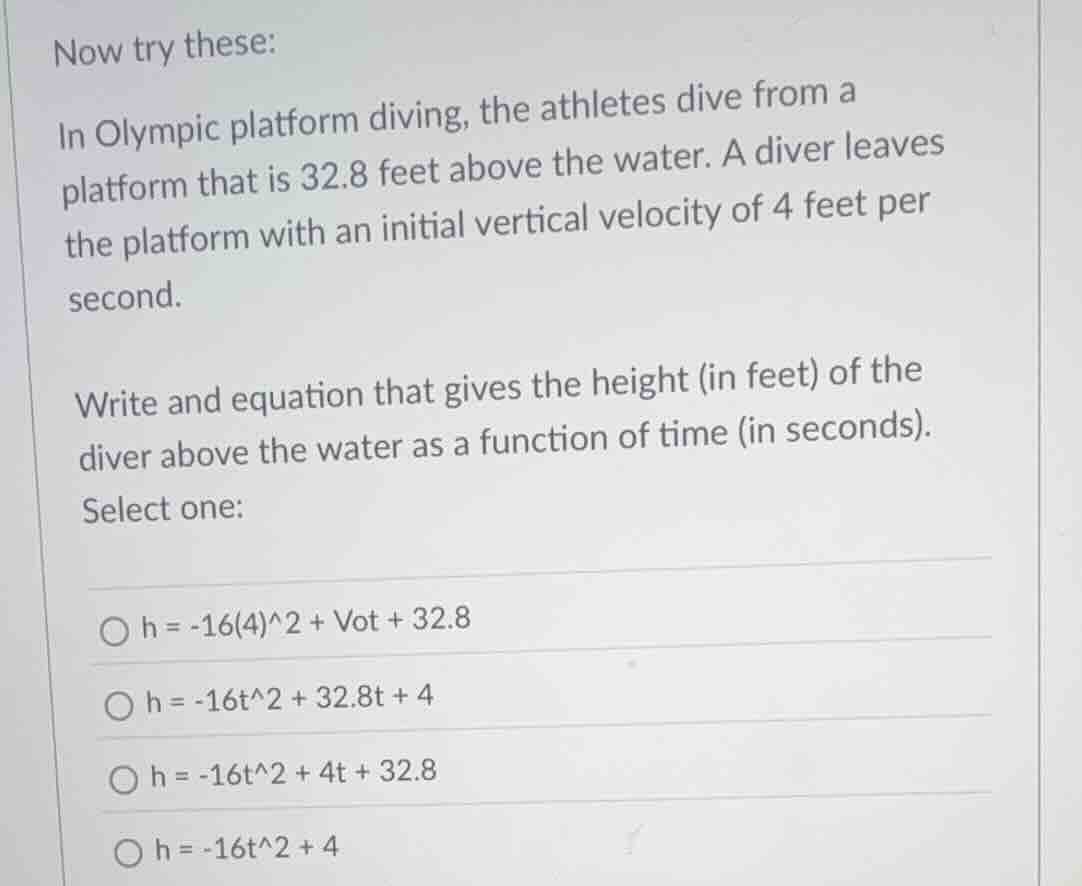
in olympic platform diving, the athletes dive from a platform that is 32.8 feet above the water. a diver leaves the platform with an initial vertical velocity of 4 feet per second.
write and equation that gives the height (in feet) of the diver above the water as a function of time (in seconds).
select one:
○ h = -16(4)^2 + vot + 32.8
○ h = -16t^2 + 32.8t + 4
○ h = -16t^2 + 4t + 32.8
○ h = -16t^2 + 4
Step1: Recall the projectile motion formula
The general formula for the height \( h \) of an object in vertical motion (under gravity, on Earth, in feet) is \( h = -16t^2 + v_0t + h_0 \), where \( -16 \) is the acceleration due to gravity (in \( \text{ft/s}^2 \)), \( v_0 \) is the initial vertical velocity (in \( \text{ft/s} \)), and \( h_0 \) is the initial height (in feet).
Step2: Identify values for \( v_0 \) and \( h_0 \)
From the problem, the initial vertical velocity \( v_0 = 4 \) ft/s, and the initial height \( h_0 = 32.8 \) feet (height of the platform above water).
Step3: Substitute values into the formula
Substituting \( v_0 = 4 \) and \( h_0 = 32.8 \) into \( h = -16t^2 + v_0t + h_0 \), we get \( h = -16t^2 + 4t + 32.8 \).

Snap & solve any problem in the app
Get step-by-step solutions on Sovi AI
Photo-based solutions with guided steps
Explore more problems and detailed explanations
\( h = -16t^2 + 4t + 32.8 \) (corresponding to the option \( h = -16t^2 + 4t + 32.8 \))