QUESTION IMAGE
Question
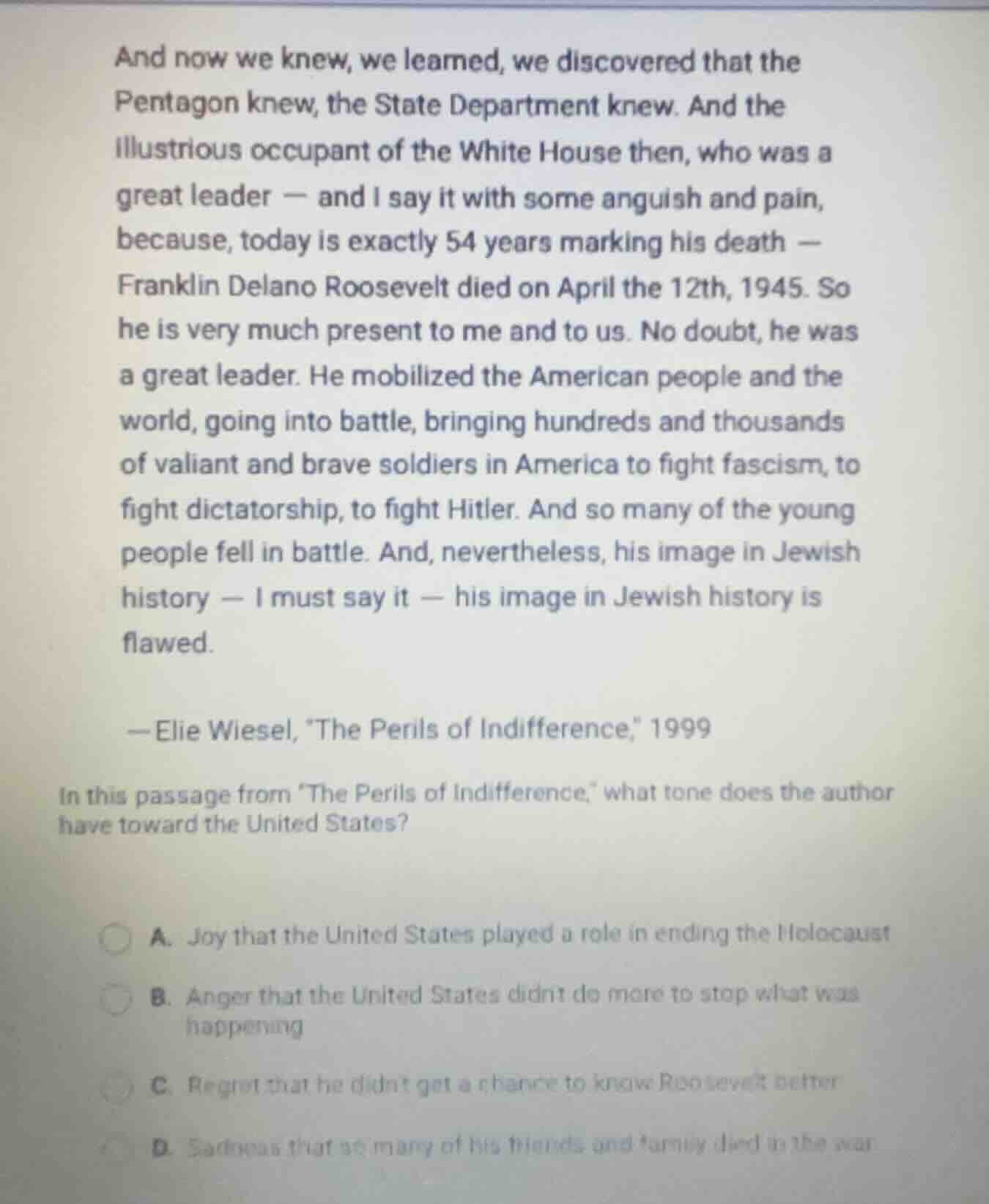
and now we knew, we learned, we discovered that the pentagon knew, the state department knew. and the illustrious occupant of the white house then, who was a great leader — and i say it with some anguish and pain, because, today is exactly 54 years marking his death — franklin delano roosevelt died on april the 12th, 1945. so he is very much present to me and to us. no doubt, he was a great leader. he mobilized the american people and the world, going into battle, bringing hundreds and thousands of valiant and brave soldiers in america to fight fascism, to fight dictatorship, to fight hitler. and so many of the young people fell in battle. and, nevertheless, his image in jewish history — i must say it — his image in jewish history is flawed.
—elie wiesel, \the perils of indifference,\ 1999
in this passage from \the perils of indifference,\ what tone does the author have toward the united states?
a. joy that the united states played a role in ending the holocaust
b. anger that the united states didnt do more to stop what was happening
c. regret that he didnt get a chance to know roosevelt better
d. sadness that so many of his friends and family died in the war
The author acknowledges FDR's leadership in fighting fascism but notes his "flawed" image in Jewish history, paired with the context of the speech The Perils of Indifference (focused on global inaction during the Holocaust). This shows frustration that the U.S. (and its leaders) failed to take more action to stop the Holocaust, even as they fought Hitler. Options A is incorrect because there is no joy; C is irrelevant as the focus is not on personal acquaintance with Roosevelt; D is incorrect as the passage does not mention his friends/family.

Snap & solve any problem in the app
Get step-by-step solutions on Sovi AI
Photo-based solutions with guided steps
Explore more problems and detailed explanations
B. Anger that the United States didn't do more to stop what was happening