QUESTION IMAGE
Question
object d:
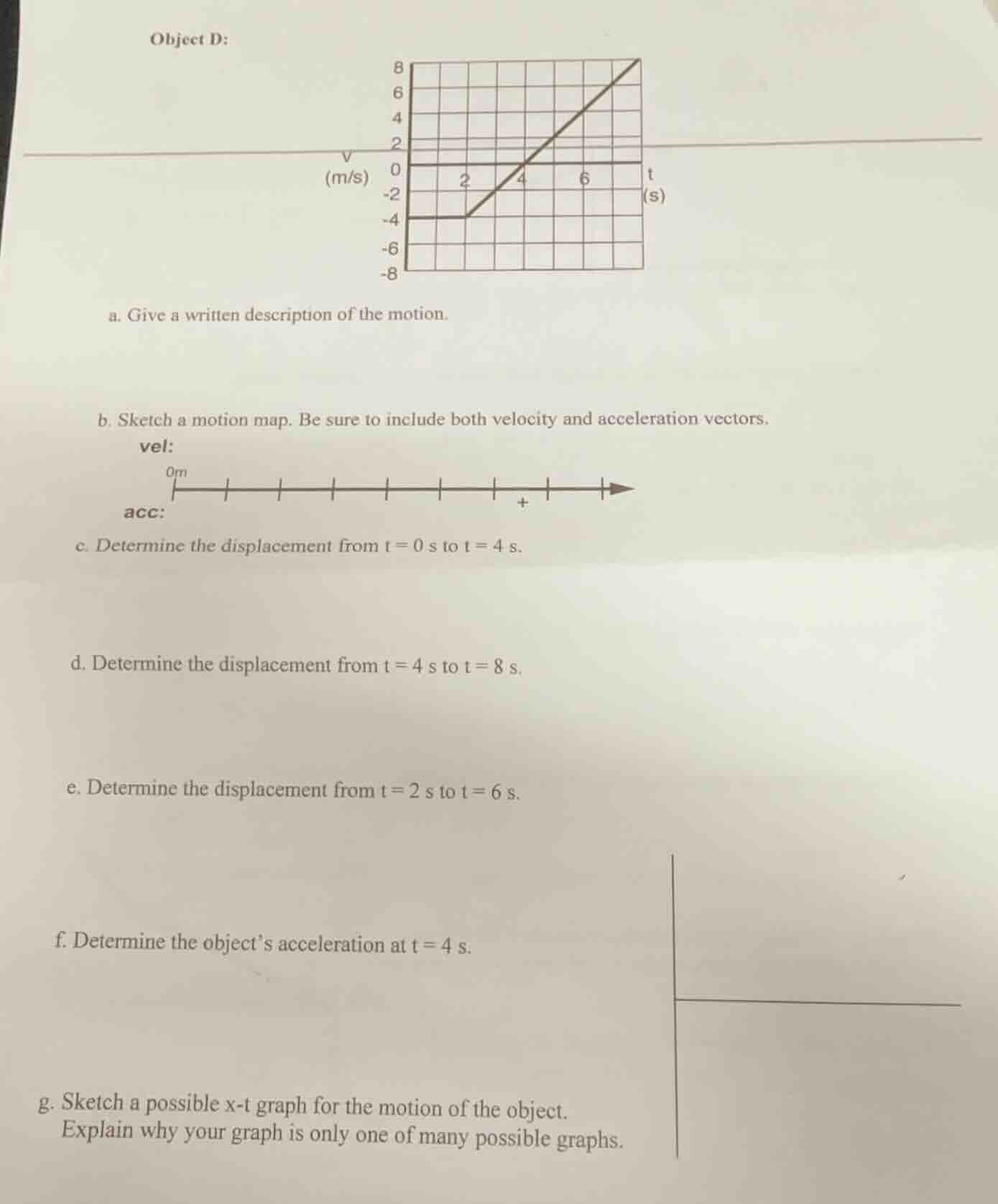
graph of velocity - time for object d: velocity (m/s) on y - axis, time (s) on x - axis. from t = 0 to t = 2 s, velocity is - 4 m/s (horizontal line). from t = 2 s to t = 8 s, velocity increases linearly from - 4 m/s to 8 m/s
a. give a written description of the motion.
b. sketch a motion map. be sure to include both velocity and acceleration vectors.
vel:
number line with 0m and + direction, tick marks
acc:
c. determine the displacement from t = 0 s to t = 4 s.
d. determine the displacement from t = 4 s to t = 8 s.
e. determine the displacement from t = 2 s to t = 6 s.
f. determine the object’s acceleration at t = 4 s.
g. sketch a possible x - t graph for the motion of the object.
explain why your graph is only one of many possible graphs.
Part a: Description of Motion
- From \( t = 0 \) to \( t = 2 \) s: The velocity is constant at \( -4 \, \text{m/s} \), so the object moves with uniform motion (constant velocity) in the negative direction.
- From \( t = 2 \) to \( t = 8 \) s: The velocity - time graph is a straight line with a positive slope, meaning the object is accelerating (constant acceleration) in the positive direction. The velocity changes from \( -4 \, \text{m/s} \) at \( t = 2 \) s to \( 8 \, \text{m/s} \) at \( t = 8 \) s. Initially (from \( t = 2 \) to \( t = 4 \) s), the velocity is negative but increasing (becoming less negative), so the object is slowing down while moving in the negative direction. At \( t = 4 \) s, the velocity becomes zero, and then from \( t = 4 \) to \( t = 8 \) s, the velocity is positive and increasing, so the object is speeding up while moving in the positive direction.
Step 1: Analyze the velocity - time graph segments
- From \( t = 0 \) to \( t = 2 \) s: The velocity \( v_1=-4\,\text{m/s} \), time interval \( \Delta t_1 = 2 - 0=2\,\text{s} \). The displacement \( d_1=v_1\times\Delta t_1 \) (since velocity is constant).
- From \( t = 2 \) to \( t = 4 \) s: The velocity - time graph is a straight line. The initial velocity at \( t = 2 \) s is \( v_{2i}=-4\,\text{m/s} \), final velocity at \( t = 4 \) s is \( v_{2f} = 0\,\text{m/s} \). The displacement for a uniformly accelerated motion (or motion with changing velocity, we can use the average velocity formula \( d_2=\frac{v_{2i}+v_{2f}}{2}\times\Delta t_2 \), where \( \Delta t_2=4 - 2 = 2\,\text{s} \))
Step 2: Calculate \( d_1 \)
\( d_1=-4\times2=-8\,\text{m} \)
Step 3: Calculate \( d_2 \)
\( d_2=\frac{-4 + 0}{2}\times2=-4\,\text{m} \)
Step 4: Total displacement \( d=d_1 + d_2 \)
\( d=-8+( - 4)=-12\,\text{m} \)
Step 1: Analyze the velocity - time graph
From \( t = 4 \) to \( t = 8 \) s, the velocity - time graph is a straight line. The initial velocity \( v_{i}=0\,\text{m/s} \) at \( t = 4 \) s, final velocity \( v_{f}=8\,\text{m/s} \) at \( t = 8 \) s, and time interval \( \Delta t=8 - 4 = 4\,\text{s} \). We can use the average velocity formula \( d=\frac{v_{i}+v_{f}}{2}\times\Delta t \) (since the motion is uniformly accelerated).
Step 2: Calculate the displacement
\( d=\frac{0 + 8}{2}\times4=4\times4 = 16\,\text{m} \)

Snap & solve any problem in the app
Get step-by-step solutions on Sovi AI
Photo-based solutions with guided steps
Explore more problems and detailed explanations
From \( t = 0 \) to \( t = 2 \, \text{s} \), the object moves with a constant velocity of \( - 4\,\text{m/s} \) (uniform motion in the negative direction). From \( t = 2 \, \text{s} \) to \( t = 8 \, \text{s} \), the object has a constant positive acceleration. From \( t = 2 \, \text{s} \) to \( t = 4 \, \text{s} \), it slows down while moving in the negative direction (velocity goes from \( - 4\,\text{m/s} \) to \( 0\,\text{m/s} \)). From \( t = 4 \, \text{s} \) to \( t = 8 \, \text{s} \), it speeds up while moving in the positive direction (velocity goes from \( 0\,\text{m/s} \) to \( 8\,\text{m/s} \)).