QUESTION IMAGE
Question
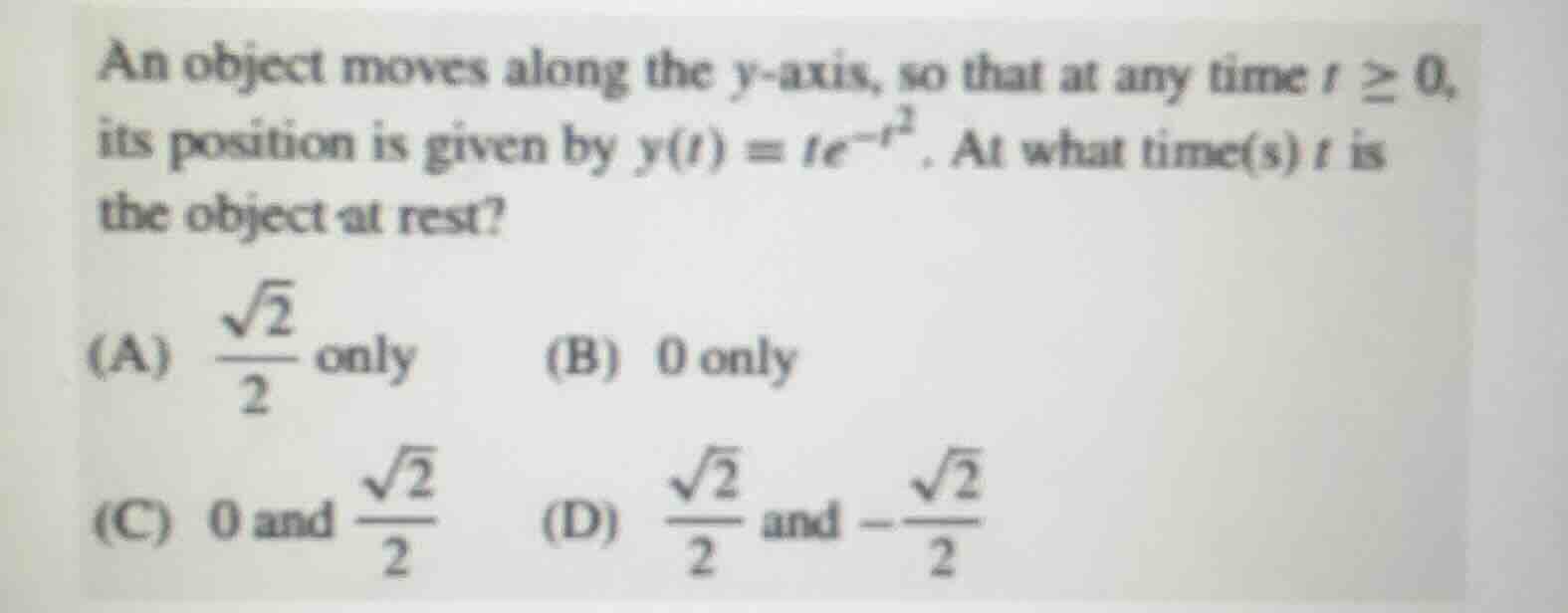
an object moves along the y-axis, so that at any time $t \geq 0$, its position is given by $y(t) = te^{-t^2}$. at what time(s) $t$ is the object at rest?
(a) $\frac{\sqrt{2}}{2}$ only
(b) 0 only
(c) 0 and $\frac{\sqrt{2}}{2}$
(d) $\frac{\sqrt{2}}{2}$ and $-\frac{\sqrt{2}}{2}$
Step1: Find velocity (derivative of position)
Use product rule: if $y(t)=u(t)v(t)$, $y'(t)=u'(t)v(t)+u(t)v'(t)$. Let $u(t)=t$, $v(t)=e^{-t^2}$.
$u'(t)=1$, $v'(t)=e^{-t^2}\cdot(-2t)$ (chain rule).
$$y'(t)=1\cdot e^{-t^2} + t\cdot(-2t e^{-t^2}) = e^{-t^2}(1-2t^2)$$
Step2: Set velocity to 0 (object at rest)
Object at rest when $y'(t)=0$. $e^{-t^2}>0$ for all real $t$, so solve $1-2t^2=0$.
$$1-2t^2=0 \implies 2t^2=1 \implies t^2=\frac{1}{2} \implies t=\pm\frac{\sqrt{2}}{2}$$
Step3: Restrict to $t\geq0$
Discard negative solution since $t\geq0$. Check $t=0$: $y'(0)=e^{0}(1-0)=1
eq0$, so $t=0$ is not a solution.

Snap & solve any problem in the app
Get step-by-step solutions on Sovi AI
Photo-based solutions with guided steps
Explore more problems and detailed explanations
(A) $\frac{\sqrt{2}}{2}$ only