QUESTION IMAGE
Question
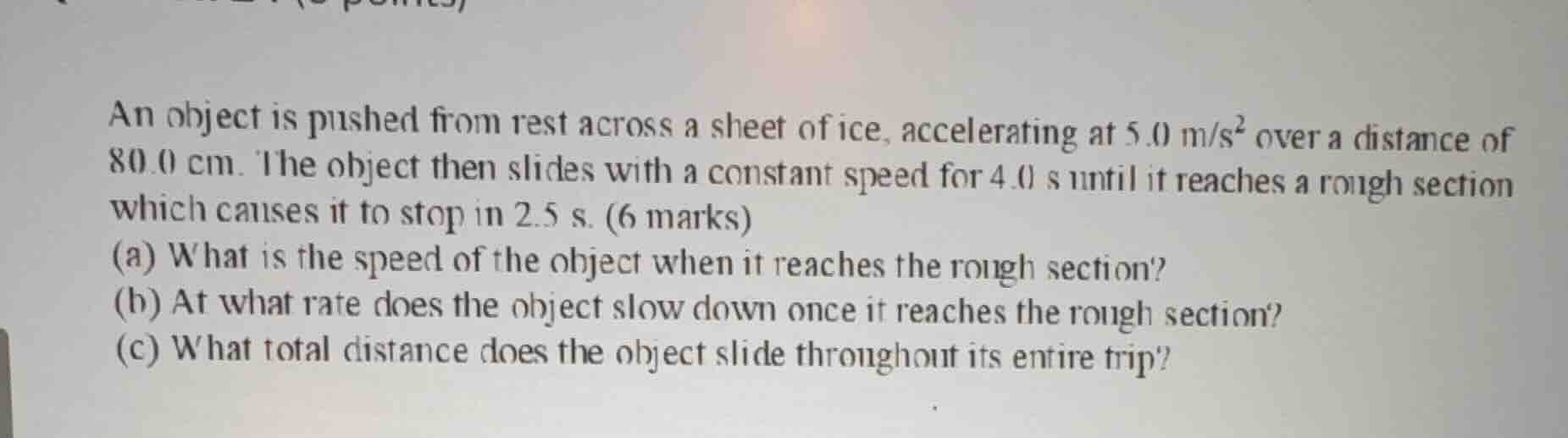
an object is pushed from rest across a sheet of ice, accelerating at 5.0 m/s² over a distance of 80.0 cm. the object then slides with a constant speed for 4.0 s until it reaches a rough section which causes it to stop in 2.5 s. (6 marks) (a) what is the speed of the object when it reaches the rough section? (b) at what rate does the object slow down once it reaches the rough section? (c) what total distance does the object slide throughout its entire trip?
Part (a)
Step1: Identify known values
The object starts from rest, so initial velocity \( u = 0\ \text{m/s} \), acceleration \( a = 5.0\ \text{m/s}^2 \), distance \( s = 80.0\ \text{cm}=0.8\ \text{m} \). We use the kinematic equation \( v^2 = u^2 + 2as \).
Step2: Substitute values into the equation
\( v^2 = 0^2 + 2\times5.0\times0.8 \)
\( v^2 = 8.0 \)
\( v=\sqrt{8.0}\approx2.83\ \text{m/s} \) (This speed is the speed when it reaches the rough section as it moves with constant speed after accelerating)
Step1: Identify known values for deceleration
Initial speed for deceleration \( u = 2.83\ \text{m/s} \) (from part a), final speed \( v = 0\ \text{m/s} \), time \( t = 2.5\ \text{s} \). We use the kinematic equation \( v = u+at \) (here \( a \) will be deceleration, let's call it \( a_d \))
Step2: Solve for deceleration
\( 0 = 2.83 + a_d\times2.5 \)
\( a_d=\frac{0 - 2.83}{2.5}\approx - 1.13\ \text{m/s}^2 \)
The negative sign indicates deceleration (slowing down), and the magnitude of the rate of slowing down is \( 1.13\ \text{m/s}^2 \)
Step1: Calculate distance during acceleration
We already know this distance \( s_1 = 0.8\ \text{m} \)
Step2: Calculate distance during constant speed motion
Speed \( v = 2.83\ \text{m/s} \), time \( t = 4.0\ \text{s} \). Distance \( s_2=v\times t \)
\( s_2 = 2.83\times4.0\approx11.32\ \text{m} \)
Step3: Calculate distance during deceleration
We can use the kinematic equation \( s_3=\frac{u + v}{2}\times t \) (since it's uniform deceleration, average speed is \( \frac{u + v}{2} \))
\( u = 2.83\ \text{m/s} \), \( v = 0\ \text{m/s} \), \( t = 2.5\ \text{s} \)
\( s_3=\frac{2.83 + 0}{2}\times2.5\approx3.54\ \text{m} \)
Step4: Calculate total distance
Total distance \( s_{\text{total}}=s_1 + s_2 + s_3 \)
\( s_{\text{total}}=0.8+11.32 + 3.54\approx15.66\ \text{m} \)
(Alternatively, using exact values: \( v = 2\sqrt{2}\ \text{m/s} \), \( s_2=2\sqrt{2}\times4 = 8\sqrt{2}\approx11.31\ \text{m} \), \( s_3=\frac{2\sqrt{2}+0}{2}\times2.5=\frac{5\sqrt{2}}{2}\approx3.54\ \text{m} \), \( s_{\text{total}}=0.8 + 8\sqrt{2}+\frac{5\sqrt{2}}{2}=0.8+\frac{21\sqrt{2}}{2}\approx0.8 + 14.85 = 15.65\ \text{m} \))

Snap & solve any problem in the app
Get step-by-step solutions on Sovi AI
Photo-based solutions with guided steps
Explore more problems and detailed explanations
The speed of the object when it reaches the rough section is approximately \( \boldsymbol{2.83\ \text{m/s}} \) (or more precisely \( \sqrt{8} = 2\sqrt{2}\approx2.83\ \text{m/s} \))