QUESTION IMAGE
Question
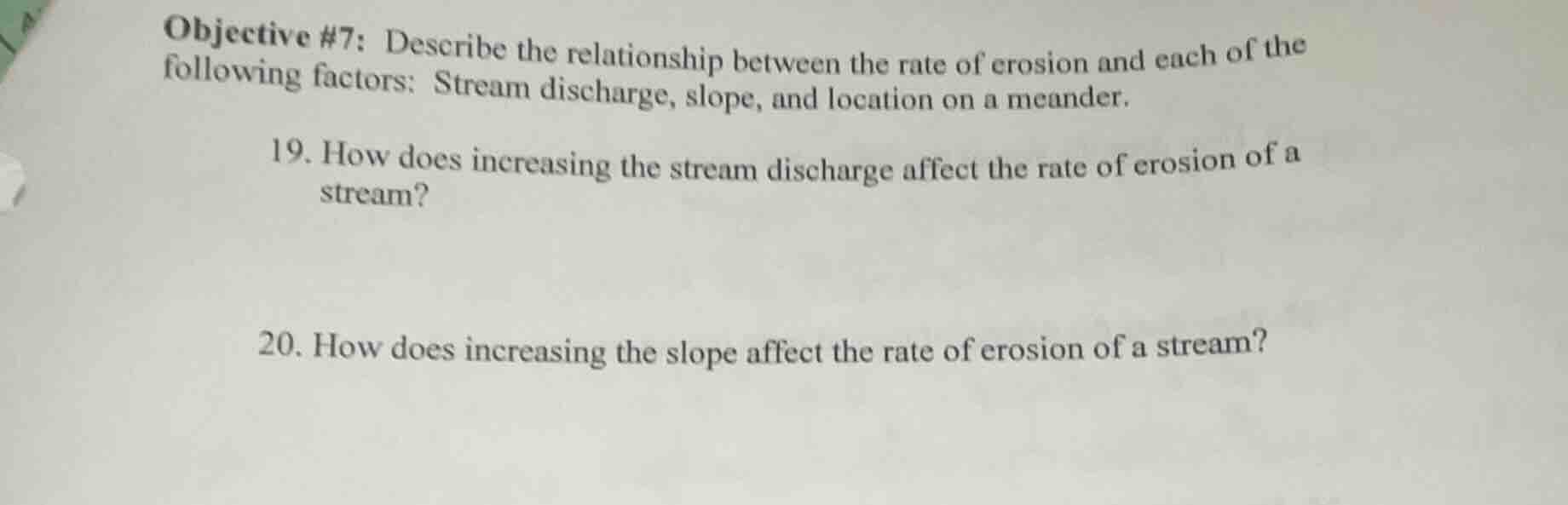
objective #7: describe the relationship between the rate of erosion and each of the following factors: stream discharge, slope, and location on a meander. 19. how does increasing the stream discharge affect the rate of erosion of a stream? 20. how does increasing the slope affect the rate of erosion of a stream?
Question 19
Stream discharge is the volume of water flowing in a stream over time. When discharge increases, the stream has more water, which means more force (kinetic energy) to move sediment and erode the stream bed/banks. Higher discharge also increases the stream's capacity to carry larger particles, so erosion rate (both hydraulic and sediment - transport related erosion) increases.
Slope (or gradient) of a stream is the change in elevation over a horizontal distance. A steeper slope means that gravity pulls the water more strongly down the slope, resulting in a higher flow velocity. Faster - moving water has more kinetic energy, which allows it to erode the stream channel more effectively (e.g., by dislodging more sediment, cutting deeper into the bed, or widening the banks).

Snap & solve any problem in the app
Get step-by-step solutions on Sovi AI
Photo-based solutions with guided steps
Explore more problems and detailed explanations
Increasing stream discharge generally increases the rate of erosion. Higher discharge means more water volume and greater flow velocity (usually, as discharge and velocity are related in open - channel flow), which provides more energy to dislodge, transport sediment, and erode the stream's bed and banks. The stream can carry more and larger sediment particles, and the force of the water against the stream channel is stronger, leading to more erosion.