QUESTION IMAGE
Question
- oceanic crust is more dense than continental crust. which of these describes the outcome of the collision between oceanic and continental crust?
a the two portions of crust will stop moving.
b the continental crust will subduct beneath the oceanic crust.
c the two portions of crust will slide past one another, side by side.
d the oceanic crust will subduct beneath the continental crust.
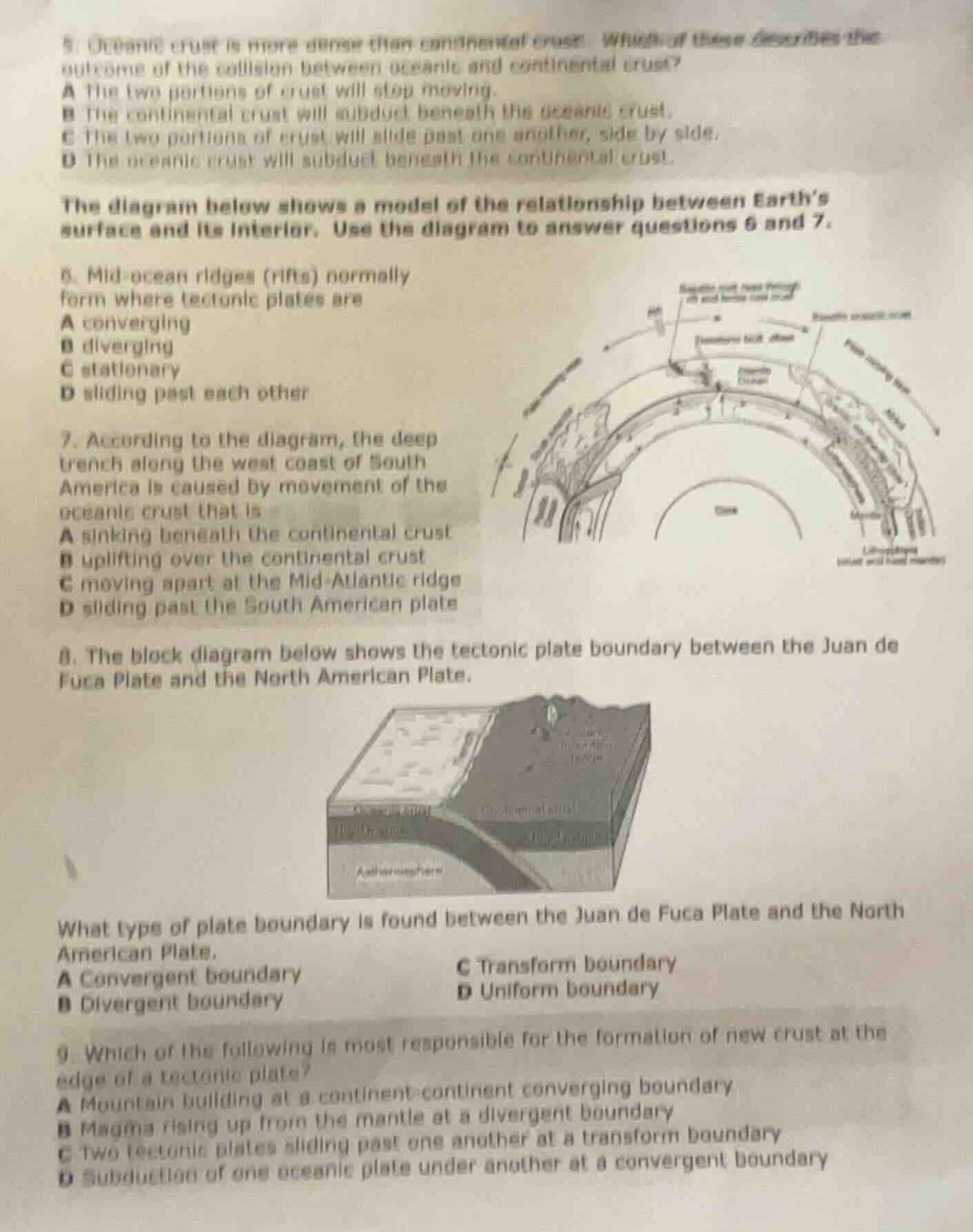
the diagram below shows a model of the relationship between earth’s surface and its interior. use the diagram to answer questions 6 and 7.
- mid - ocean ridges (rifts) normally form where tectonic plates are
a converging
b diverging
c stationary
d sliding past each other
- according to the diagram, the deep trench along the west coast of south america is caused by movement of the oceanic crust that is
a sinking beneath the continental crust
b uplifting over the continental crust
c moving apart at the mid - atlantic ridge
d sliding past the south american plate
- the block diagram below shows the tectonic plate boundary between the juan de fuca plate and the north american plate.
what type of plate boundary is found between the juan de fuca plate and the north american plate?
a convergent boundary
b divergent boundary
c transform boundary
d uniform boundary
- which of the following is most responsible for the formation of new crust at the edge of a tectonic plate?
a mountain building at a continent - continent converging boundary
b magma rising up from the mantle at a divergent boundary
c two tectonic plates sliding past one another at a transform boundary
d subduction of one oceanic plate under another at a convergent boundary
- Denser oceanic crust subducts under less dense continental crust when they collide.
- Mid-ocean ridges form where tectonic plates move apart (diverge), allowing magma to rise.
- The deep trench off South America forms as dense oceanic crust sinks beneath continental crust.
- The Juan de Fuca (oceanic) plate subducts under North American (continental) plate, a convergent boundary.
- New crust forms at divergent boundaries when mantle magma rises, cools, and solidifies.

Snap & solve any problem in the app
Get step-by-step solutions on Sovi AI
Photo-based solutions with guided steps
Explore more problems and detailed explanations
- D. The oceanic crust will subduct beneath the continental crust.
- B. diverging
- A. sinking beneath the continental crust
- A. Convergent boundary
- B. Magma rising up from the mantle at a divergent boundary