QUESTION IMAGE
Question
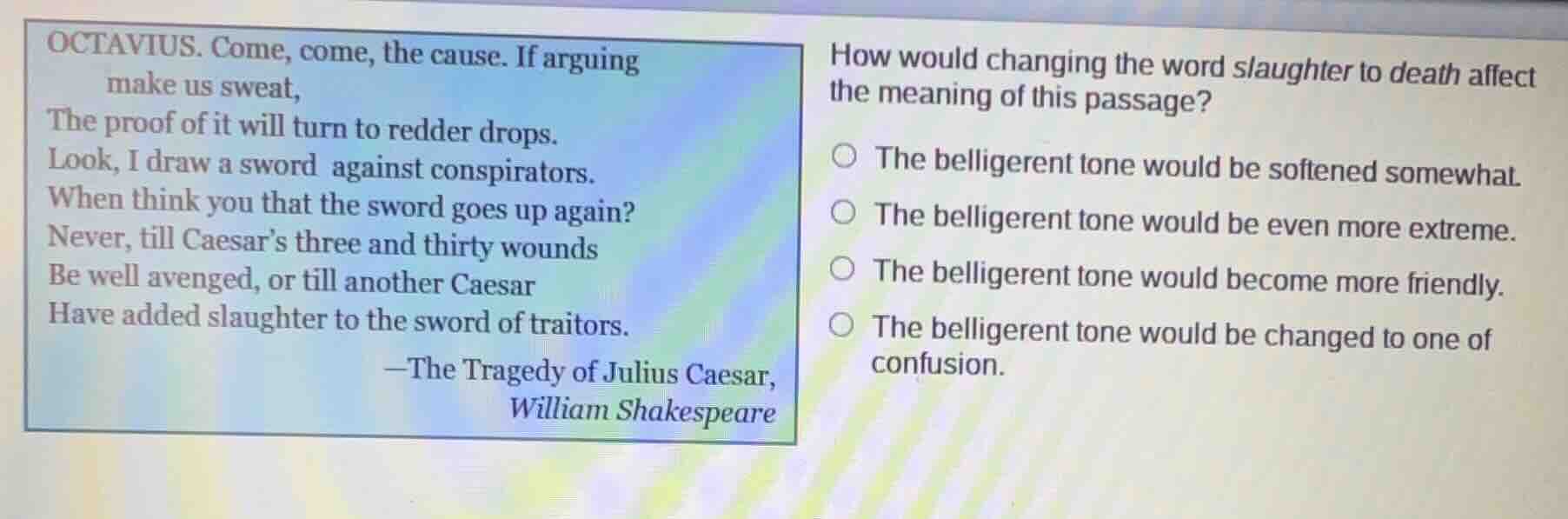
octavius. come, come, the cause. if arguing make us sweat, the proof of it will turn to redder drops. look, i draw a sword against conspirators. when think you that the sword goes up again? never, till caesar’s three and thirty wounds be well avenged, or till another caesar have added slaughter to the sword of traitors. —the tragedy of julius caesar, william shakespeare how would changing the word slaughter to death affect the meaning of this passage? the belligerent tone would be softened somewhat. the belligerent tone would be even more extreme. the belligerent tone would become more friendly. the belligerent tone would be changed to one of confusion.
To determine the effect of changing "slaughter" to "death", we analyze the connotations. "Slaughter" implies a violent, mass killing, while "death" is a more general term. Replacing "slaughter" with "death" would reduce the intensity of the belligerent (aggressive, war - like) tone.
- Option 1: "The belligerent tone would be softened somewhat." This makes sense because "slaughter" has a more intense, violent connotation than "death", so using "death" would make the aggressive tone less strong.
- Option 2: "The belligerent tone would be even more extreme." This is incorrect because "death" is less intense than "slaughter", so the tone would not become more extreme.
- Option 3: "The belligerent tone would become more friendly." "Death" is still a serious term and does not introduce a friendly tone, so this is wrong.
- Option 4: "The belligerent tone would be changed to one of confusion." There is no element in the change from "slaughter" to "death" that would introduce confusion, so this is incorrect.

Snap & solve any problem in the app
Get step-by-step solutions on Sovi AI
Photo-based solutions with guided steps
Explore more problems and detailed explanations
A. The belligerent tone would be softened somewhat.