QUESTION IMAGE
Question
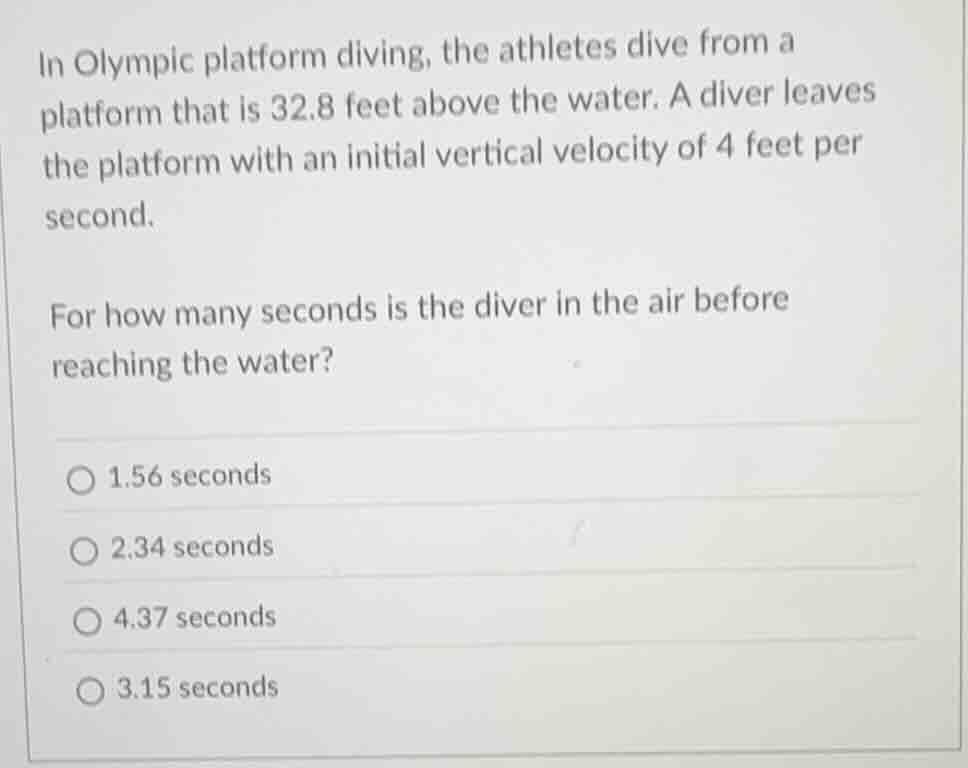
in olympic platform diving, the athletes dive from a platform that is 32.8 feet above the water. a diver leaves the platform with an initial vertical velocity of 4 feet per second.
for how many seconds is the diver in the air before reaching the water?
1.56 seconds
2.34 seconds
4.37 seconds
3.15 seconds
Step1: Recall the vertical motion formula
The height \( h \) of an object in vertical motion is given by the formula \( h = -16t^2 + v_0t + h_0 \), where \( h \) is the height at time \( t \), \( v_0 \) is the initial vertical velocity, \( h_0 \) is the initial height, and \( t \) is the time in seconds. The acceleration due to gravity is approximately \( 32 \) feet per second squared, so the coefficient of \( t^2 \) is \( -\frac{1}{2} \times 32=-16 \) (negative because it's acting downward).
Here, \( h_0 = 32.8 \) feet (initial height above water), \( v_0 = 4 \) feet per second (initial upward velocity, positive because it's upward), and we want to find \( t \) when \( h = 0 \) (when the diver reaches the water). So we set up the equation:
\( 0=-16t^2 + 4t + 32.8 \)
Step2: Rearrange the quadratic equation
Rewrite the equation in standard quadratic form \( ax^2+bx + c = 0 \). Here, \( a=-16 \), \( b = 4 \), \( c = 32.8 \). The quadratic formula is \( t=\frac{-b\pm\sqrt{b^2 - 4ac}}{2a} \).
First, calculate the discriminant \( D=b^2-4ac \):
\( D=(4)^2-4\times(-16)\times(32.8) \)
\( D = 16 + 4\times16\times32.8 \)
\( D=16+2099.2 \)
\( D = 2115.2 \)
Step3: Apply the quadratic formula
Now, substitute \( a=-16 \), \( b = 4 \), and \( D = 2115.2 \) into the quadratic formula:
\( t=\frac{-4\pm\sqrt{2115.2}}{2\times(-16)} \)
We have two solutions for \( t \) from the \( \pm \) sign. We discard the negative solution because time cannot be negative.
First, calculate \( \sqrt{2115.2}\approx45.99 \)
Then, for the positive root:
\( t=\frac{-4 - 45.99}{-32} \) (we take the minus sign in the numerator because \( -4+\sqrt{2115.2} \) would be positive, but let's check:
Wait, actually, the quadratic formula is \( t=\frac{-b\pm\sqrt{D}}{2a} \), so with \( a=-16 \), \( b = 4 \):
\( t=\frac{-4\pm\sqrt{2115.2}}{-32}=\frac{4\mp\sqrt{2115.2}}{32} \)
We need to take the solution where the numerator is positive (since time is positive). So we take the minus sign in the numerator:
\( t=\frac{4-\sqrt{2115.2}}{32} \) would be negative (since \( \sqrt{2115.2}\approx45.99>4 \)), so we take the plus sign in the numerator:
\( t=\frac{4 + 45.99}{32}=\frac{49.99}{32}\approx1.56 \)? Wait, no, that can't be right. Wait, maybe I made a mistake in the sign of the initial velocity. Wait, if the diver leaves the platform with an initial vertical velocity of 4 feet per second, is it upward or downward? In platform diving, usually, the initial velocity when leaving the platform is upward (like a jump), so \( v_0 = 4 \) (upward, positive). But when the diver is moving towards the water, the height decreases. Wait, maybe I messed up the sign of \( h \). Wait, when the diver reaches the water, \( h = 0 \), and the initial height \( h_0 = 32.8 \), so the equation is \( 0=-16t^2+4t + 32.8 \), which is correct.
Wait, let's recalculate the discriminant:
\( b^2-4ac=(4)^2-4\times(-16)\times(32.8)=16 + 2099.2 = 2115.2 \), correct.
\( \sqrt{2115.2}\approx45.99 \)
Then, \( t=\frac{-4\pm45.99}{-32} \)
For the two solutions:
- \( t=\frac{-4 + 45.99}{-32}=\frac{41.99}{-32}\approx - 1.31 \) (discard, negative time)
- \( t=\frac{-4 - 45.99}{-32}=\frac{-49.99}{-32}\approx1.56 \)
Wait, but this contradicts the options? Wait, maybe the initial velocity is downward? If the initial velocity is downward, then \( v_0=-4 \) (since upward is positive, downward is negative). Let's try that.
So the equation becomes \( 0=-16t^2-4t + 32.8 \)
Then, \( a=-16 \), \( b=-4 \), \( c = 32.8 \)
Discriminant \( D=(-4)^2-4\times(-16)\times(32.8)=16 + 2099.2 = 2115.2 \) (same d…

Snap & solve any problem in the app
Get step-by-step solutions on Sovi AI
Photo-based solutions with guided steps
Explore more problems and detailed explanations
1.56 seconds (the option: 1.56 seconds)