QUESTION IMAGE
Question
one pair of angles in your map to illustrate each angle relationship mentioned in elena’s description. tell how you know that the angles illustrate the relationship. show your work. use a diagram, words, and angle relationships to explain your answer. possible answer:
Step1: Identify Angle Relationships
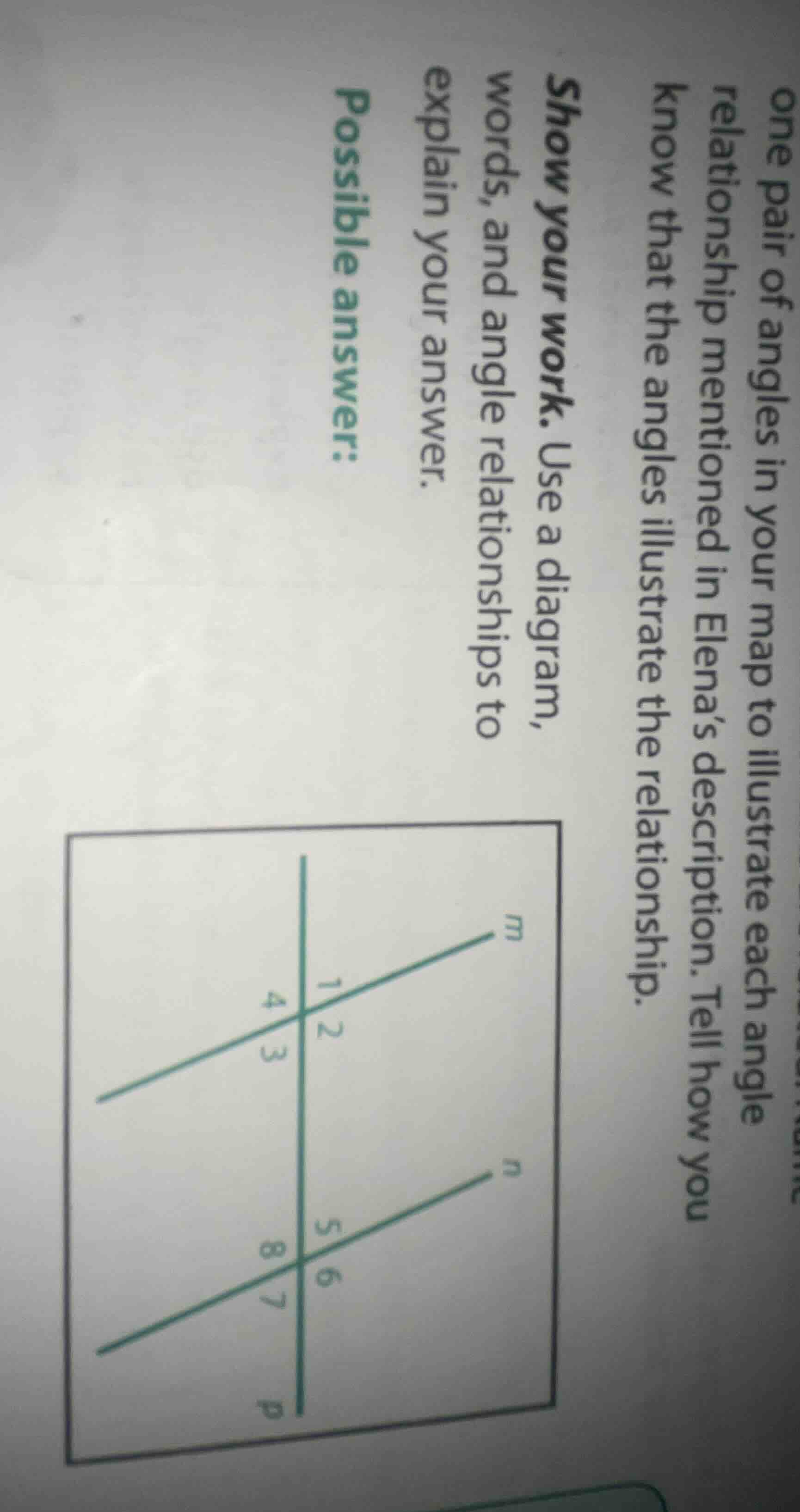
In the diagram, lines \( m \) and \( n \) are parallel (assumed, as the angles suggest corresponding or vertical angle relationships), and line \( p \) is a transversal. Let's take \( \angle 1 \) and \( \angle 5 \). \( \angle 1 \) and \( \angle 5 \) are corresponding angles. Corresponding angles are equal when the lines cut by the transversal are parallel.
Step2: Explain the Relationship
Corresponding angles: When two parallel lines are cut by a transversal, the angles in the same relative position (e.g., above the parallel line and to the right of the transversal) are equal. So \( \angle 1 \cong \angle 5 \) (congruent, meaning they have the same measure). Another example: \( \angle 2 \) and \( \angle 6 \) are also corresponding angles, so \( \angle 2 \cong \angle 6 \). Vertical angles, like \( \angle 1 \) and \( \angle 3 \), are equal because they are opposite each other when two lines intersect. \( \angle 1 = \angle 3 \) (vertical angles theorem). Linear pairs, like \( \angle 1 \) and \( \angle 2 \), are supplementary (sum to \( 180^\circ \)) because they form a straight line. \( \angle 1 + \angle 2 = 180^\circ \).

Snap & solve any problem in the app
Get step-by-step solutions on Sovi AI
Photo-based solutions with guided steps
Explore more problems and detailed explanations
For example, \( \angle 1 \) and \( \angle 5 \) are corresponding angles (if \( m \parallel n \)) and are equal. \( \angle 1 \) and \( \angle 3 \) are vertical angles and equal. \( \angle 1 \) and \( \angle 2 \) are a linear pair and supplementary (\( \angle 1 + \angle 2 = 180^\circ \)). (Choose one pair, e.g., \( \angle 1 \cong \angle 5 \) as corresponding angles when \( m \parallel n \).)