QUESTION IMAGE
Question
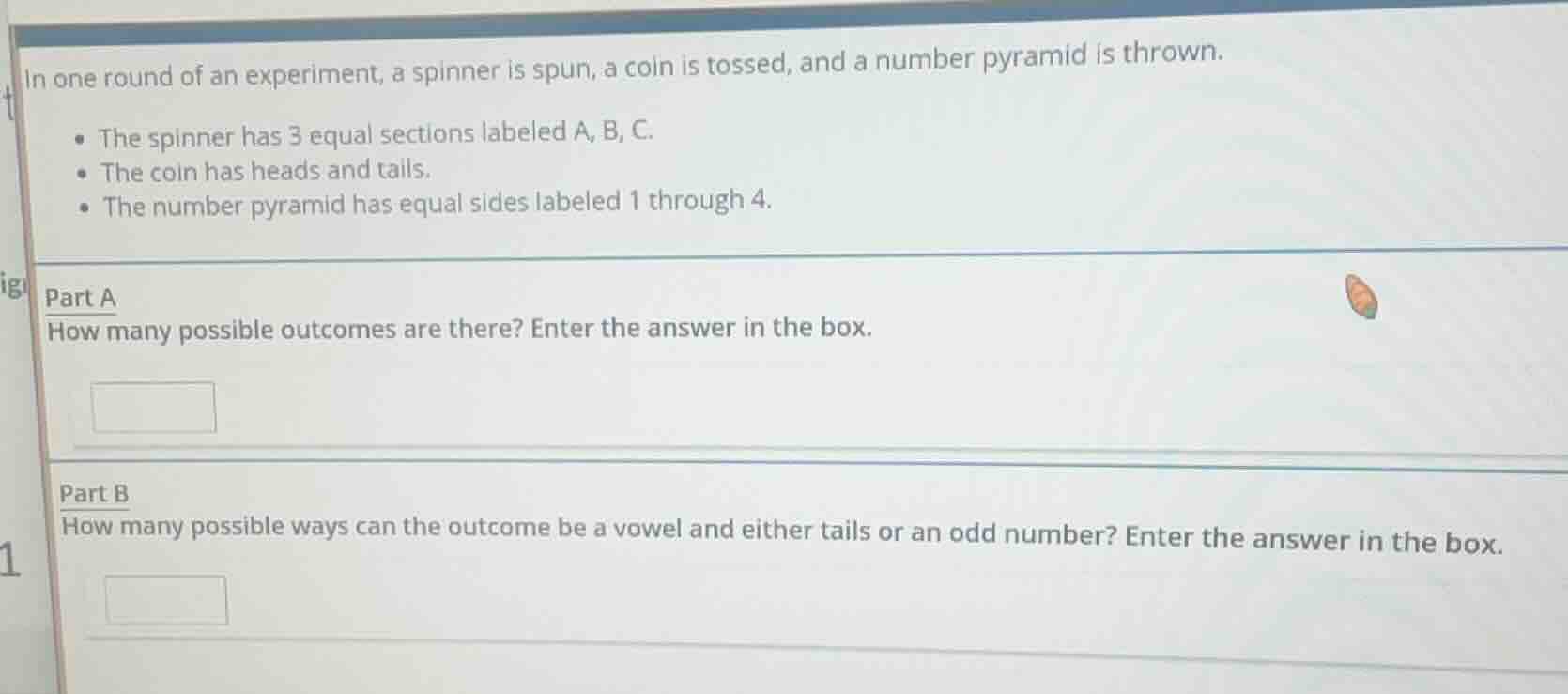
in one round of an experiment, a spinner is spun, a coin is tossed, and a number pyramid is thrown. - the spinner has 3 equal sections labeled a, b, c. - the coin has heads and tails. - the number pyramid has equal sides labeled 1 through 4. part a how many possible outcomes are there? enter the answer in the box. part b how many possible ways can the outcome be a vowel and either tails or an odd number? enter the answer in the box.
Part A
Step1: Determine outcomes for each event
- Spinner: 3 outcomes (A, B, C)
- Coin: 2 outcomes (heads, tails)
- Number pyramid: 4 outcomes (1, 2, 3, 4)
Step2: Apply multiplication principle
Total outcomes = \( 3 \times 2 \times 4 \)
\( 3 \times 2 = 6 \), \( 6 \times 4 = 24 \)
Step1: Identify vowel on spinner
Vowel on spinner: only A (since A, B, C; A is vowel)
Step2: Analyze coin and pyramid for "tails or odd number"
- Coin: tails (1 outcome)
- Pyramid: odd numbers (1, 3) → 2 outcomes
- "Tails or odd number" includes:
- Tails (any number: 4 outcomes)
- Odd number (any coin: 2 outcomes, but overlap with tails & odd: 2 outcomes)
- Using inclusion - exclusion: \( 4 + 2 - 2 = 4 \)? Wait, better:
- Outcomes for (coin = tails) OR (pyramid = odd):
- Tails + any number: 4
- Heads + odd number: 2
- Total: \( 4 + 2 = 6 \)
Step3: Calculate total for vowel (A) and (tails or odd)
Vowel (A: 1 outcome) × (tails or odd: 6 outcomes) = \( 1 \times 6 = 6 \)? Wait, no:
Wait, correct approach:
- Vowel on spinner: A (1 option)
- For the coin and pyramid, we want (tails) OR (odd number). Let's list all possibilities:
- Coin = tails:
- Pyramid: 1, 2, 3, 4 (4 outcomes)
- Coin = heads:
- Pyramid: 1, 3 (2 outcomes, since odd)
- Total for (tails or odd): \( 4 + 2 = 6 \)
- Now, spinner is A (1 outcome), so total ways: \( 1 \times 6 = 6 \)? Wait, no, wait:
Wait, another way:
- Spinner: A (1)
- Coin: 2 options (heads, tails)
- Pyramid: 4 options (1 - 4)
We want (spinner = A) AND [(coin = tails) OR (pyramid is odd)]
Using logic: \( P(A) \times [P(tails) + P(odd) - P(tails \cap odd)] \)
- \( P(tails) = \frac{1}{2} \), \( P(odd) = \frac{2}{4}=\frac{1}{2} \), \( P(tails \cap odd)=\frac{1}{2} \times \frac{2}{4}=\frac{1}{4} \)
But in terms of counts:
- Spinner: 1
- Coin - pyramid combinations for (tails or odd):
- Tails (any pyramid): 4
- Heads (odd pyramid): 2
- Total: 4 + 2 = 6 (since tails and odd: when tails and odd, it's included in tails, so no double - count if we do tails (4) + heads (odd: 2))
- So total: 1 (spinner) × 6 (coin - pyramid) = 6? Wait, no, wait:
Wait, let's list all possible triples (spinner, coin, pyramid) where spinner = A and (coin = tails or pyramid is odd):
- Spinner = A, Coin = tails, Pyramid = 1
- Spinner = A, Coin = tails, Pyramid = 2
- Spinner = A, Coin = tails, Pyramid = 3
- Spinner = A, Coin = tails, Pyramid = 4
- Spinner = A, Coin = heads, Pyramid = 1
- Spinner = A, Coin = heads, Pyramid = 3
That's 6 outcomes. Wait, but let's check:
- Tails + any pyramid (4) + heads + odd (2) = 6. And spinner is A (1), so 1×6 = 6.
Wait, but wait, is that correct?
Wait, another way:
- Spinner: A (1)
- Coin: 2 choices, Pyramid: 4 choices.
We want (coin = tails) OR (pyramid ∈ {1, 3})
The number of (coin, pyramid) pairs where (coin = tails) OR (pyramid ∈ {1, 3}):
- Let S be the set of (coin, pyramid) pairs. |S| = 2×4 = 8
- Let T be (coin = tails): |T| = 4
- Let O be (pyramid ∈ {1, 3}): |O| = 2×2 = 4? Wait, no: pyramid has 4 sides, so for pyramid ∈ {1, 3}, coin can be heads or tails, so |O| = 2 (coin) × 2 (pyramid) = 4
- T ∩ O: (coin = tails) AND (pyramid ∈ {1, 3}): |T ∩ O| = 2
- By inclusion - exclusion: |T ∪ O| = |T| + |O| - |T ∩ O| = 4 + 4 - 2 = 6
- So (spinner = A) × |T ∪ O| = 1×6 = 6
Yes, so total ways: 6

Snap & solve any problem in the app
Get step-by-step solutions on Sovi AI
Photo-based solutions with guided steps
Explore more problems and detailed explanations
24