QUESTION IMAGE
Question
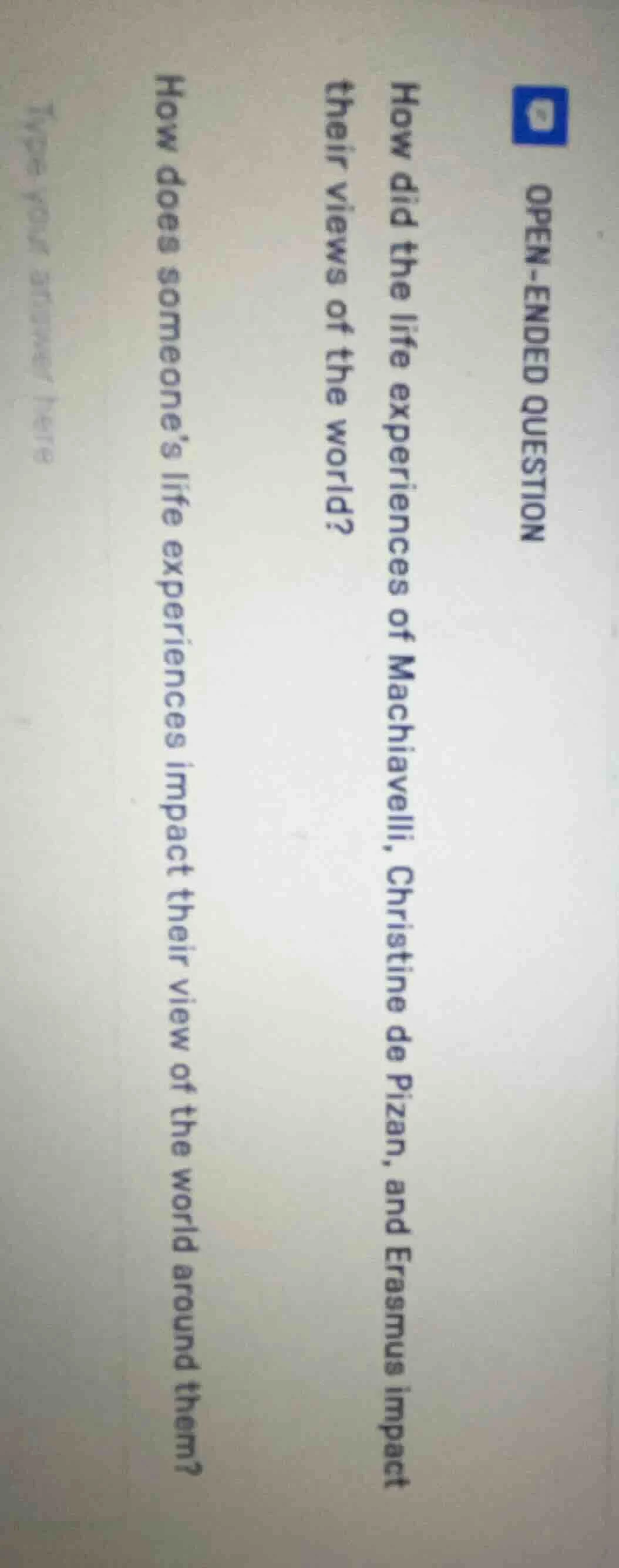
open-ended question how did the life experiences of machiavelli, christine de pizan, and erasmus impact their views of the world? how does someone’s life experiences impact their view of the world around them?
Machiavelli:
- Life Experience: Lived in Renaissance Italy, a time of political fragmentation, power struggles among city - states, and frequent foreign invasions. Served as a diplomat, observing the ruthless power plays of rulers.
- Impact on Worldview: His experiences led him to believe that political power was the ultimate goal, and rulers should use any means (including deception and force) to maintain or gain power. This is evident in "The Prince", where he advocated for practical, amoral political strategies, viewing the world as a place where power dynamics dominated and morality was secondary in statecraft.
Christine de Pizan:
- Life Experience: Widowed young, she had to support her family through writing. She lived in a male - dominated society where women's intellectual and social roles were highly restricted.
- Impact on Worldview: Her struggles led her to become a strong advocate for women's rights and education. She challenged the misogynistic views of her time, arguing that women were capable of intellectual and moral excellence, and that society's view of women was unjustly negative. Her works, like "The Book of the City of Ladies", reflected a worldview that sought to elevate women's status and counter gender - based discrimination.
Erasmus:
- Life Experience: A scholar of the Northern Renaissance, he was exposed to both the corrupt practices of the Catholic Church (such as the sale of indulgences) and the rich classical learning of the past. He traveled widely, engaging with different intellectual circles.
- Impact on Worldview: He became a proponent of humanism and religious reform from within the Church. He believed in the power of education and the study of classical texts to improve society and the Church. He viewed the world as in need of moral and intellectual renewal, advocating for a more personal and scholarly approach to Christianity, and criticizing the excesses and abuses of the Church hierarchy.
In general, life experiences shape worldview by providing the raw material (observations, challenges, opportunities) that individuals interpret and use to form their beliefs about human nature, society, power, and morality. For example, experiences of injustice can lead to a worldview focused on reform, while experiences of political chaos can lead to a worldview focused on practical power - holding strategies.

Snap & solve any problem in the app
Get step-by-step solutions on Sovi AI
Photo-based solutions with guided steps
Explore more problems and detailed explanations
- Machiavelli: His experiences of political turmoil in Renaissance Italy led to a worldview emphasizing amoral, power - centric statecraft.
- Christine de Pizan: Her struggles as a widowed female scholar in a misogynistic society led to a worldview advocating for women's rights and intellectual equality.
- Erasmus: His exposure to Church corruption and classical learning led to a humanist, reform - oriented worldview.
- General Impact: Life experiences (e.g., challenges, exposures to power dynamics, social norms) shape how individuals perceive human nature, society, and moral/political values, forming their unique worldviews.