QUESTION IMAGE
Question
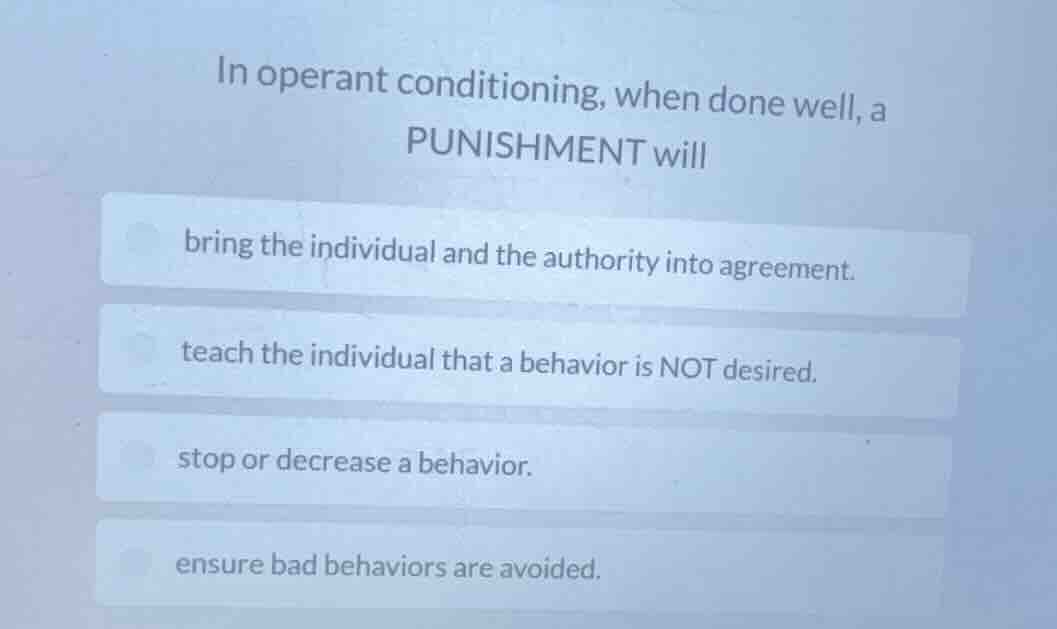
in operant conditioning, when done well, a punishment will bring the individual and the authority into agreement. teach the individual that a behavior is not desired. stop or decrease a behavior. ensure bad behaviors are avoided.
Brief Explanations
In operant conditioning, punishment is defined as a consequence that is intended to stop or decrease the frequency of a behavior. Let's analyze each option:
- "bring the individual and the authority into agreement": Punishment is not about agreement between individual and authority, so this is incorrect.
- "teach the individual that a behavior is NOT desired": While punishment can signal undesirability, its primary function (when done well in operant conditioning terms) is to reduce the behavior, not just teach about desirability.
- "stop or decrease a behavior": This aligns with the definition of punishment in operant conditioning—punishment is used to decrease the likelihood of a behavior occurring again.
- "ensure bad behaviors are avoided": Punishment does not guarantee that bad behaviors will be avoided (as other factors like reinforcement of alternative behaviors matter), and its main goal is to decrease the behavior, not ensure avoidance.

Snap & solve any problem in the app
Get step-by-step solutions on Sovi AI
Photo-based solutions with guided steps
Explore more problems and detailed explanations
C. stop or decrease a behavior.