QUESTION IMAGE
Question
opioids’ effects on the
brain and body
opioids are most well - known for impacting the
brain’s reward pathway, but they can have many
other cognitive and physical effects.
review the infographic to the right.
which effect of opioids do you think is the riskiest?
explain your choice.
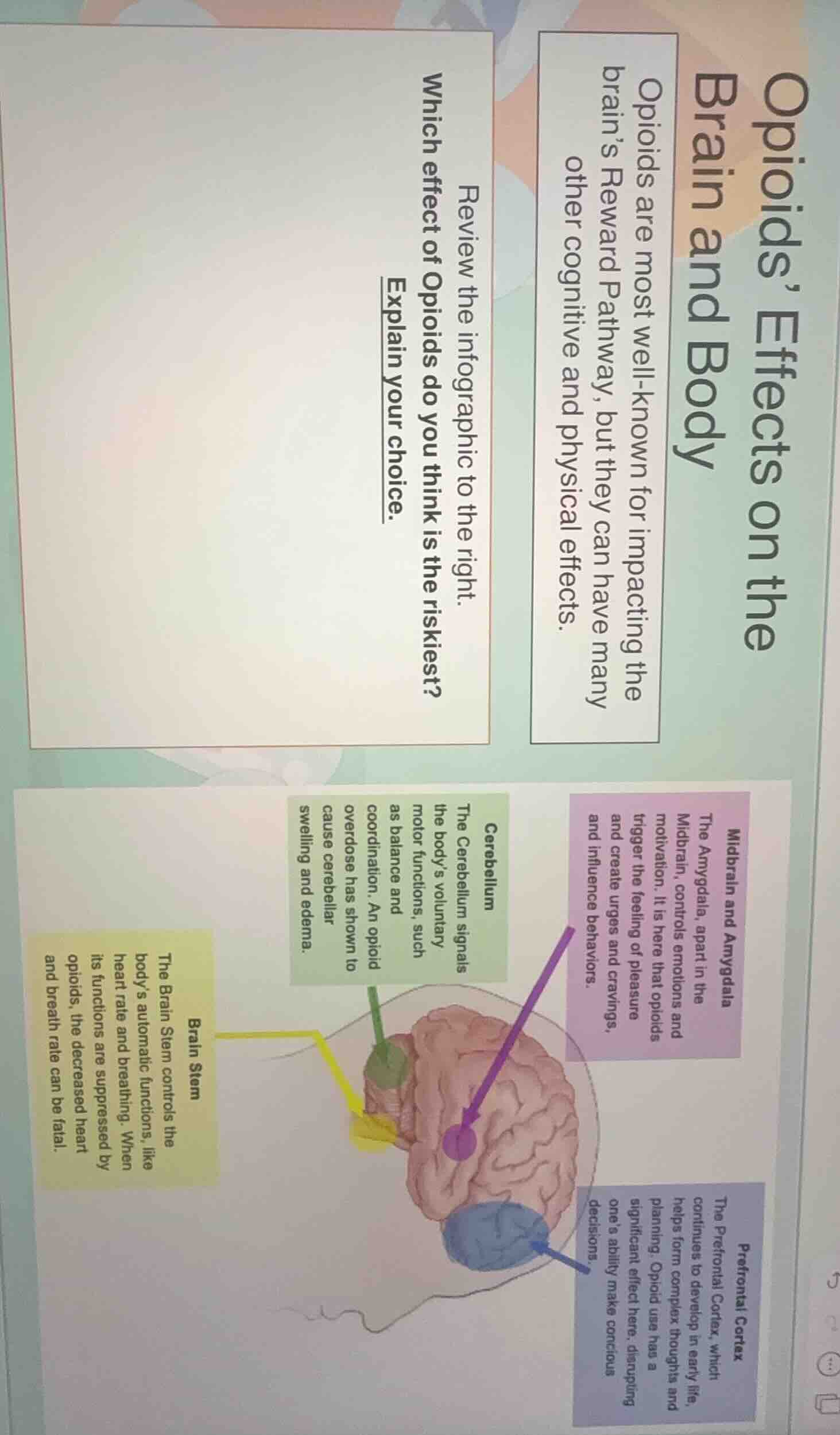
midbrain and amygdala
the amygdala, apart in the
midbrain, controls emotions and
motivation. it is here that opioids
trigger the feeling of pleasure
and create urges and cravings,
and influence behaviors.
prefrontal cortex
the prefrontal cortex, which
continues to develop in early life,
helps form complex thoughts and
planning. opioid use has a
significant effect here, disrupting
one’s ability make conscious
decisions.
cerebellum
the cerebellum signals
the body’s voluntary
motor functions, such
as balance and
coordination. an opioid
overdose has shown to
cause cerebellar
swelling and edema.
brain stem
the brain stem controls the
body’s automatic functions, like
heart rate and breathing. when
its functions are suppressed by
opioids, the decreased heart
and breath rate can be fatal.
The brain stem controls life-sustaining automatic functions (heart rate, breathing). Opioid suppression of this region can stop these functions, leading to death, which is an immediately life-threatening outcome unlike the other listed effects that do not directly cause fatal harm.

Snap & solve any problem in the app
Get step-by-step solutions on Sovi AI
Photo-based solutions with guided steps
Explore more problems and detailed explanations
The riskiest effect of opioids is the suppression of the brain stem, which controls automatic, life-sustaining functions like heart rate and breathing. When these functions are suppressed by opioids, decreased heart rate and stopped breathing can occur, which is fatal.