QUESTION IMAGE
Question
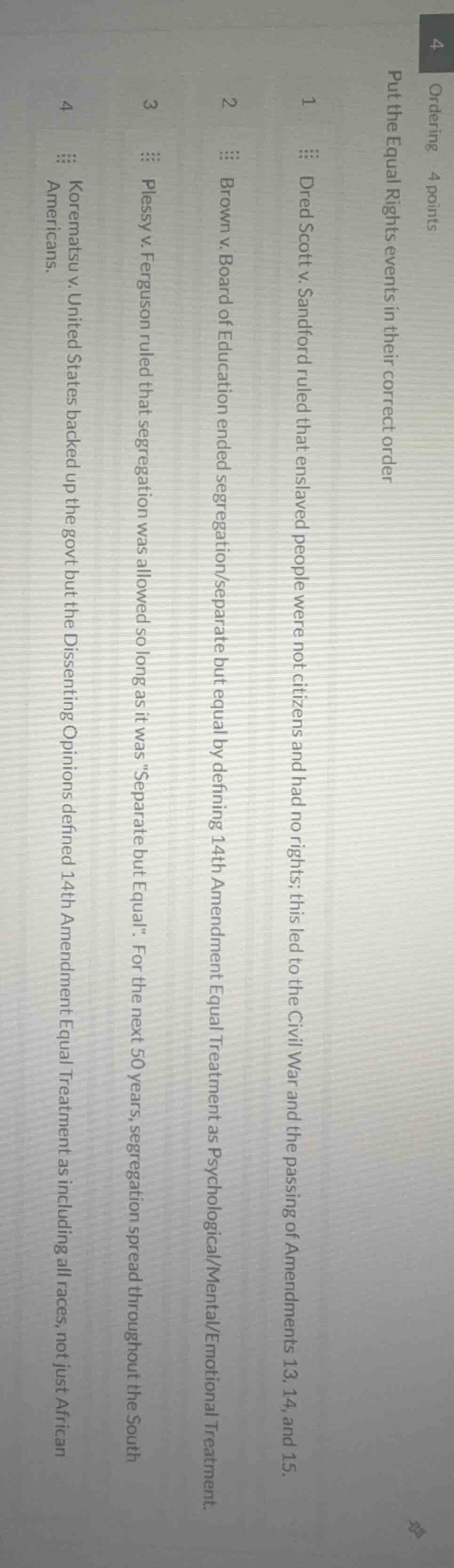
ordering 4 points put the equal rights events in their correct order 1 dred scott v. sandford ruled that enslaved people were not citizens and had no rights; this led to the civil war and the passing of amendments 13, 14, and 15. 2 brown v. board of education ended segregation/separate but equal by defining 14th amendment equal treatment as psychological/mental/emotional treatment. 3 plessy v. ferguson ruled that segregation was allowed so long as it was \separate but equal\. for the next 50 years, segregation spread throughout the south 4 korematsu v. united states backed up the govt but the dissenting opinions defined 14th amendment equal treatment as including all races, not just african americans.
Each event is ordered by the year of the Supreme Court ruling:
- Dred Scott v. Sandford (1857) preceded the Civil War and post-war amendments.
- Plessy v. Ferguson (1896) established the "separate but equal" doctrine that stood for decades.
- Korematsu v. United States (1944) occurred during WWII, addressing racial restrictions beyond Black Americans.
- Brown v. Board of Education (1954) overturned the "separate but equal" ruling, ending legal school segregation.

Snap & solve any problem in the app
Get step-by-step solutions on Sovi AI
Photo-based solutions with guided steps
Explore more problems and detailed explanations
- Dred Scott v. Sandford ruled that enslaved people were not citizens and had no rights; this led to the Civil War and the passing of Amendments 13, 14, and 15.
- Plessy v. Ferguson ruled that segregation was allowed so long as it was "Separate but Equal". For the next 50 years, segregation spread throughout the South
- Korematsu v. United States backed up the govt but the Dissenting Opinions defined 14th Amendment Equal Treatment as including all races, not just African Americans.
- Brown v. Board of Education ended segregation/separate but equal by defining 14th Amendment Equal Treatment as Psychological/Mental/Emotional Treatment.