QUESTION IMAGE
Question
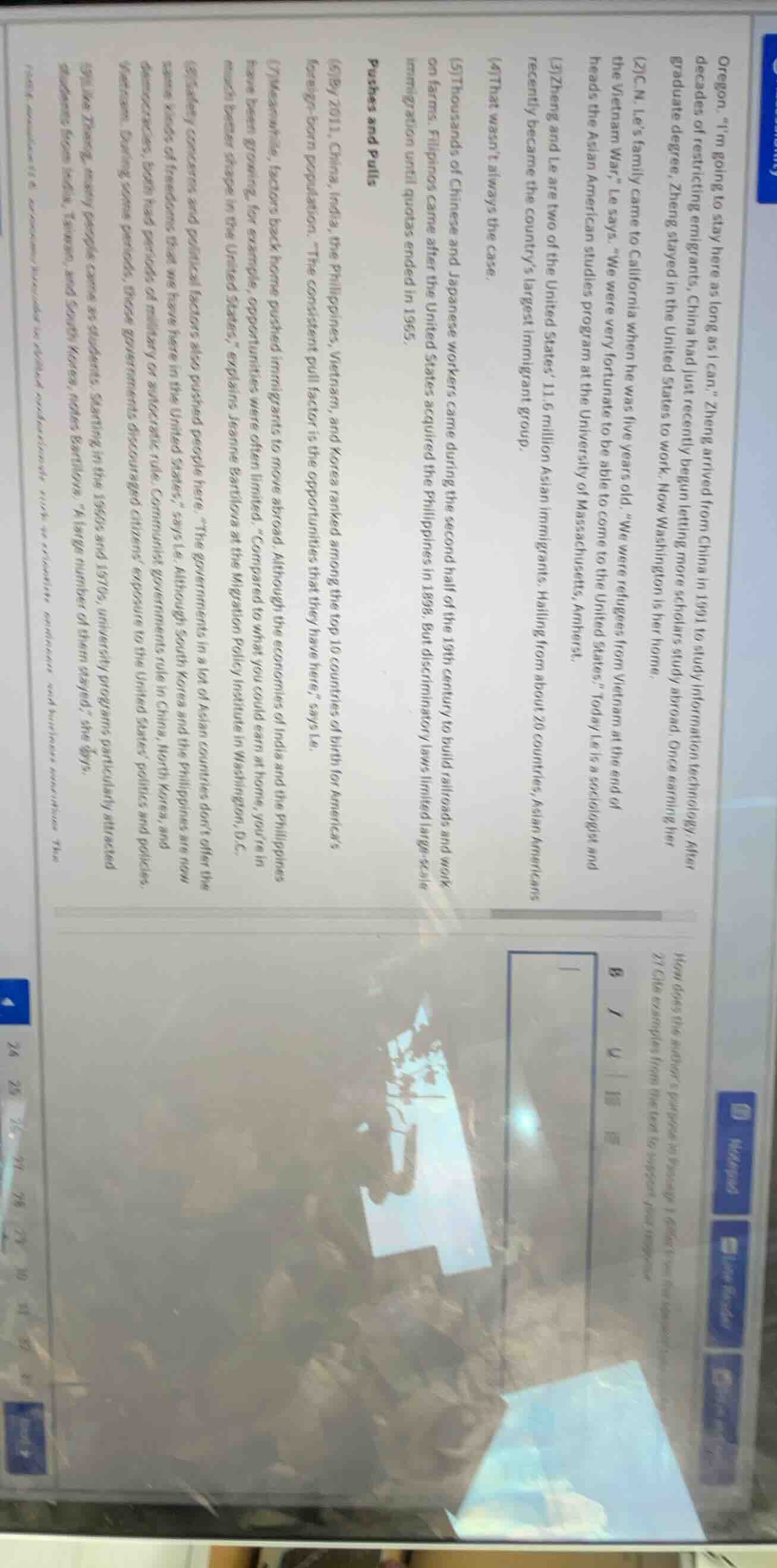
oregon. “i’m going to stay here as long as i can,” zheng arrived from china in 1991 to study information technology. after decades of restricting emigrants, china had just begun letting more scholars study abroad. once earning her graduate degree, zheng stayed in the united states to work. now washington is her home. (2)c.n. le’s family came to california when he was five years old. “we were refugees from vietnam at the end of the vietnam war,” le says. “we were very fortunate to be able to come to the united states.” today le is a sociologist and heads the asian american studies program at the university of massachusetts, amherst. (3)zheng and le are two of the united states’. 11.6 million asian immigrants. hailing from about 20 countries, asian americans recently became the country’s largest immigrant group. (4)that wasn’t always the case. (5)thousands of chinese and japanese workers came during the second half of the 19th century to build railroads and work on farms. filipinos came after the united states acquired the philippines in 1898. but discriminatory laws limited large - scale immigration until quotas ended in 1965. pushes and pulls (6)by 2011, china, india, the philippines, vietnam, and korea ranked among the top 10 countries of birth for america’s foreign - born population. “the consistent pull factor is the opportunities that they have here,” says le. (7)meanwhile, factors back home pushed immigrants to move abroad. although the economies of india and the philippines have been growing, for example, opportunities were often limited. “compared to what you could earn at home, you’re in much better shape in the united states,” explains jeanne batalova at the migration policy institute in washington, d.c. (8)safety concerns and political factors also pushed people here. “the governments in a lot of asian countries don’t offer the same kinds of freedoms that we have here in the united states,” says le. although south korea and the philippines are now democracies, both had periods of military or autocratic rule. communist governments rule in china, north korea, and vietnam. during some periods, those governments discouraged citizens’ exposure to the united states’ politics and policies. (9)like zheng, many people came as students. starting in the 1950s and 1970s, university programs particularly attracted students from india, taiwan, and south korea. “a large number of them stayed,” she says.
The author's purpose is to explain the history and drivers of Asian immigration to the U.S.
- Personal examples: Uses cases of Zheng (a Chinese immigrant who stayed for work after studies) and C.N. Le (a Vietnamese refugee who built an academic career in the U.S.) to illustrate individual immigrant experiences and outcomes.
- Historical labor immigration: Notes 19th-century Chinese/Japanese workers recruited for railroads/farms, and Filipinos who came after the U.S. acquired the Philippines, showing early structured immigration.
- Push-pull factor examples: Cites poor economic opportunities in India/Philippines, political oppression in China/North Korea/Vietnam, and better U.S. opportunities/safety as drivers of immigration.
- Demographic data: States Asian Americans are now the largest U.S. immigrant group, and lists top Asian origin countries (China, India, Philippines, Vietnam, Korea) by 2011 to quantify modern immigration trends.
- Student immigration trend: Mentions 1960s-70s university programs attracting students from India, Taiwan, South Korea, many of whom stayed, highlighting another immigration pathway.

Snap & solve any problem in the app
Get step-by-step solutions on Sovi AI
Photo-based solutions with guided steps
Explore more problems and detailed explanations
The author's purpose is to examine the history, pathways, and driving factors of Asian immigration to the United States. Supporting examples include:
- Personal stories of immigrants like Zheng (a Chinese student who stayed to work in the U.S. post-graduation) and C.N. Le (a Vietnamese refugee who built an academic career in the U.S.).
- Historical labor immigration: 19th-century recruitment of Chinese and Japanese workers for railroads and farms, and Filipino immigration after the U.S. acquired the Philippines (restricted by quotas until 1965).
- Push-pull factors: Limited economic opportunities in India and the Philippines; political oppression/limited freedoms in China, North Korea, and Vietnam; and better economic and safety opportunities in the U.S.
- Demographic data: Asian Americans are now the U.S.'s largest immigrant group, and by 2011, China, India, the Philippines, Vietnam, and Korea ranked among the top 10 origin countries for U.S. foreign-born residents.
- Student immigration pathways: 1960s-70s university programs that attracted students from India, Taiwan, and South Korea, many of whom remained in the U.S.