QUESTION IMAGE
Question
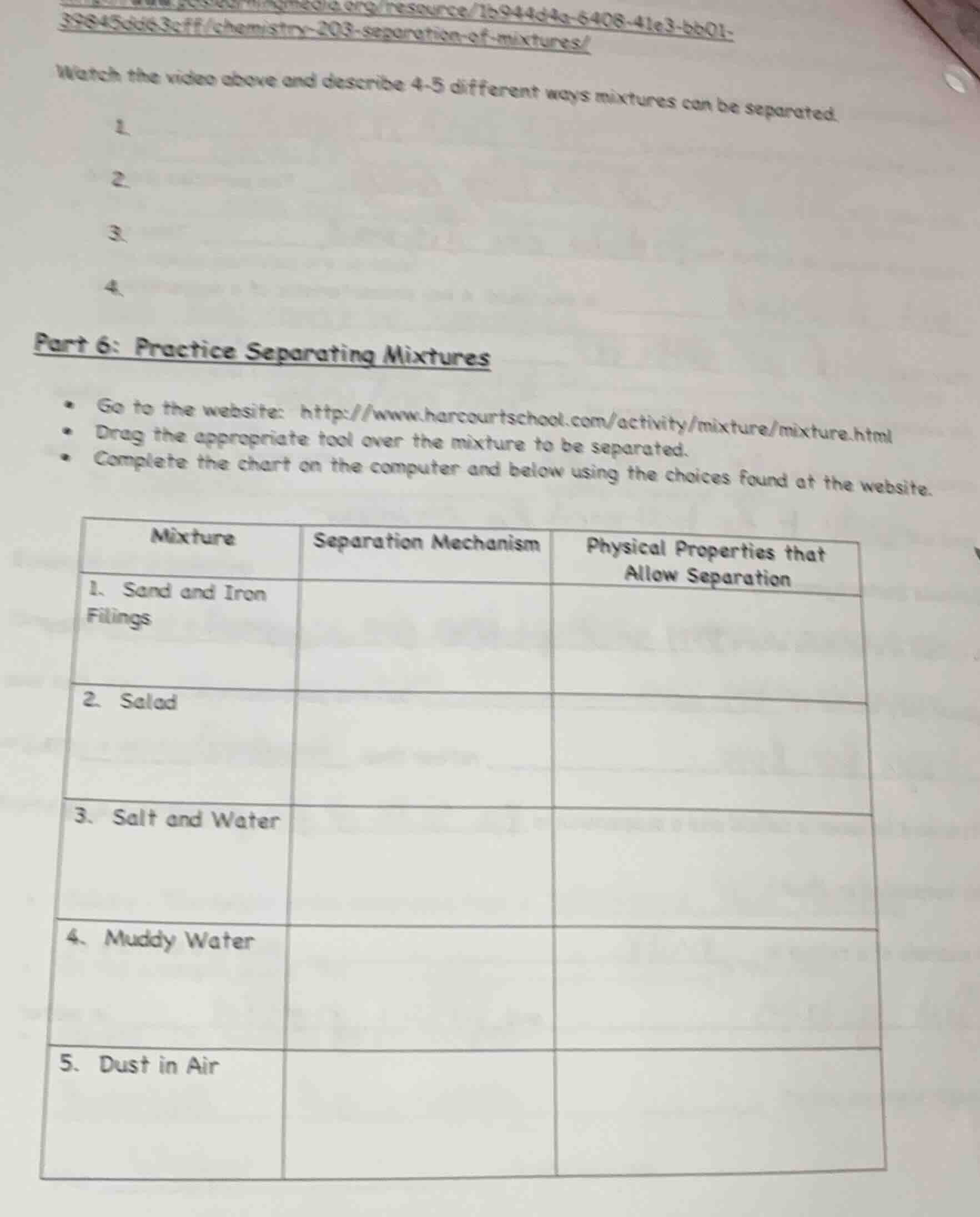
org/resource/1b944d4a-6408-41e3-bb01-39845bd63cff/chemistry-203-separation-of-mixtures/watch the video above and describe 4-5 different ways mixtures can be separated.1.2.3.4.part 6: practice separating mixtures• go to the website: http://www.harcourtschool.com/activity/mixture/mixture.html• drag the appropriate tool over the mixture to be separated.• complete the chart on the computer and below using the choices found at the website.| mixture | separation mechanism | physical properties that allow separation || ---- | ---- | ---- || 1. sand and iron filings | | || 2. salad | | || 3. salt and water | | || 4. muddy water | | || 5. dust in air | | |
First, 4 common mixture separation methods are described. Then, for each mixture in the chart, the separation mechanism and the key physical property enabling separation are identified based on standard chemistry principles.

Snap & solve any problem in the app
Get step-by-step solutions on Sovi AI
Photo-based solutions with guided steps
Explore more problems and detailed explanations
4-5 Different Ways to Separate Mixtures:
- Magnetic Separation: Use a magnet to pull out magnetic components from non-magnetic ones in a mixture.
- Filtration: Pass a mixture through a porous barrier to trap solid particles and let liquid/gas pass through.
- Evaporation: Heat a solution to turn the liquid solvent into vapor, leaving dissolved solid solute behind.
- Hand Sorting: Physically separate distinct, large components of a heterogeneous mixture by hand.
Completed Separation Chart:
| Mixture | Separation Mechanism | Physical Properties that Allow Separation |
|---|---|---|
| 2. Salad | Hand Sorting | Components are large, distinct solids |
| 3. Salt and Water | Evaporation | Water has a low boiling point; salt has a high boiling point (does not vaporize with water) |
| 4. Muddy Water | Filtration | Mud particles are large enough to be trapped by filter paper; water is a small liquid molecule |
| 5. Dust in Air | Filtration (using an air filter) | Dust particles are larger than the pores in the air filter; air molecules are small enough to pass through |