QUESTION IMAGE
Question
** orphan trains
b. haq
introduction
- in the 1850s, thousands of children lived on the streets of new york city. they had become homeless due to many reasons. for some, it was the death of their parents and the absence of extended family to care for them. for others, wretched poverty, parental neglect, or abandonment by poor european immigrants was why they ended up being homeless.
the orphan train movement
- very few orphanages existed at that time. they were usually overcrowded, and the children received minimal food and care. very often, the children received little or no education in orphanages
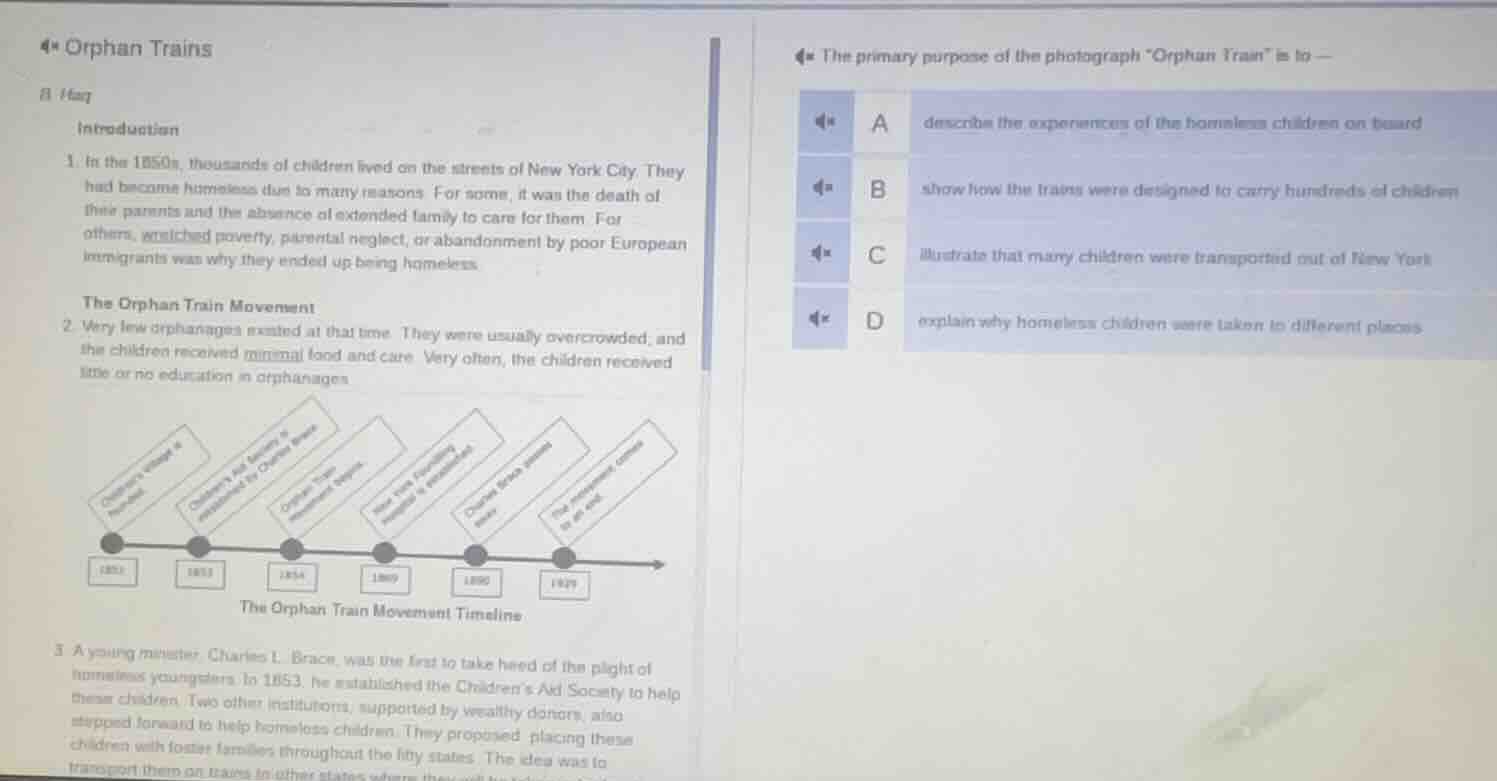
the orphan train movement timeline
- a young minister, charles l. brace, was the first to take heed of the plight of homeless youngsters. in 1853, he established the childrens aid society to help these children. two other institutions, supported by wealthy donors, also stepped forward to help homeless children. they proposed placing these children with foster families throughout the fifty states. the idea was to transport them on trains in other states
- the primary purpose of the photograph \orphan train\ is to —
a describe the experiences of the homeless children on board
b show how the trains were designed to carry hundreds of children
c illustrate that many children were transported out of new york
d explain why homeless children were taken to different places
The text outlines that the Orphan Train Movement transported large numbers of homeless New York City children to foster families across the US. A photograph titled "Orphan Train" would primarily serve to visually show the scale of this transportation, which aligns with option C. Option A focuses on on-board experiences not highlighted as the core purpose here; option B centers on train design, which is not the focus of the movement's story; option D addresses the "why" which is explained in text, not the photo's primary purpose.

Snap & solve any problem in the app
Get step-by-step solutions on Sovi AI
Photo-based solutions with guided steps
Explore more problems and detailed explanations
C. illustrate that many children were transported out of New York