QUESTION IMAGE
Question
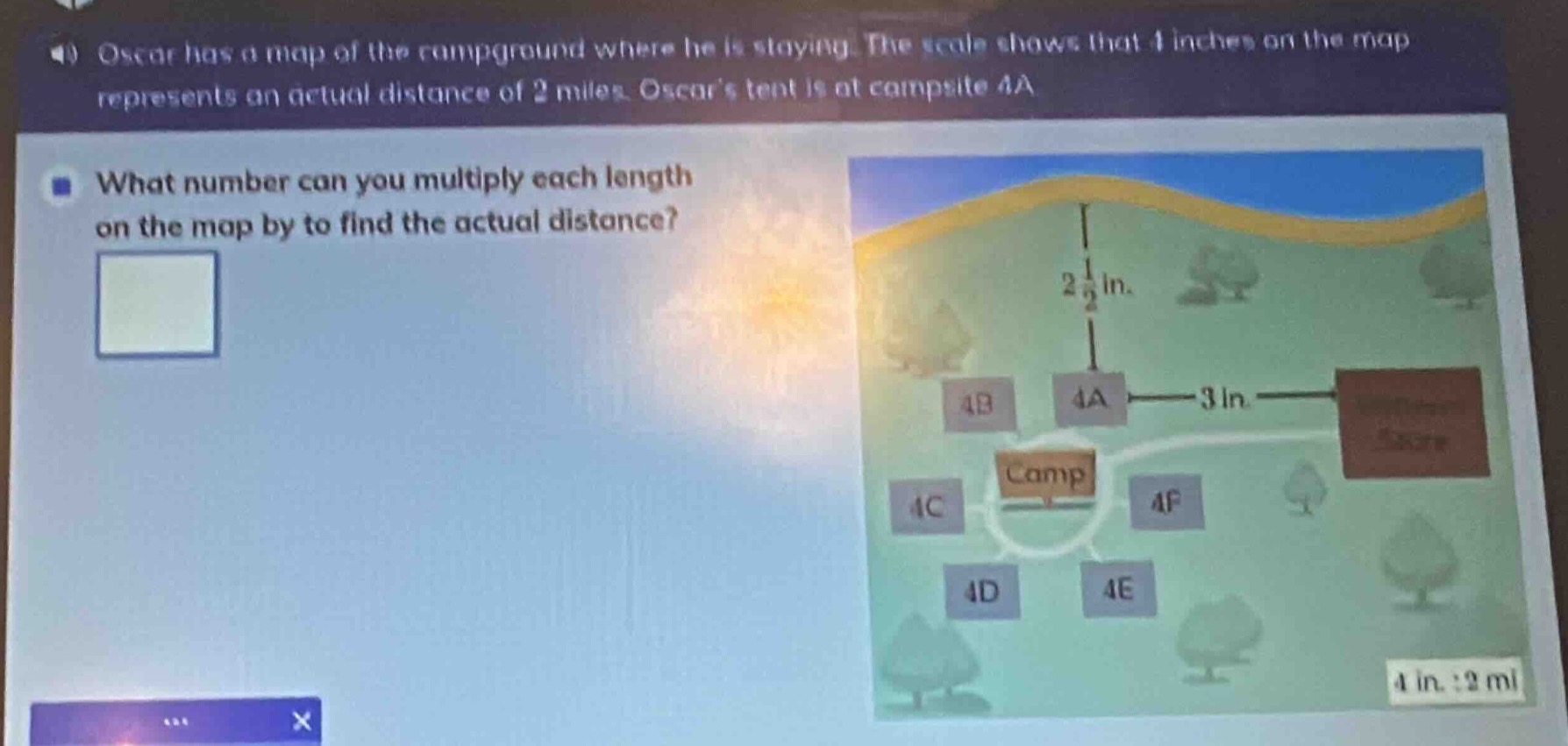
oscar has a map of the campground where he is staying. the scale shows that 4 inches on the map represents an actual distance of 2 miles. oscar’s tent is at campsite 4a
what number can you multiply each length on the map by to find the actual distance?
blank square
image of a campground map with campsites, distances marked as 2 1/2 in. and 3 in., and scale 4 in. : 2 mi
Step1: Understand the scale
The scale is 4 inches on the map represents 2 miles. We need to find the number (let's call it \( k \)) such that map length \( \times k \) = actual distance.
First, find the ratio of actual distance to map distance. For 4 inches map distance, actual distance is 2 miles. So \( k=\frac{2}{4} \)? Wait, no, wait. Wait, the scale is 4 inches : 2 miles. Wait, no, maybe I misread. Wait, the problem says "4 inches on the map represents an actual distance of 2 miles"? Wait, no, the bottom right says "4 in. : 2 mi". Wait, no, maybe it's 1 inch? Wait, no, let's re-express. Wait, the scale is 4 inches map = 2 miles actual. So to find how many miles per inch, we can calculate \( \frac{2 \text{ miles}}{4 \text{ inches}} = 0.5 \text{ miles per inch} \). Wait, but maybe the scale is 1 inch? Wait, no, the problem says "4 inches on the map represents an actual distance of 2 miles"? Wait, the bottom right has "4 in. : 2 mi", so 4 inches map = 2 miles actual. So to find the multiplier, we need to find for 1 inch map, what's the actual distance? Wait, no, the question is "What number can you multiply each length on the map by to find the actual distance?" So if map length is \( x \) inches, actual distance is \( x \times k \) miles. From the scale, 4 inches map = 2 miles actual. So \( 4 \times k = 2 \), so \( k = \frac{2}{4} = 0.5 \)? Wait, no, that would be if 4 inches map is 2 miles. Wait, but maybe the scale is 1 inch? Wait, no, maybe I made a mistake. Wait, let's check again. The scale is 4 inches on the map equals 2 miles actual. So to find the multiplier, we can think: if 4 inches map = 2 miles actual, then 1 inch map = \( \frac{2}{4} = 0.5 \) miles? No, wait, that can't be. Wait, maybe the scale is 1 inch represents 0.5 miles? Wait, no, 4 inches is 2 miles, so 1 inch is 0.5 miles. But the question is, what number do we multiply the map length (in inches) by to get actual distance (in miles). So if map length is \( x \) inches, actual distance is \( x \times \frac{2}{4} \)? Wait, no, \( \frac{2 \text{ miles}}{4 \text{ inches}} = 0.5 \text{ miles per inch} \). Wait, but maybe the scale is 4 inches map = 2 miles actual, so the multiplier is \( \frac{2}{4} = 0.5 \)? Wait, no, that would mean 1 inch map is 0.5 miles actual. But let's verify. If we have a map length of 4 inches, multiplying by 0.5 gives 2 miles, which matches the scale. So the multiplier is 0.5, which is \( \frac{1}{2} \), or 0.5. Wait, but maybe the scale is 1 inch represents 0.5 miles? Wait, no, 4 inches is 2 miles, so 1 inch is 0.5 miles. So the multiplier is 0.5, or \( \frac{1}{2} \), or 2/4 simplified. Wait, but let's do the math. Let the map length be \( L \) inches. Actual distance \( D = L \times k \). From the scale, when \( L = 4 \) inches, \( D = 2 \) miles. So \( 4k = 2 \), so \( k = 2/4 = 0.5 \). So the number is 0.5, or \( \frac{1}{2} \), or 2 divided by 4. Wait, but maybe the scale is 1 inch represents 0.5 miles, so the multiplier is 0.5. So the answer is 0.5, or \( \frac{1}{2} \), or 2/4. But let's check with the example. If the map length is 3 inches (like from 4A to the store), then multiplying by 0.5 would give 1.5 miles? Wait, no, that doesn't seem right. Wait, maybe I misread the scale. Wait, the bottom right says "4 in. : 2 mi", which is 4 inches map = 2 miles actual. So 4 inches map = 2 miles actual, so 1 inch map = 0.5 miles actual. So the multiplier is 0.5, which is \( \frac{1}{2} \), or 2/4. So the number to multiply the map length (in inches) by to get actual distance (in miles) is 0.5, or \( \frac{1}{2} \), or 2 divided by 4. W…

Snap & solve any problem in the app
Get step-by-step solutions on Sovi AI
Photo-based solutions with guided steps
Explore more problems and detailed explanations
The number is \( \frac{1}{2} \) (or 0.5). So you multiply each length on the map by \( \frac{1}{2} \) (or 0.5) to find the actual distance.