QUESTION IMAGE
Question
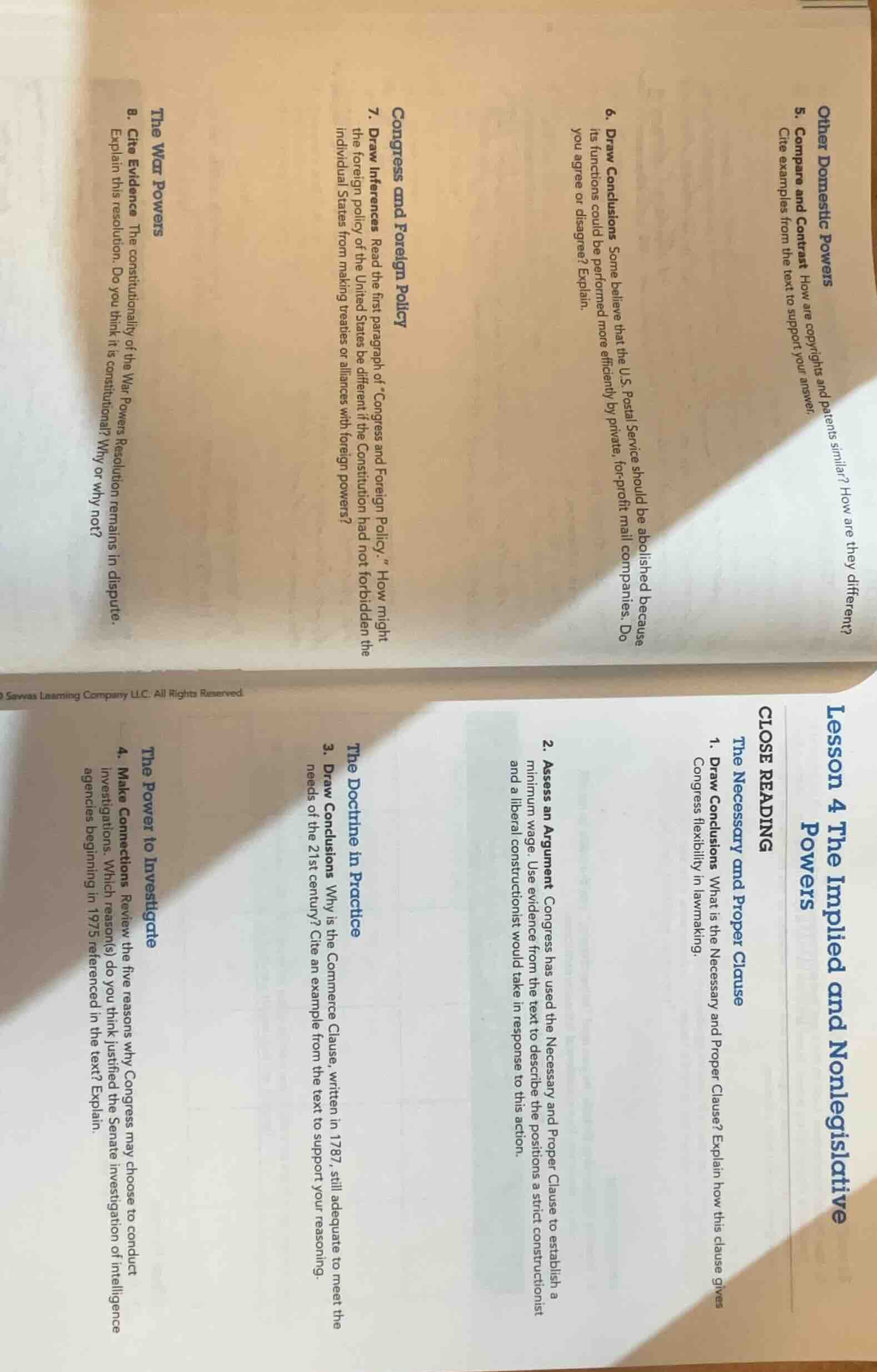
other domestic powers
- compare and contrast how are copyrights and patents similar? how are they different? cite examples from the text to support your answer.
- draw conclusions some believe that the u.s. postal service should be abolished because its functions could be performed more efficiently by private, for - profit mail companies. do you agree or disagree? explain.
congress and foreign policy
- draw inferences read the first paragraph of “congress and foreign policy.” how might the foreign policy of the united states be different if the constitution had not forbidden the individual states from making treaties or alliances with foreign powers?
the war powers
- cite evidence the constitutionality of the war powers resolution remains in dispute. explain this resolution. do you think it is constitutional? why or why not?
lesson 4 the implied and nonlegislative powers
close reading
the necessary and proper clause
- draw conclusions what is the necessary and proper clause? explain how this clause gives congress flexibility in lawmaking.
- assess an argument congress has used the necessary and proper clause to establish a minimum wage. use evidence from the text to describe the positions a strict constructionist and a liberal constructionist would take in response to this action.
the doctrine in practice
- draw conclusions why is the commerce clause, written in 1787, still adequate to meet the needs of the 21st century? cite an example from the text to support your reasoning.
the power to investigate
- make connections review the five reasons why congress may choose to conduct investigations. which reason(s) do you think justified the senate investigation of intelligence agencies beginning in 1975 referenced in the text? explain.
- For Question 1 (Necessary and Proper Clause):
The Necessary and Proper Clause (Article I, Section 8, Clause 18) is a constitutional provision that grants Congress the authority to pass any laws that are "necessary and proper" to execute its enumerated powers. This clause gives Congress flexibility because it allows lawmakers to create laws that adapt to new, unforeseen situations not explicitly listed in the original Constitution. For example, Congress used this clause to establish a national bank, as it determined this was a necessary tool to carry out its power to coin money and regulate commerce.
- For Question 2 (Strict vs Liberal Constructionist):
- A strict constructionist would argue that Congress can only use the Necessary and Proper Clause to pass laws that are absolutely essential to execute enumerated powers. They would reject a minimum wage law under this clause, as a federal minimum wage is not explicitly tied to a core enumerated power, and they would argue the issue falls to state governments.
- A liberal constructionist would argue that the clause allows for broad, flexible interpretation of congressional powers. They would support a federal minimum wage, framing it as a necessary measure to regulate interstate commerce (an enumerated power), as wage standards impact the flow of goods and labor across state lines.
- For Question 3 (Commerce Clause Adequacy):
The Commerce Clause (Article I, Section 8, Clause 3) grants Congress power to regulate interstate and international commerce. It remains adequate for the 21st century because Congress has interpreted it broadly to address modern issues. For example, Congress used it to pass the Civil Rights Act of 1964, arguing that racial discrimination in businesses affects interstate commerce, and to regulate online commerce, as digital transactions cross state and national borders.
- For Question 4 (Senate Intelligence Investigation):
Congress conducts investigations to oversee executive branch actions, gather information for legislation, and ensure accountability. The Senate's 1975 intelligence agency investigation was justified to address concerns about illegal surveillance and covert operations by agencies like the CIA. This falls under Congress's oversight power, a key nonlegislative function to check executive overreach.
- For Question 5 (Copyrights vs Patents):
- Similarity: Both are forms of intellectual property protection granted by the U.S. government, intended to give creators exclusive rights to their work for a set period, encouraging innovation and creativity.
- Difference: Copyrights protect original works of authorship (e.g., books, music, art) from unauthorized reproduction. Patents protect new, useful inventions or processes (e.g., a new medical device, manufacturing technique), granting the holder the right to prevent others from making, using, or selling the invention.
- For Question 6 (Abolishing the U.S. Postal Service):
- Agree argument: Private companies (like UPS, FedEx) have extensive infrastructure and offer competitive, specialized services (e.g., overnight shipping) that could make mail delivery more efficient. A private system could adapt faster to market demands and reduce government spending on postal operations.
- Disagree argument: The Postal Service has a legal mandate to provide universal service, delivering mail to every address in the U.S., including remote, low-population areas that private companies would ignore due to low profitability. It also serves as a critical public service, esp…

Snap & solve any problem in the app
Get step-by-step solutions on Sovi AI
Photo-based solutions with guided steps
Explore more problems and detailed explanations
- The Necessary and Proper Clause (Article I, Section 8, Clause 18) lets Congress pass laws needed to execute its enumerated powers; it gives flexibility by allowing adaptation to new circumstances (e.g., creating a national bank to support financial regulation powers).
- Strict constructionist: Would reject a minimum wage, arguing it is not strictly necessary to execute an enumerated power and is a state issue. Liberal constructionist: Would support it, framing it as a necessary measure to regulate interstate commerce (an enumerated power).
- Yes, it is adequate. Congress has broadly interpreted it to address modern issues, such as using it to pass the Civil Rights Act of 1964 (regulating commerce affected by discrimination) and laws governing online interstate commerce.
- The investigation was justified under Congress's oversight power, to hold executive branch intelligence agencies accountable for illegal covert operations and surveillance, ensuring checks on executive overreach.
- Similarity: Both are federal intellectual property protections that grant exclusive rights to creators/inventors to encourage innovation. Difference: Copyrights protect creative works (books, art); patents protect tangible inventions/processes (medical devices, manufacturing methods).
- (Example stance: Disagree) The U.S. Postal Service provides universal, mandatory mail service to all U.S. addresses, including remote areas private companies would not serve, making it a critical public service that private firms cannot fully replace.
- U.S. foreign policy would be fragmented; individual states could make conflicting treaties/alliances with foreign powers, weakening the nation's unified global diplomatic and strategic position.
- (Example stance: Constitutional) It upholds the Constitution's separation of powers, enforcing Congress's explicit war-declaring power by limiting unilateral presidential military commitments, ensuring legislative oversight of wartime actions.