QUESTION IMAGE
Question
the outer structure of the earth - discovering the moho
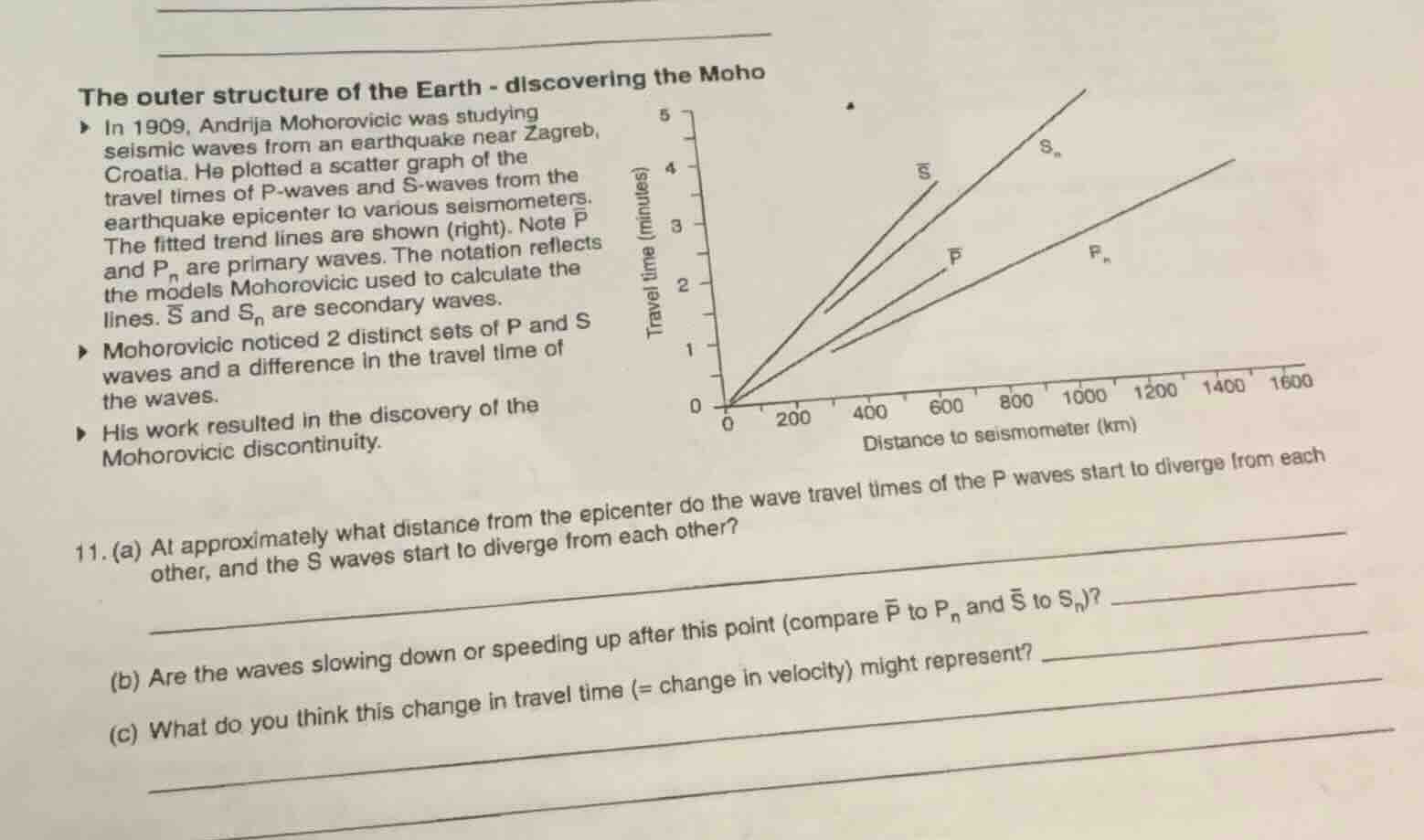
- in 1909, andrija mohorovicic was studying seismic waves from an earthquake near zagreb, croatia. he plotted a scatter graph of the travel times of p - waves and s - waves from the earthquake epicenter to various seismometers. the fitted trend lines are shown (right). note $\bar{p}$ and $p_n$ are primary waves. the notation reflects the models mohorovicic used to calculate the lines. $\bar{s}$ and $s_n$ are secondary waves.
- mohorovicic noticed 2 distinct sets of p and s waves and a difference in the travel time of the waves.
- his work resulted in the discovery of the mohorovicic discontinuity.
- (a) at approximately what distance from the epicenter do the wave travel times of the p waves start to diverge from each other, and the s waves start to diverge from each other?
(b) are the waves slowing down or speeding up after this point (compare $\bar{p}$ to $p_n$ and $\bar{s}$ to $s_n$)?
(c) what do you think this change in travel time (= change in velocity) might represent?
11.(a)
To determine the divergence distance, we analyze the scatter - graph (trend lines for P - waves (\(\bar{P}\), \(P_{n}\)) and S - waves (\(\bar{S}\), \(S_{n}\))). By visually inspecting the graph, we look for the point where the trend lines of the same - type waves (P - waves and S - waves) start to deviate from each other. From the given graph (with distance on the x - axis and travel time on the y - axis), we observe that the deviation (divergence) of the P - wave and S - wave trend lines begins approximately at a distance of 400 km from the epicenter.
Velocity of a wave is given by the formula \(v=\frac{d}{t}\) (where \(v\) is velocity, \(d\) is distance, and \(t\) is time). After the divergence point, for a given increase in distance (\(d\)), the increase in travel time (\(t\)) for \(P_{n}\) (compared to \(\bar{P}\)) and \(S_{n}\) (compared to \(\bar{S}\)) is less. Since \(v=\frac{d}{t}\), if \(t\) increases less for the same \(d\), the velocity (\(v\)) increases. So the waves are speeding up.
A change in the velocity of seismic waves (P - waves and S - waves) as they travel through the Earth's interior is related to a change in the medium's properties. Seismic waves travel at different speeds in different layers of the Earth (e.g., crust, mantle). The change in travel time (and thus velocity) observed here likely represents the boundary between two different layers of the Earth's interior (the Mohorovičić discontinuity, or Moho, which is the boundary between the Earth's crust and the mantle). At this boundary, the density and composition of the rock change, leading to a change in the speed of seismic waves.

Snap & solve any problem in the app
Get step-by-step solutions on Sovi AI
Photo-based solutions with guided steps
Explore more problems and detailed explanations
Approximately 400 km.