QUESTION IMAGE
Question
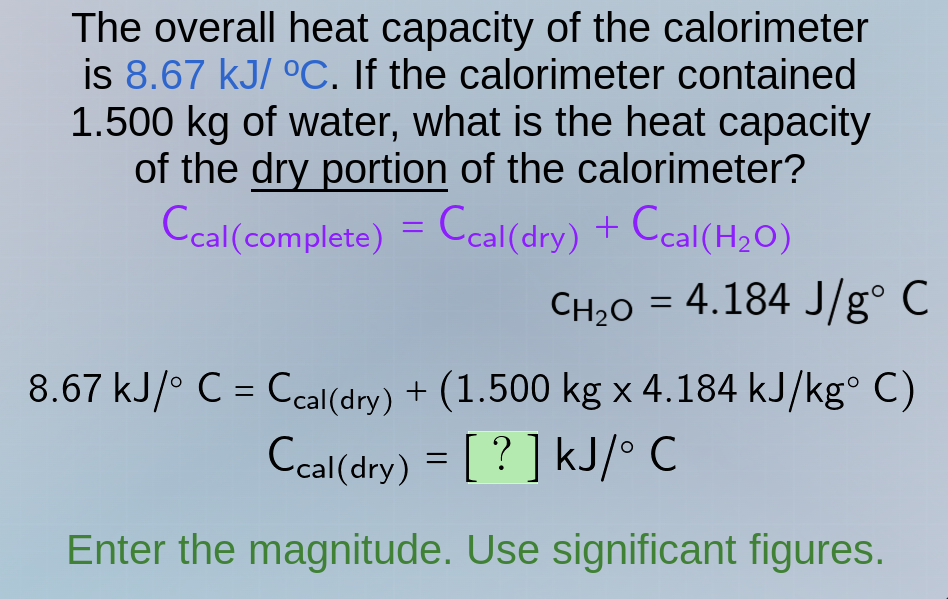
the overall heat capacity of the calorimeter is 8.67 kj/ °c. if the calorimeter contained 1.500 kg of water, what is the heat capacity of the dry portion of the calorimeter?
$c_{cal(complete)} = c_{cal(dry)} + c_{cal(h_2o)}$
$c_{h_2o} = 4.184 j/g° c$
$8.67 kj/° c = c_{cal(dry)} + (1.500 kg × 4.184 kj/kg° c)$
$c_{cal(dry)} = ? kj/° c$
enter the magnitude. use significant figures.
Step1: Calculate heat capacity of water
First, find \( C_{\text{cal}(\text{H}_2\text{O})} \) using \( C = m \times c \). Given \( m = 1.500 \, \text{kg} \) and \( c_{\text{H}_2\text{O}} = 4.184 \, \text{kJ/kg}^\circ\text{C} \) (converted to kJ for consistency).
\( C_{\text{cal}(\text{H}_2\text{O})} = 1.500 \, \text{kg} \times 4.184 \, \text{kJ/kg}^\circ\text{C} = 6.276 \, \text{kJ/}^\circ\text{C} \).
Step2: Solve for dry calorimeter heat capacity
Use the formula \( C_{\text{cal(complete)}} = C_{\text{cal(dry)}} + C_{\text{cal(H}_2\text{O)}} \). Rearrange to solve for \( C_{\text{cal(dry)}} \):
\( C_{\text{cal(dry)}} = C_{\text{cal(complete)}} - C_{\text{cal(H}_2\text{O)}} \).
Substitute \( C_{\text{cal(complete)}} = 8.67 \, \text{kJ/}^\circ\text{C} \) and \( C_{\text{cal(H}_2\text{O)}} = 6.276 \, \text{kJ/}^\circ\text{C} \):
\( C_{\text{cal(dry)}} = 8.67 - 6.276 = 2.394 \, \text{kJ/}^\circ\text{C} \).
Round to three significant figures (consistent with given values: 8.67 has three, 1.500 has four, 4.184 has four; result should match least precise? Wait, 8.67 is three, so final answer: 2.39 (or 2.40? Wait, 8.67 - 6.276 = 2.394, which rounds to 2.39 or 2.40? Wait, 8.67 is three sig figs, 6.276 is four. Subtraction: decimal places. 8.67 has two decimal places? No, 8.67 is to the hundredth place (0.01), 6.276 is to the thousandth. So result should be to the hundredth? Wait, 8.67 - 6.276 = 2.394. The least number of decimal places in the terms is two (8.67 has two decimal places? Wait, 8.67 is 8.67 (two decimal places), 6.276 is three. So when subtracting, the result should have two decimal places? Wait, no: 8.67 is 8.670 (to thousandth) for subtraction. 8.670 - 6.276 = 2.394, which is 2.39 when rounded to three significant figures? Wait, 8.67 has three significant figures, so the answer should have three. 2.394 rounded to three sig figs is 2.39 (wait, 2.394: first three sig figs are 2,3,9; next digit is 4, which is less than 5, so round down? Wait, 2.394: 2.39 (three sig figs) or 2.40? Wait, 2.394: the third sig fig is 9, next digit 4, so 2.39. But wait, let's check calculation again. 8.67 - 6.276 = 2.394. So with three significant figures, it's 2.39 (or 2.40? Wait, 8.67 is three, 1.500 is four, 4.184 is four. The formula is addition/subtraction, so the number of decimal places matters. 8.67 has two decimal places (0.01), 6.276 has three. So the result should have two decimal places? Wait, 8.67 is 8.67 (two decimal places), 6.276 is 6.28 when rounded to two decimal places? No, subtraction: 8.67 - 6.276 = 2.394, which is 2.39 when rounded to two decimal places? Wait, no, 8.67 is to the hundredth (0.01), so the result should be to the hundredth. 2.394 rounded to the hundredth is 2.39 (since 0.004 < 0.005). So final answer: 2.39 kJ/°C (or 2.40? Wait, maybe I made a mistake. Wait, 8.67 - 6.276: 8.670 - 6.276 = 2.394. So three significant figures: 2.39 (the first three digits are 2,3,9; the next digit is 4, so we don't round up). So 2.39.

Snap & solve any problem in the app
Get step-by-step solutions on Sovi AI
Photo-based solutions with guided steps
Explore more problems and detailed explanations
2.39