QUESTION IMAGE
Question
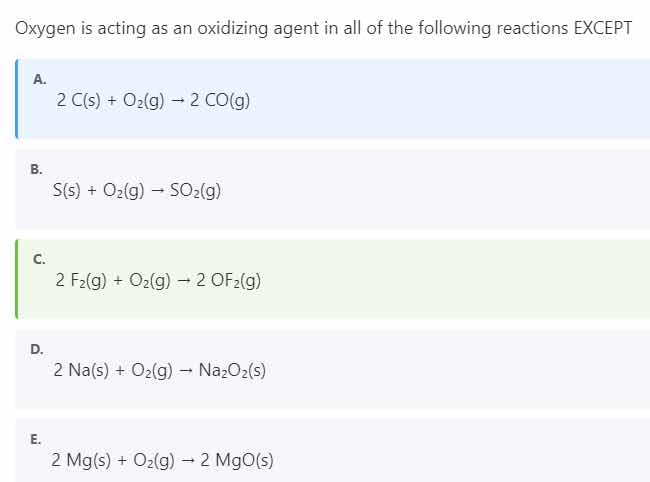
oxygen is acting as an oxidizing agent in all of the following reactions excepta. \\( 2 c(s) + o_2(g) \
ightarrow 2 co(g) \\)b. \\( s(s) + o_2(g) \
ightarrow so_2(g) \\)c. \\( 2 f_2(g) + o_2(g) \
ightarrow 2 of_2(g) \\)d. \\( 2 na(s) + o_2(g) \
ightarrow na_2o_2(s) \\)e. \\( 2 mg(s) + o_2(g) \
ightarrow 2 mgo(s) \\)
To determine in which reaction oxygen is not acting as an oxidizing agent, we analyze the oxidation states of oxygen in each reaction. An oxidizing agent is reduced (its oxidation state decreases).
Step 1: Recall oxidation state rules
- In elemental form (e.g., \(O_2\)), oxidation state of \(O\) is \(0\).
- In compounds, oxidation state of \(O\) is usually \(-2\), except in peroxides (e.g., \(Na_2O_2\)) where it is \(-1\), and in compounds with \(F\) (e.g., \(OF_2\)) where it is positive.
Step 2: Analyze Reaction A (\(2C(s) + O_2(g)
ightarrow 2CO(g)\))
- \(O_2\) (oxidation state \(0\)) becomes \(O\) in \(CO\) (oxidation state \(-2\)).
- Oxidation state of \(O\) decreases (from \(0\) to \(-2\)), so \(O_2\) is reduced (oxidizing agent).
Step 3: Analyze Reaction B (\(S(s) + O_2(g)
ightarrow SO_2(g)\))
- \(O_2\) (oxidation state \(0\)) becomes \(O\) in \(SO_2\) (oxidation state \(-2\)).
- Oxidation state of \(O\) decreases (from \(0\) to \(-2\)), so \(O_2\) is reduced (oxidizing agent).
Step 4: Analyze Reaction C (\(2F_2(g) + O_2(g)
ightarrow 2OF_2(g)\))
- \(O_2\) (oxidation state \(0\)) becomes \(O\) in \(OF_2\).
- In \(OF_2\), let oxidation state of \(O\) be \(x\). Since \(F\) has oxidation state \(-1\), and the compound is neutral: \(x + 2(-1)=0 \implies x = +2\).
- Oxidation state of \(O\) increases (from \(0\) to \(+2\)), so \(O_2\) is oxidized (not an oxidizing agent, it is a reducing agent here).
Step 5: Analyze Reaction D (\(2Na(s) + O_2(g)
ightarrow Na_2O_2(s)\))
- \(O_2\) (oxidation state \(0\)) becomes \(O\) in \(Na_2O_2\) (oxidation state \(-1\)).
- Oxidation state of \(O\) decreases (from \(0\) to \(-1\)), so \(O_2\) is reduced (oxidizing agent).
Step 6: Analyze Reaction E (\(2Mg(s) + O_2(g)
ightarrow 2MgO(s)\))
- \(O_2\) (oxidation state \(0\)) becomes \(O\) in \(MgO\) (oxidation state \(-2\)).
- Oxidation state of \(O\) decreases (from \(0\) to \(-2\)), so \(O_2\) is reduced (oxidizing agent).

Snap & solve any problem in the app
Get step-by-step solutions on Sovi AI
Photo-based solutions with guided steps
Explore more problems and detailed explanations
C. \(2 F_2(g) + O_2(g)
ightarrow 2 OF_2(g)\)