QUESTION IMAGE
Question
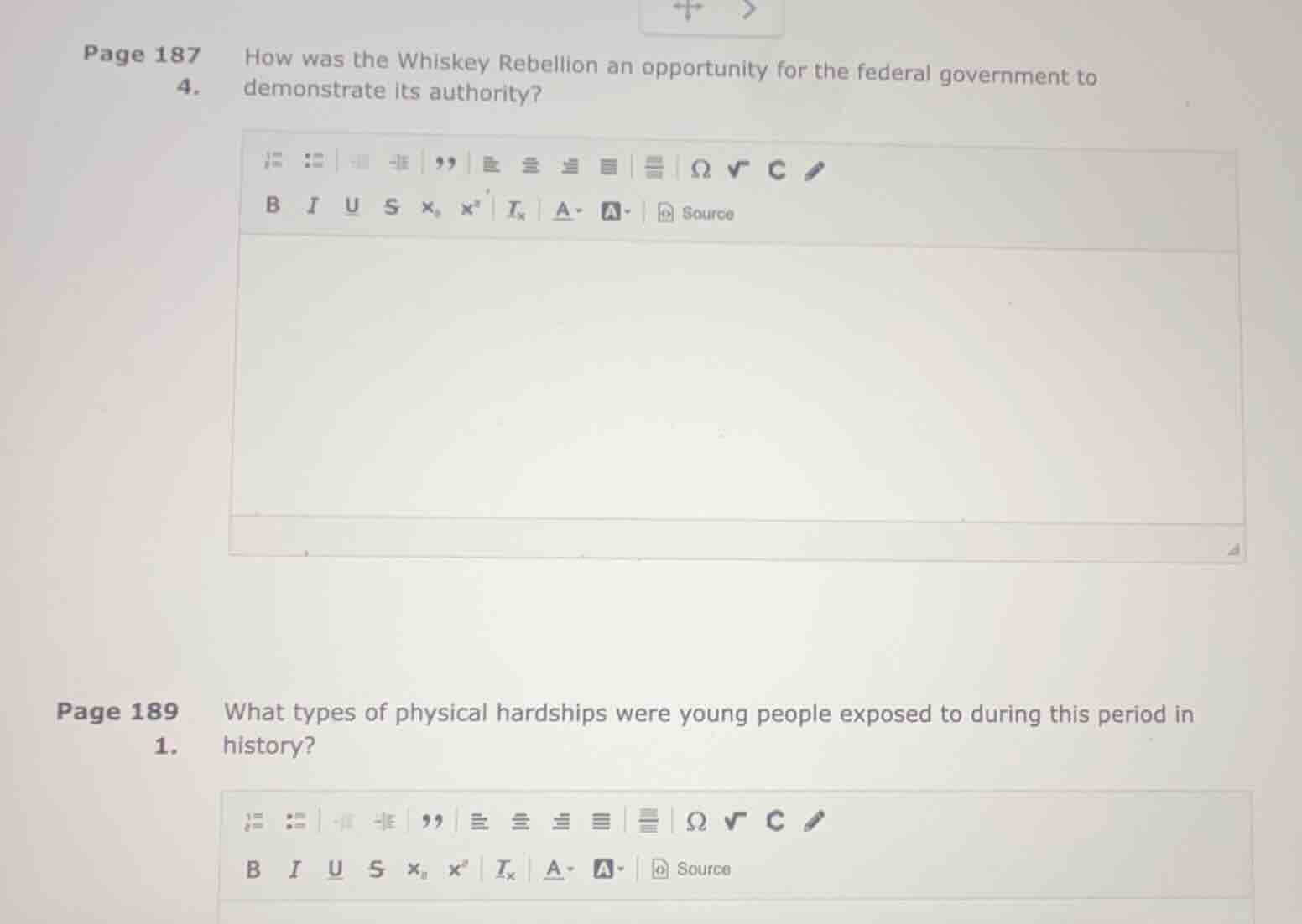
page 187 4. how was the whiskey rebellion an opportunity for the federal government to demonstrate its authority? page 189 1. what types of physical hardships were young people exposed to during this period in history?
For the first question: The Whiskey Rebellion (1794) was a protest by western Pennsylvania farmers against a federal whiskey tax. The federal government, led by President Washington, raised a large militia force to suppress the rebellion without major bloodshed. This showed the federal government could enforce federal laws across the states, unlike the weak national government under the Articles of Confederation, which failed to address similar unrest. It established that the federal government had the authority to levy and collect taxes and use force to uphold its laws when necessary.
For the second question (assuming the period refers to the early American frontier era, concurrent with the Whiskey Rebellion context): Young people faced harsh physical conditions including backbreaking labor (farming, hunting, building shelters), exposure to extreme weather (severe winters, hot summers with no modern climate control), high risk of injury or death from work accidents, lack of access to modern medical care leading to preventable deaths from common illnesses, and food scarcity from failed crops or poor hunting yields.

Snap & solve any problem in the app
Get step-by-step solutions on Sovi AI
Photo-based solutions with guided steps
Explore more problems and detailed explanations
- The Whiskey Rebellion allowed the federal government to demonstrate its authority by:
- Raising and deploying a large federal militia to enforce a federal tax, proving it could act to uphold federal laws over state-level or local resistance.
- Successfully quelling the rebellion without major violence, establishing that the federal government had the power to maintain order and enforce its policies across the entire nation, a capability the previous Articles of Confederation government lacked.
- Young people in this frontier-era period faced physical hardships including:
- Grueling, constant manual labor (farming, constructing homes, hunting/gathering for survival)
- Exposure to extreme, unregulated weather conditions with no modern protection
- High risk of injury or death from work accidents, with limited access to medical care
- Frequent food shortages and malnutrition from crop failures or poor hunting results
- High rates of illness and death from contagious diseases due to lack of healthcare infrastructure