QUESTION IMAGE
Question
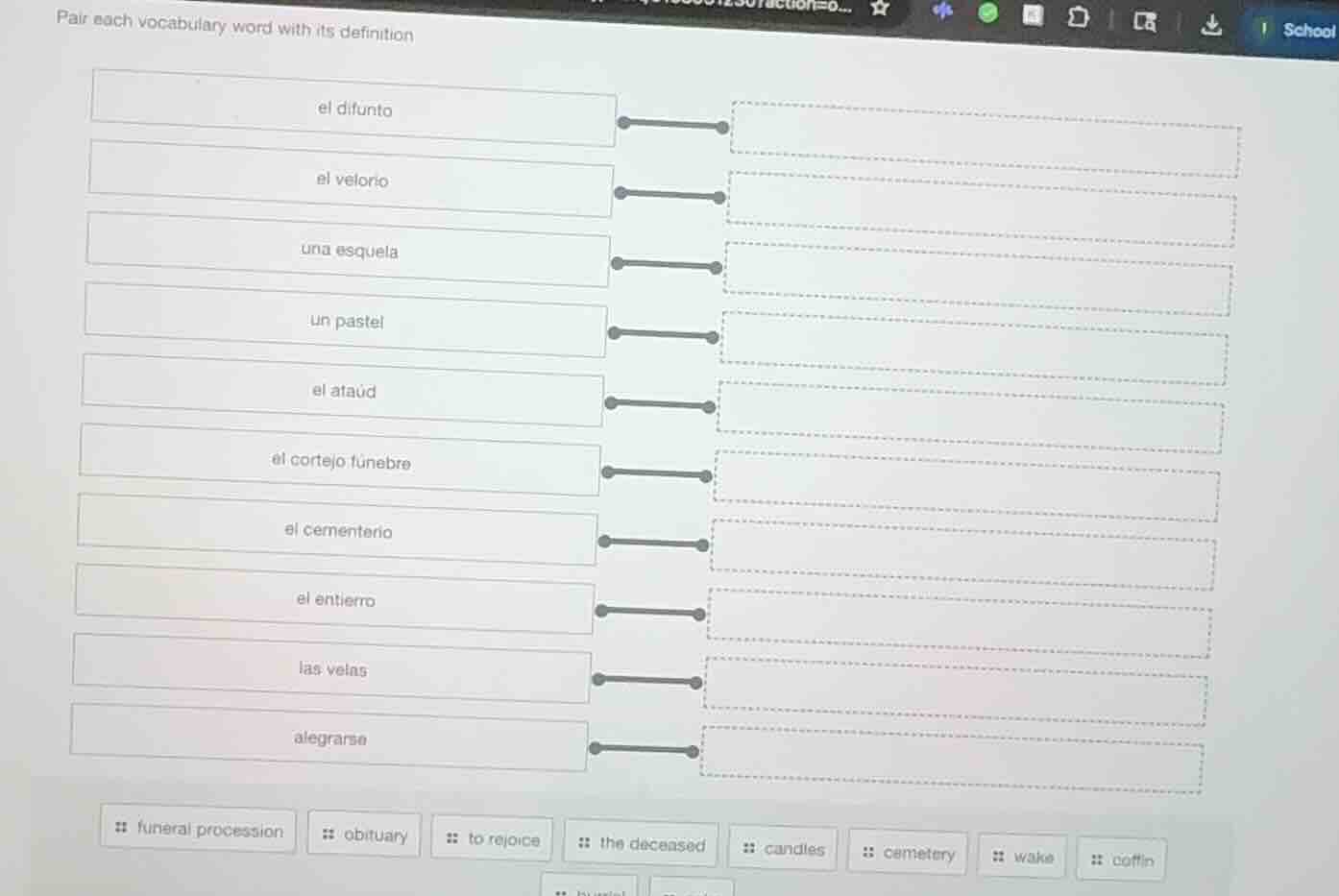
pair each vocabulary word with its definition
el difunto
el velorio
una esquela
un pastel
el ataud
el cortejo fúnebre
el cementerio
el entierro
las velas
alegrarse
funeral procession obituary to rejoice the deceased candles cemetery wake coffin
To solve this vocabulary - pairing problem, we analyze each Spanish term and match it with the corresponding English definition:
1. For "el difunto"
The meaning of "el difunto" in English is "the deceased". So we pair "el difunto" with "the deceased".
2. For "el velorio"
"El velorio" in English is "wake" (the event held before a funeral). So we pair "el velorio" with "wake".
3. For "una esquela"
"Una esquela" translates to "obituary" (a notice of a person's death). So we pair "una esquela" with "obituary".
4. For "un pastel"
Wait, there seems to be a mistake here. If we assume it's a typo and maybe "un ramo" (a wreath) was intended, but based on the given options and if we consider maybe a mis - input and looking at the funeral - related terms, but if we go with the given "un pastel", it doesn't fit the funeral - related options. However, if we assume it's a mistake and maybe "un ramo" is not there, but among the given options, maybe it's a wrong term. But if we proceed with the correct funeral - related terms:
5. For "el ataúd"
"El ataúd" means "coffin" (the box in which a dead body is buried or cremated). So we pair "el ataúd" with "coffin".
6. For "el cortejo fúnebre"
"El cortejo fúnebre" is "funeral procession" (the group of people and vehicles moving to the funeral). So we pair "el cortejo fúnebre" with "funeral procession".
7. For "el cementerio"
"El cementerio" is "cemetery" (the place where dead people are buried). So we pair "el cementerio" with "cemetery".
8. For "el entierro"
"El entierro" means "funeral" (the ceremony of burying the dead). So we pair "el entierro" with "funeral".
9. For "las velas"
"Las velas" means "candles" (the light - giving objects often used in funerals or wakes). So we pair "las velas" with "candles".
10. For "alegrarse"
"Alegrarse" means "to rejoice" (to feel happy or glad). So we pair "alegrarse" with "to rejoice".
Final Pairings:
- el difunto - the deceased
- el velorio - wake
- una esquela - obituary
- el ataúd - coffin
- el cortejo fúnebre - funeral procession
- el cementerio - cemetery
- el entierro - funeral
- las velas - candles
- alegrarse - to rejoice
(Note: There is an issue with "un pastel" as it doesn't match any of the given funeral - related English terms. It might be a typo. If we assume it's a different context, but in the context of this funeral - related vocabulary exercise, it's an out - of - place term.)

Snap & solve any problem in the app
Get step-by-step solutions on Sovi AI
Photo-based solutions with guided steps
Explore more problems and detailed explanations
To solve this vocabulary - pairing problem, we analyze each Spanish term and match it with the corresponding English definition:
1. For "el difunto"
The meaning of "el difunto" in English is "the deceased". So we pair "el difunto" with "the deceased".
2. For "el velorio"
"El velorio" in English is "wake" (the event held before a funeral). So we pair "el velorio" with "wake".
3. For "una esquela"
"Una esquela" translates to "obituary" (a notice of a person's death). So we pair "una esquela" with "obituary".
4. For "un pastel"
Wait, there seems to be a mistake here. If we assume it's a typo and maybe "un ramo" (a wreath) was intended, but based on the given options and if we consider maybe a mis - input and looking at the funeral - related terms, but if we go with the given "un pastel", it doesn't fit the funeral - related options. However, if we assume it's a mistake and maybe "un ramo" is not there, but among the given options, maybe it's a wrong term. But if we proceed with the correct funeral - related terms:
5. For "el ataúd"
"El ataúd" means "coffin" (the box in which a dead body is buried or cremated). So we pair "el ataúd" with "coffin".
6. For "el cortejo fúnebre"
"El cortejo fúnebre" is "funeral procession" (the group of people and vehicles moving to the funeral). So we pair "el cortejo fúnebre" with "funeral procession".
7. For "el cementerio"
"El cementerio" is "cemetery" (the place where dead people are buried). So we pair "el cementerio" with "cemetery".
8. For "el entierro"
"El entierro" means "funeral" (the ceremony of burying the dead). So we pair "el entierro" with "funeral".
9. For "las velas"
"Las velas" means "candles" (the light - giving objects often used in funerals or wakes). So we pair "las velas" with "candles".
10. For "alegrarse"
"Alegrarse" means "to rejoice" (to feel happy or glad). So we pair "alegrarse" with "to rejoice".
Final Pairings:
- el difunto - the deceased
- el velorio - wake
- una esquela - obituary
- el ataúd - coffin
- el cortejo fúnebre - funeral procession
- el cementerio - cemetery
- el entierro - funeral
- las velas - candles
- alegrarse - to rejoice
(Note: There is an issue with "un pastel" as it doesn't match any of the given funeral - related English terms. It might be a typo. If we assume it's a different context, but in the context of this funeral - related vocabulary exercise, it's an out - of - place term.)