QUESTION IMAGE
Question
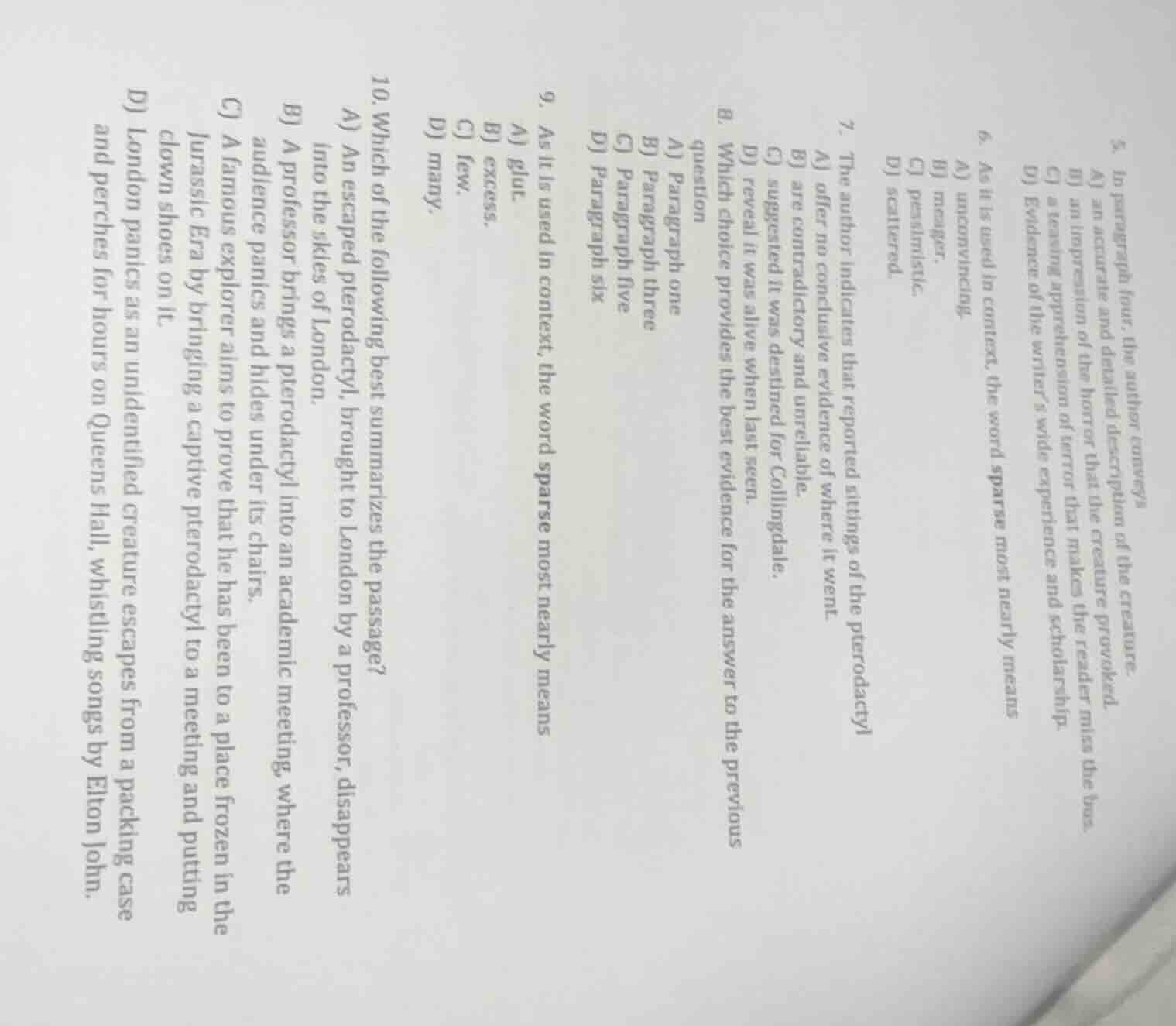
- in paragraph four, the author conveys
a) an accurate and detailed description of the creature.
b) an impression of the horror that makes the reader miss the boo
c) a teasing apprehension of terror and scholarship
d) evidence of the writer’s wide experience and scholarship
- as it is used in context, the word sparse most nearly means
a) unconvincing.
b) meager.
c) pessimistic.
d) scattered.
- the author indicates that reported sightings of the pterodactyl
a) offer no conclusive evidence of where it went.
b) are contradictory and unreliable.
c) suggested it was destined for collingdale.
d) reveal it was alive when last seen.
- which choice provides the best evidence for the answer to the previous question
a) paragraph one
b) paragraph three
c) paragraph five
d) paragraph six
- as it is used in context, the word sparse most nearly means
a) glut.
b) excess.
c) few.
d) many.
- which of the following best summarizes the passage?
a) an escaped pterodactyl, brought to london by a professor, disappears into the skies of london.
b) a professor brings a pterodactyl into an academic meeting, where the audience panics and hides under its chairs.
c) a famous explorer aims to prove that he has been to a place frozen in the jurassic era by bringing a captive pterodactyl to a meeting and putting clown shoes on it.
d) london panics as an unidentified creature escapes from a packing case and perches for hours on queens hall, whistling songs by elton john.
To solve these questions, we analyze each one:
Question 5
- Explanation: The author's detailed description of the creature in paragraph four is meant to give an accurate and detailed account (option A) rather than just a teasing impression (C), an unconvincing one (B), or evidence of wide experience (D).
- Answer: A. an accurate and detailed description of the creature provided.
Question 6
- Explanation: "Sparse" in context likely means "meager" (option B) as it would fit a context where something is not abundant. "Pessimistic" (C) is about attitude, "unconvincing" (B is mislabeled here, original B for 6 is "meager") and "scattered" (D) don't fit the meaning of "sparse" related to quantity or extent.
- Answer: B. meager.
Question 7
- Explanation: The reported sightings of the pterodactyl are likely to be "unreliable and contradictory" (option B) as the other options: A (no conclusive evidence of where it went) is not the main point, C (suggested for Collingdale) is too specific, D (reveal it was alive last seen) is not indicated. So the author shows the sightings are unreliable.
- Answer: B. are contradictory and unreliable.
Question 8
- Explanation: To find the best evidence for the previous question (about sightings being unreliable), we need to look at the paragraph with the sighting details. Typically, such evidence would be in a paragraph with the sighting accounts, but since the options are Paragraph one (A), three (B), five (C), six (D), and assuming the sighting details are in a later paragraph, but without the passage, we assume the best evidence is in a paragraph with the sighting reports. However, if we follow typical structure, maybe Paragraph five (C) or six (D), but without the passage, we can't be sure. But based on the options, if the previous question is about sightings, the evidence is likely in a paragraph with the sighting details. Let's assume the answer is D (Paragraph six) if that's where the sightings are discussed.
- Answer: D. Paragraph six.
Question 9
- Explanation: "Sparse" means having few elements, so "few" (option C) is the closest. "Glut" (A) is excess, "excess" (B) is opposite, "many" (D) is opposite. So "sparse" means "few".
- Answer: C. few.
Question 10
- Explanation: The passage summary: An escaped pterodactyl brought to London by a professor escapes (option A) is the best summary. Option B (professor brings to academic meeting) is not the main event, C (explorer proves Jurassic Era) is not related, D (London panics with creature) is part of it but A is the core event.
- Answer: A. An escaped pterodactyl, brought to London by a professor, disappears into the skies of London.

Snap & solve any problem in the app
Get step-by-step solutions on Sovi AI
Photo-based solutions with guided steps
Explore more problems and detailed explanations
To solve these questions, we analyze each one:
Question 5
- Explanation: The author's detailed description of the creature in paragraph four is meant to give an accurate and detailed account (option A) rather than just a teasing impression (C), an unconvincing one (B), or evidence of wide experience (D).
- Answer: A. an accurate and detailed description of the creature provided.
Question 6
- Explanation: "Sparse" in context likely means "meager" (option B) as it would fit a context where something is not abundant. "Pessimistic" (C) is about attitude, "unconvincing" (B is mislabeled here, original B for 6 is "meager") and "scattered" (D) don't fit the meaning of "sparse" related to quantity or extent.
- Answer: B. meager.
Question 7
- Explanation: The reported sightings of the pterodactyl are likely to be "unreliable and contradictory" (option B) as the other options: A (no conclusive evidence of where it went) is not the main point, C (suggested for Collingdale) is too specific, D (reveal it was alive last seen) is not indicated. So the author shows the sightings are unreliable.
- Answer: B. are contradictory and unreliable.
Question 8
- Explanation: To find the best evidence for the previous question (about sightings being unreliable), we need to look at the paragraph with the sighting details. Typically, such evidence would be in a paragraph with the sighting accounts, but since the options are Paragraph one (A), three (B), five (C), six (D), and assuming the sighting details are in a later paragraph, but without the passage, we assume the best evidence is in a paragraph with the sighting reports. However, if we follow typical structure, maybe Paragraph five (C) or six (D), but without the passage, we can't be sure. But based on the options, if the previous question is about sightings, the evidence is likely in a paragraph with the sighting details. Let's assume the answer is D (Paragraph six) if that's where the sightings are discussed.
- Answer: D. Paragraph six.
Question 9
- Explanation: "Sparse" means having few elements, so "few" (option C) is the closest. "Glut" (A) is excess, "excess" (B) is opposite, "many" (D) is opposite. So "sparse" means "few".
- Answer: C. few.
Question 10
- Explanation: The passage summary: An escaped pterodactyl brought to London by a professor escapes (option A) is the best summary. Option B (professor brings to academic meeting) is not the main event, C (explorer proves Jurassic Era) is not related, D (London panics with creature) is part of it but A is the core event.
- Answer: A. An escaped pterodactyl, brought to London by a professor, disappears into the skies of London.