QUESTION IMAGE
Question
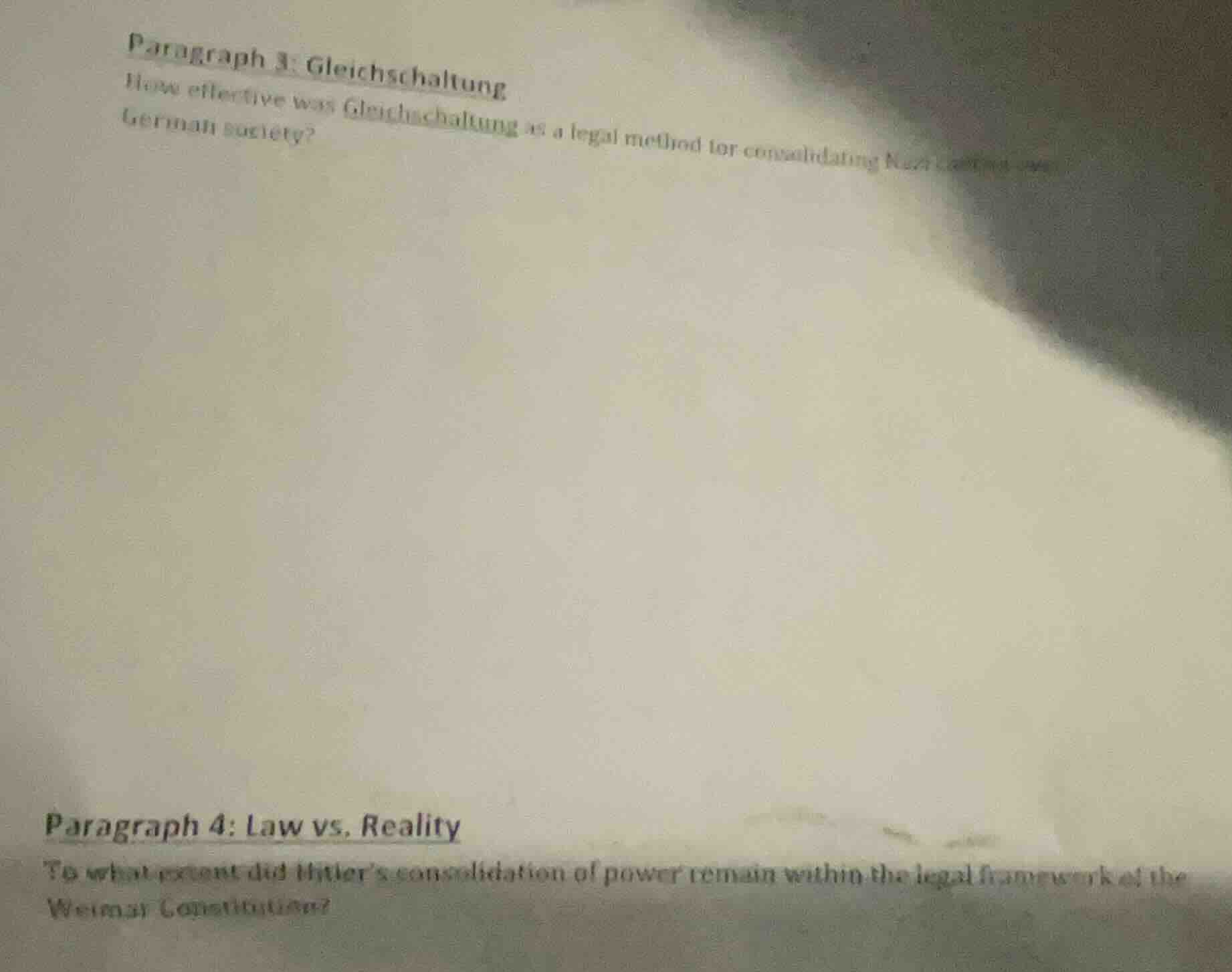
paragraph 3: gleichschaltung
how effective was gleichschaltung as a legal method for consolidating nazi control over german society?
paragraph 4: law vs. reality
to what extent did hitler’s consolidation of power remain within the legal framework of the weimar constitution?
For Paragraph 3 (Gleichschaltung):
Gleichschaltung was highly effective in consolidating Nazi control. Legally, laws like the Enabling Act gave Hitler dictatorial powers. It eliminated opposition parties, unions, and independent organizations, replacing them with Nazi - controlled entities. Socially, it enforced Nazi ideology in all aspects of life (education, media, culture), suppressing dissent. Though some resistance existed, it largely unified German society under Nazi rule, using legal mechanisms to centralize power.
Hitler’s consolidation of power mostly deviated from the Weimar Constitution’s legal framework. Initially, some steps (e.g., forming a coalition) were legal, but the Enabling Act (1933) bypassed constitutional checks by suspending civil liberties and allowing Hitler to legislate without the Reichstag. Later, the constitution was ignored as Hitler established a dictatorship, abolished other parties, and centralized power, violating principles of democracy, separation of powers, and individual rights enshrined in Weimar.

Snap & solve any problem in the app
Get step-by-step solutions on Sovi AI
Photo-based solutions with guided steps
Explore more problems and detailed explanations
Gleichschaltung was largely effective. Legally, it used laws (e.g., Enabling Act) to eliminate opposition, control institutions, and enforce Nazi ideology across German society, though some resistance persisted.