QUESTION IMAGE
Question
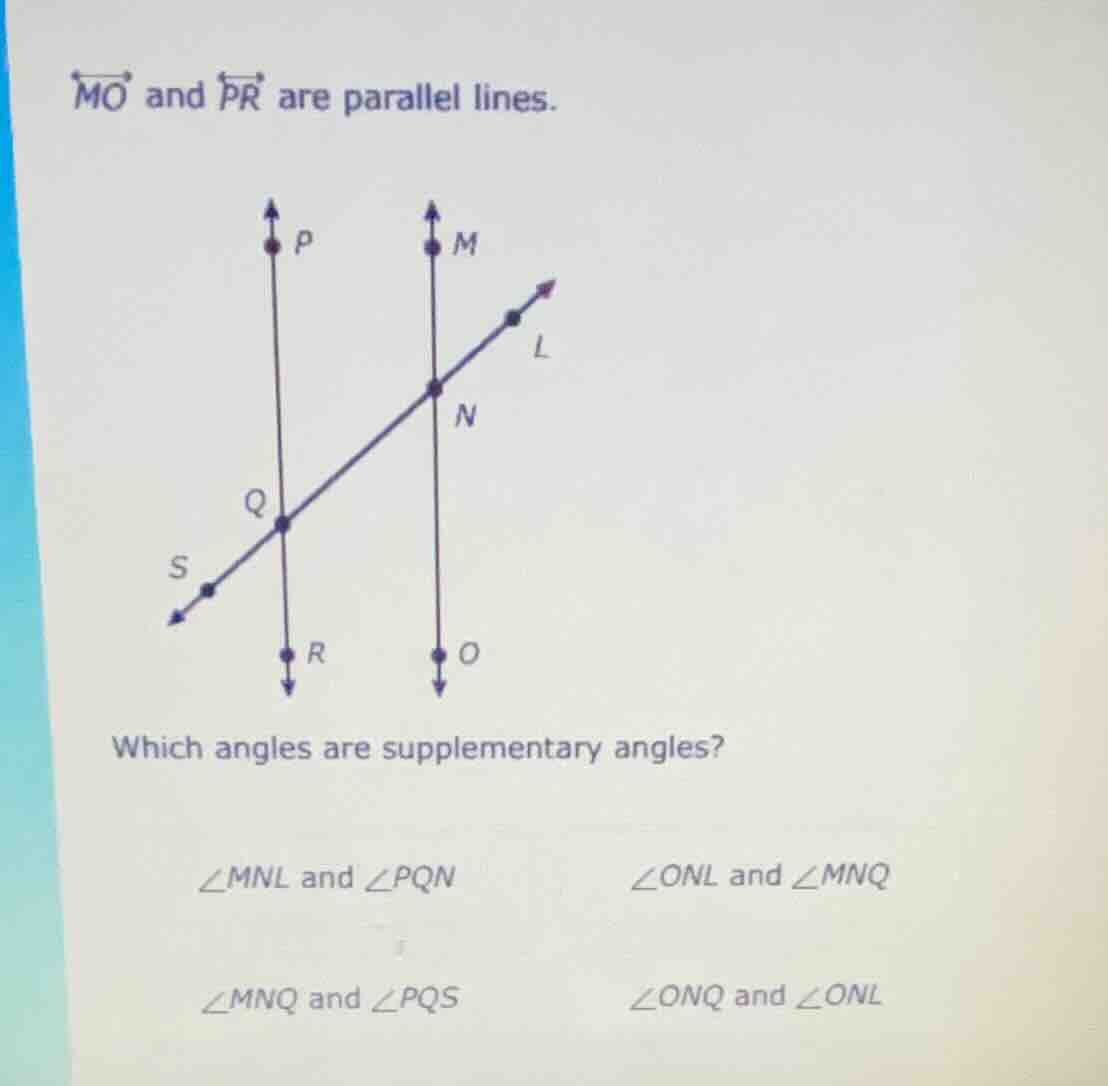
$\overleftrightarrow{mo}$ and $\overleftrightarrow{pr}$ are parallel lines.
image of two parallel vertical lines (pr and mo) and a transversal line (sl) intersecting them, with points p, m at the top, r, o at the bottom, and q, n on the transversal
which angles are supplementary angles?
$\angle mnl$ and $\angle pqn$ $\angle onl$ and $\angle mnq$
$\angle mnq$ and $\angle pqs$ $\angle onq$ and $\angle onl$
Step1: Recall Supplementary Angles Definition
Supplementary angles are two angles whose sum is \(180^\circ\) (a straight angle). They can be adjacent (forming a linear pair) or non - adjacent.
Step2: Analyze Each Option
- Option 1: \(\angle MNL\) and \(\angle PQN\)
Since \(MO\parallel PR\) and \(SL\) is a transversal, \(\angle MNL\) and \(\angle PQN\) are alternate interior angles. Alternate interior angles are equal, not supplementary (unless they are right angles, but there's no indication of that here). So this pair is not supplementary.
- Option 2: \(\angle ONL\) and \(\angle MNQ\)
\(\angle ONL\) and \(\angle MNQ\): Let's see the positions. \(\angle ONL\) and \(\angle MNQ\) are not a linear pair and there's no clear relationship that their sum is \(180^\circ\). In fact, \(\angle ONL\) and \(\angle MNL\) are a linear pair, but not with \(\angle MNQ\). So this pair is not supplementary.
- Option 3: \(\angle MNQ\) and \(\angle PQS\)
\(\angle MNQ\) and \(\angle PQS\): \(\angle PQS\) and \(\angle PQN\) are a linear pair (supplementary), and \(\angle MNQ\) and \(\angle MNL\) are a linear pair. But \(\angle MNQ\) and \(\angle PQS\) - since \(MO\parallel PR\), \(\angle MNQ\) and \(\angle PQN\) are alternate interior angles. \(\angle PQS\) and \(\angle PQN\) are supplementary. But \(\angle MNQ=\angle PQN\), so \(\angle MNQ+\angle PQS=\angle PQN + \angle PQS=180^\circ\)? Wait, no. Wait, \(\angle PQS\) and \(\angle PQN\) are adjacent and form a linear pair, so \(\angle PQS+\angle PQN = 180^\circ\). And \(\angle MNQ=\angle PQN\) (alternate interior angles as \(MO\parallel PR\) and \(SL\) is transversal). So \(\angle MNQ+\angle PQS=\angle PQN+\angle PQS = 180^\circ\)? Wait, no, \(\angle PQS\) and \(\angle PQN\) are a linear pair, so \(\angle PQS+\angle PQN=180^\circ\), and \(\angle MNQ = \angle PQN\) (alternate interior angles), so \(\angle MNQ+\angle PQS=180^\circ\)? Wait, maybe I made a mistake here. Let's check the fourth option.
- Option 4: \(\angle ONQ\) and \(\angle ONL\)
\(\angle ONQ\) and \(\angle ONL\) form a linear pair. A linear pair of angles is formed when two adjacent angles form a straight line. So by the definition of a linear pair, their sum is \(180^\circ\), which means they are supplementary.

Snap & solve any problem in the app
Get step-by-step solutions on Sovi AI
Photo-based solutions with guided steps
Explore more problems and detailed explanations
\(\angle ONQ\) and \(\angle ONL\) (the fourth option: \(\boldsymbol{\angle ONQ}\) and \(\boldsymbol{\angle ONL}\))