QUESTION IMAGE
Question
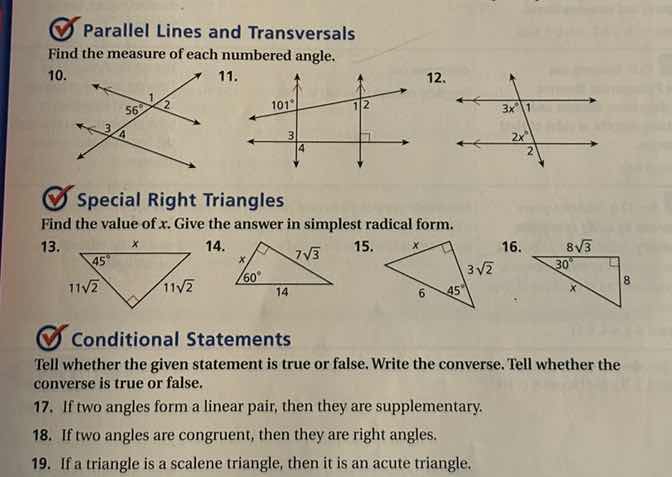
parallel lines and transversals
find the measure of each numbered angle.
10.
11.
12.
special right triangles
find the value of x. give the answer in simplest radical form.
13.
14.
15.
16.
conditional statements
tell whether the given statement is true or false. write the converse. tell whether the
converse is true or false.
- if two angles form a linear pair, then they are supplementary.
- if two angles are congruent, then they are right angles.
- if a triangle is a scalene triangle, then it is an acute triangle.
Let's solve these problems one by one. We'll start with the "Parallel Lines and Transversals" section (problem 10), then "Special Right Triangles" (problem 13 as an example), and finally "Conditional Statements" (problem 17 as an example).
Problem 10: Parallel Lines and Transversals
We have two parallel lines cut by a transversal, forming angles. Let's analyze the numbered angles (∠1, ∠2, ∠3, ∠4) with a given 56° angle.
Step 1: Identify ∠1
∠1 and the 56° angle are linear pairs (they form a straight line). Linear pairs are supplementary (sum to 180°).
Step 2: Identify ∠2
∠2 and the 56° angle are vertical angles (opposite angles formed by intersecting lines) or alternate interior angles? Wait, actually, ∠2 and the 56° angle are vertical angles? Wait, no—wait, the 56° angle and ∠2: let's check the diagram. If the 56° is adjacent to ∠2, maybe ∠2 is equal to 56°? Wait, no—wait, ∠1 and ∠2 are also a linear pair? Wait, no, maybe the 56° and ∠2 are vertical angles. Wait, let's re-examine.
Wait, the two lines are parallel, and the transversal crosses them. The 56° angle and ∠2: if the 56° is an acute angle, then ∠2 is equal to 56° (vertical angles or alternate interior angles). Wait, maybe ∠1 is supplementary to 56°, so ∠1 = 124°, ∠2 = 56° (vertical angle with the 56° angle), ∠3 = 124° (vertical angle with ∠1), and ∠4 = 56° (vertical angle with ∠2 or alternate interior).
Let’s confirm:
- ∠1: linear pair with 56° → \( 180 - 56 = 124^\circ \)
- ∠2: vertical angle with 56° → \( 56^\circ \) (or alternate interior, since lines are parallel)
- ∠3: vertical angle with ∠1 → \( 124^\circ \)
- ∠4: vertical angle with ∠2 → \( 56^\circ \)
Problem 13: Special Right Triangles (45-45-90 Triangle)
A 45-45-90 triangle has legs of equal length, and the hypotenuse is \( \text{leg} \times \sqrt{2} \).
Given: legs = \( 11\sqrt{2} \), find hypotenuse \( x \).
Step 1: Recall 45-45-90 formula
For a 45-45-90 triangle:
Step 2: Substitute the leg length
Here, leg = \( 11\sqrt{2} \). Wait, no—wait, the legs are \( 11\sqrt{2} \), so hypotenuse \( x \):
Wait, actually, if the legs are \( 11\sqrt{2} \), then:
Simplify: \( \sqrt{2} \times \sqrt{2} = 2 \), so:
Problem 17: Conditional Statements
Statement: If two angles form a linear pair, then they are supplementary.
Step 1: Determine if the original statement is true
A linear pair of angles are adjacent and form a straight line (180°). By definition, supplementary angles sum to 180°. So if two angles form a linear pair, they must sum to 180° (supplementary). Thus, the original statement is true.
Step 2: Write the converse
The converse of "If \( p \), then \( q \)" is "If \( q \), then \( p \)".
Original: \( p \): two angles form a linear pair; \( q \): they are supplementary.
Converse: If two angles are supplementary, then they form a linear pair.
Step 3: Determine if the converse is true
Supplementary angles sum to 180°, but they don’t have to be adjacent (e.g., two angles in different parts of a diagram that sum to 180° but aren’t adjacent). Thus, the converse is false (not all supplementary angles form a linear pair).
Summary of Answers (Selected Problems)
- Problem 10 (Angles):
\( \angle 1 = 124^\circ \), \( \angle 2 = 56^\circ \), \( \angle 3 = 124^\circ \), \( \angle 4 = 56^\circ \) (assuming standard parall…

Snap & solve any problem in the app
Get step-by-step solutions on Sovi AI
Photo-based solutions with guided steps
Explore more problems and detailed explanations
Let's solve these problems one by one. We'll start with the "Parallel Lines and Transversals" section (problem 10), then "Special Right Triangles" (problem 13 as an example), and finally "Conditional Statements" (problem 17 as an example).
Problem 10: Parallel Lines and Transversals
We have two parallel lines cut by a transversal, forming angles. Let's analyze the numbered angles (∠1, ∠2, ∠3, ∠4) with a given 56° angle.
Step 1: Identify ∠1
∠1 and the 56° angle are linear pairs (they form a straight line). Linear pairs are supplementary (sum to 180°).
Step 2: Identify ∠2
∠2 and the 56° angle are vertical angles (opposite angles formed by intersecting lines) or alternate interior angles? Wait, actually, ∠2 and the 56° angle are vertical angles? Wait, no—wait, the 56° angle and ∠2: let's check the diagram. If the 56° is adjacent to ∠2, maybe ∠2 is equal to 56°? Wait, no—wait, ∠1 and ∠2 are also a linear pair? Wait, no, maybe the 56° and ∠2 are vertical angles. Wait, let's re-examine.
Wait, the two lines are parallel, and the transversal crosses them. The 56° angle and ∠2: if the 56° is an acute angle, then ∠2 is equal to 56° (vertical angles or alternate interior angles). Wait, maybe ∠1 is supplementary to 56°, so ∠1 = 124°, ∠2 = 56° (vertical angle with the 56° angle), ∠3 = 124° (vertical angle with ∠1), and ∠4 = 56° (vertical angle with ∠2 or alternate interior).
Let’s confirm:
- ∠1: linear pair with 56° → \( 180 - 56 = 124^\circ \)
- ∠2: vertical angle with 56° → \( 56^\circ \) (or alternate interior, since lines are parallel)
- ∠3: vertical angle with ∠1 → \( 124^\circ \)
- ∠4: vertical angle with ∠2 → \( 56^\circ \)
Problem 13: Special Right Triangles (45-45-90 Triangle)
A 45-45-90 triangle has legs of equal length, and the hypotenuse is \( \text{leg} \times \sqrt{2} \).
Given: legs = \( 11\sqrt{2} \), find hypotenuse \( x \).
Step 1: Recall 45-45-90 formula
For a 45-45-90 triangle:
Step 2: Substitute the leg length
Here, leg = \( 11\sqrt{2} \). Wait, no—wait, the legs are \( 11\sqrt{2} \), so hypotenuse \( x \):
Wait, actually, if the legs are \( 11\sqrt{2} \), then:
Simplify: \( \sqrt{2} \times \sqrt{2} = 2 \), so:
Problem 17: Conditional Statements
Statement: If two angles form a linear pair, then they are supplementary.
Step 1: Determine if the original statement is true
A linear pair of angles are adjacent and form a straight line (180°). By definition, supplementary angles sum to 180°. So if two angles form a linear pair, they must sum to 180° (supplementary). Thus, the original statement is true.
Step 2: Write the converse
The converse of "If \( p \), then \( q \)" is "If \( q \), then \( p \)".
Original: \( p \): two angles form a linear pair; \( q \): they are supplementary.
Converse: If two angles are supplementary, then they form a linear pair.
Step 3: Determine if the converse is true
Supplementary angles sum to 180°, but they don’t have to be adjacent (e.g., two angles in different parts of a diagram that sum to 180° but aren’t adjacent). Thus, the converse is false (not all supplementary angles form a linear pair).
Summary of Answers (Selected Problems)
- Problem 10 (Angles):
\( \angle 1 = 124^\circ \), \( \angle 2 = 56^\circ \), \( \angle 3 = 124^\circ \), \( \angle 4 = 56^\circ \) (assuming standard parallel lines/transversal relationships).
- Problem 13 (45-45-90 Triangle):
\( x = 22 \)
- Problem 17 (Conditional Statement):
Original statement: True.
Converse: If two angles are supplementary, then they form a linear pair.
Converse: False.
If you need help with other problems (11, 12, 14–16, 18–19), let me know! I can walk you through each one.