QUESTION IMAGE
Question
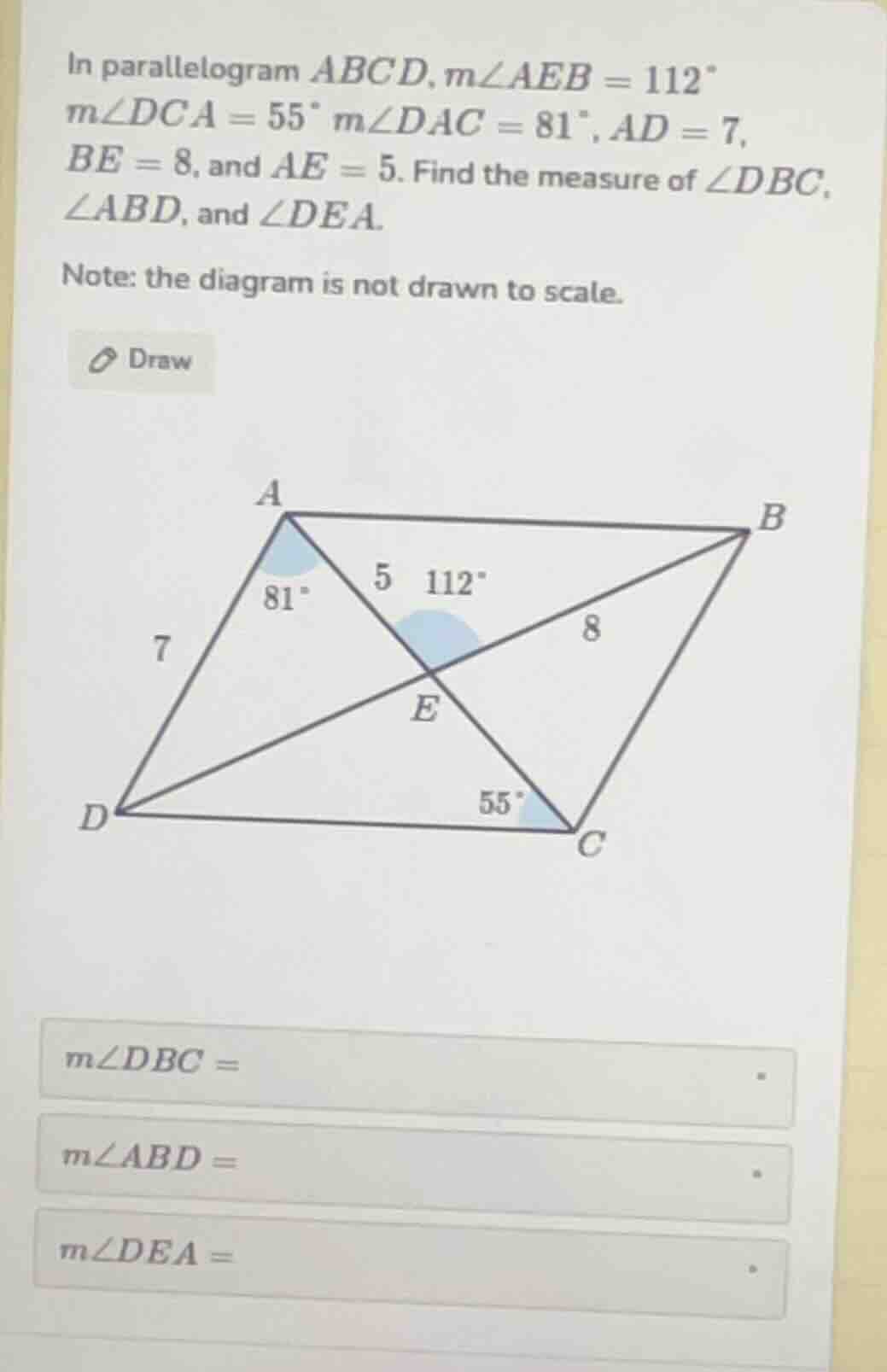
in parallelogram (abcd), (mangle aeb = 112^circ), (mangle dca = 55^circ), (mangle dac = 81^circ), (ad = 7), (be = 8), and (ae = 5). find the measure of (angle dbc), (angle abd), and (angle dea).
note: the diagram is not drawn to scale.
(mangle dbc =)
(mangle abd =)
(mangle dea =)
Step1: Find \( m\angle DBC \)
In parallelogram \(ABCD\), \(AD \parallel BC\), so \( \angle DAC = \angle BCA = 81^\circ \) (alternate interior angles). In \(\triangle BEC\), we know \( \angle DCA = 55^\circ \), but wait, actually, since \(AD \parallel BC\), \( \angle DAC = \angle BCA = 81^\circ \)? Wait, no, \( \angle DCA = 55^\circ \), and \(AD \parallel BC\), so \( \angle DAC \) and \( \angle BCA \) are alternate interior angles? Wait, \(AD \parallel BC\) and \(AC\) is a transversal, so \( \angle DAC = \angle BCA = 81^\circ \)? Wait, no, the given \( \angle DCA = 55^\circ \). Wait, maybe better to use triangle angle sum. Wait, in parallelogram \(ABCD\), \(AD = BC = 7\) (opposite sides of parallelogram are equal). Also, \(AD \parallel BC\), so \( \angle DAC = \angle BCA = 81^\circ \) (alternate interior angles). Now, to find \( \angle DBC \), we can look at \(\triangle BEC\)? Wait, no, maybe first find \( \angle ADB \) or use the fact that \(AB \parallel DC\), so \( \angle ABD = \angle CDB \). Wait, maybe start with \( \angle DBC \). Since \(AD \parallel BC\), \( \angle DAC = \angle BCA = 81^\circ \) (alternate interior angles). Wait, but \( \angle DCA = 55^\circ \), and in triangle \(ADC\), the sum of angles is \(180^\circ\). Wait, \( \angle DAC = 81^\circ \), \( \angle DCA = 55^\circ \), so \( \angle ADC = 180 - 81 - 55 = 44^\circ \). Since \(ABCD\) is a parallelogram, \( \angle ABC = \angle ADC = 44^\circ \)? Wait, no, opposite angles of parallelogram are equal, so \( \angle ADC = \angle ABC \), and consecutive angles are supplementary. Wait, maybe I made a mistake. Let's correct: In \(\triangle ADC\), angles are \( \angle DAC = 81^\circ \), \( \angle DCA = 55^\circ \), so \( \angle ADC = 180 - 81 - 55 = 44^\circ \). Then, since \(AD \parallel BC\), \( \angle ADC + \angle BCD = 180^\circ \) (consecutive angles of parallelogram are supplementary), so \( \angle BCD = 180 - 44 = 136^\circ \). But \( \angle DCA = 55^\circ \), so \( \angle BCA = \angle BCD - \angle DCA = 136 - 55 = 81^\circ \), which matches the alternate interior angle from \(AD \parallel BC\) (since \( \angle DAC = 81^\circ \) and \( \angle BCA = 81^\circ \), alternate interior angles, so \(AD \parallel BC\) holds, which it does in a parallelogram). Now, to find \( \angle DBC \), we can use the fact that \(AD \parallel BC\), so \( \angle ADB = \angle DBC \) (alternate interior angles, since \(BD\) is a transversal). Wait, in \(\triangle ADE\), we know \( \angle DAC = 81^\circ \), \(AE = 5\), \(AD = 7\), but maybe we can find \( \angle ADE \) first. Wait, no, let's look at \( \angle AEB = 112^\circ \), which is a vertical angle with \( \angle DEC \), so \( \angle DEC = 112^\circ \). Also, \( \angle AEB \) and \( \angle DEA \) are supplementary, so \( \angle DEA = 180 - 112 = 68^\circ \). Wait, that's a simpler step. Let's do that first for \( \angle DEA \).
Step2: Find \( m\angle DEA \)
\( \angle AEB \) and \( \angle DEA \) are adjacent angles forming a linear pair, so they are supplementary. Thus, \( m\angle DEA = 180^\circ - m\angle AEB \).
Given \( m\angle AEB = 112^\circ \), so \( m\angle DEA = 180 - 112 = 68^\circ \).
Step3: Find \( m\angle DBC \)
In parallelogram \(ABCD\), \(AD \parallel BC\), so \( \angle DAC = \angle BCA = 81^\circ \) (alternate interior angles, since \(AC\) is a transversal). Now, consider \(\triangle BEC\)? Wait, no, let's look at \( \angle ADB \) and \( \angle DBC \). Since \(AD \parallel BC\), \( \angle ADB = \angle DBC \) (alternate interior angles, \(BD\) is transversal). To find \( \angle ADB \), we can use \(\triangle ADE\).…

Snap & solve any problem in the app
Get step-by-step solutions on Sovi AI
Photo-based solutions with guided steps
Explore more problems and detailed explanations
\( m\angle DBC = 31^\circ \)
\( m\angle ABD = 13^\circ \)
\( m\angle DEA = 68^\circ \)