QUESTION IMAGE
Question
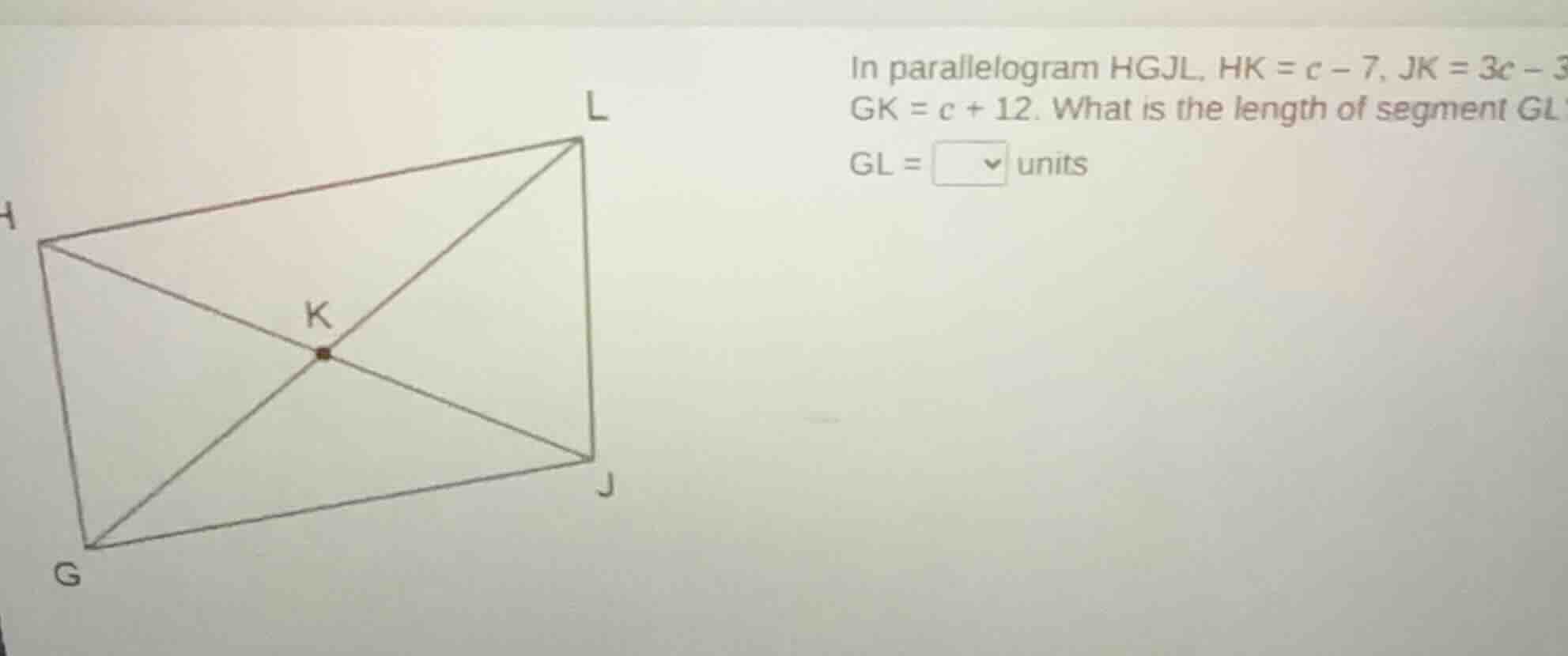
in parallelogram hgjl, hk = c - 7, jk = 3c - 3, gk = c + 12. what is the length of segment gl? gl = units
Step1: Recall parallelogram diagonal property
In a parallelogram, diagonals bisect each other. So, \( HK = JK \) (wait, no, actually in parallelogram \( HGJL \), diagonals \( HJ \) and \( GL \) bisect each other at \( K \), so \( HK = JK \)? Wait, no, looking at the diagram, \( HJ \) and \( GL \) are diagonals, intersecting at \( K \). So \( HK = JK \)? Wait, no, the problem says \( HK = c - 7 \), \( JK = 3c - 3 \)? Wait, maybe a typo? Wait, no, maybe \( HJ \) and \( GL \) are diagonals, so \( HK = JK \)? Wait, no, in a parallelogram, diagonals bisect each other, so \( HK = JK \)? Wait, no, \( HJ \) is a diagonal, so \( HK = JK \)? Wait, no, \( H \) to \( K \) to \( J \), so \( HK = JK \). Wait, but the problem also has \( GK = c + 12 \). Wait, maybe \( GL \) is a diagonal, so \( GK = LK \), and \( GL = GK + LK = 2 \times GK \). But first, we need to find \( c \) using the fact that diagonals bisect each other, so \( HK = JK \)? Wait, no, \( HJ \) and \( GL \) are diagonals, so \( HK = JK \) (since \( K \) is the midpoint of \( HJ \)) and \( GK = LK \) (since \( K \) is the midpoint of \( GL \)). Wait, but the problem states \( HK = c - 7 \), \( JK = 3c - 3 \). Wait, that must mean \( HK = JK \), so set them equal:
\( c - 7 = 3c - 3 \)
Step2: Solve for \( c \)
\( c - 7 = 3c - 3 \)
Subtract \( c \) from both sides:
\( -7 = 2c - 3 \)
Add 3 to both sides:
\( -4 = 2c \)
Divide by 2:
\( c = -2 \)
Wait, that can't be right, because \( GK = c + 12 \), if \( c = -2 \), \( GK = 10 \), but let's check again. Wait, maybe I mixed up the diagonals. Wait, in parallelogram \( HGJL \), the diagonals are \( HJ \) and \( GL \), intersecting at \( K \). So \( HK = JK \) (midpoint of \( HJ \)) and \( GK = LK \) (midpoint of \( GL \)). But the problem says \( HK = c - 7 \), \( JK = 3c - 3 \). Wait, maybe that's a mistake, and it's \( HK = c - 7 \), \( KJ = 3c - 3 \), but no, \( HK = KJ \). Wait, maybe the other diagonal: \( GK = c + 12 \), and \( GL = 2 \times GK \). But first, solve for \( c \) using \( HK = JK \):
\( c - 7 = 3c - 3 \)
\( -7 + 3 = 3c - c \)
\( -4 = 2c \)
\( c = -2 \)
Then \( GK = c + 12 = -2 + 12 = 10 \)
Then \( GL = 2 \times GK = 2 \times 10 = 20 \)
Wait, but let's check again. Wait, maybe the diagonals are \( HJ \) and \( GL \), so \( HK = JK \) (midpoint of \( HJ \)) and \( GK = LK \) (midpoint of \( GL \)). So \( HK = JK \) gives \( c - 7 = 3c - 3 \), solving gives \( c = -2 \), then \( GK = -2 + 12 = 10 \), so \( GL = 2 \times 10 = 20 \). That seems to work.

Snap & solve any problem in the app
Get step-by-step solutions on Sovi AI
Photo-based solutions with guided steps
Explore more problems and detailed explanations
20