QUESTION IMAGE
Question
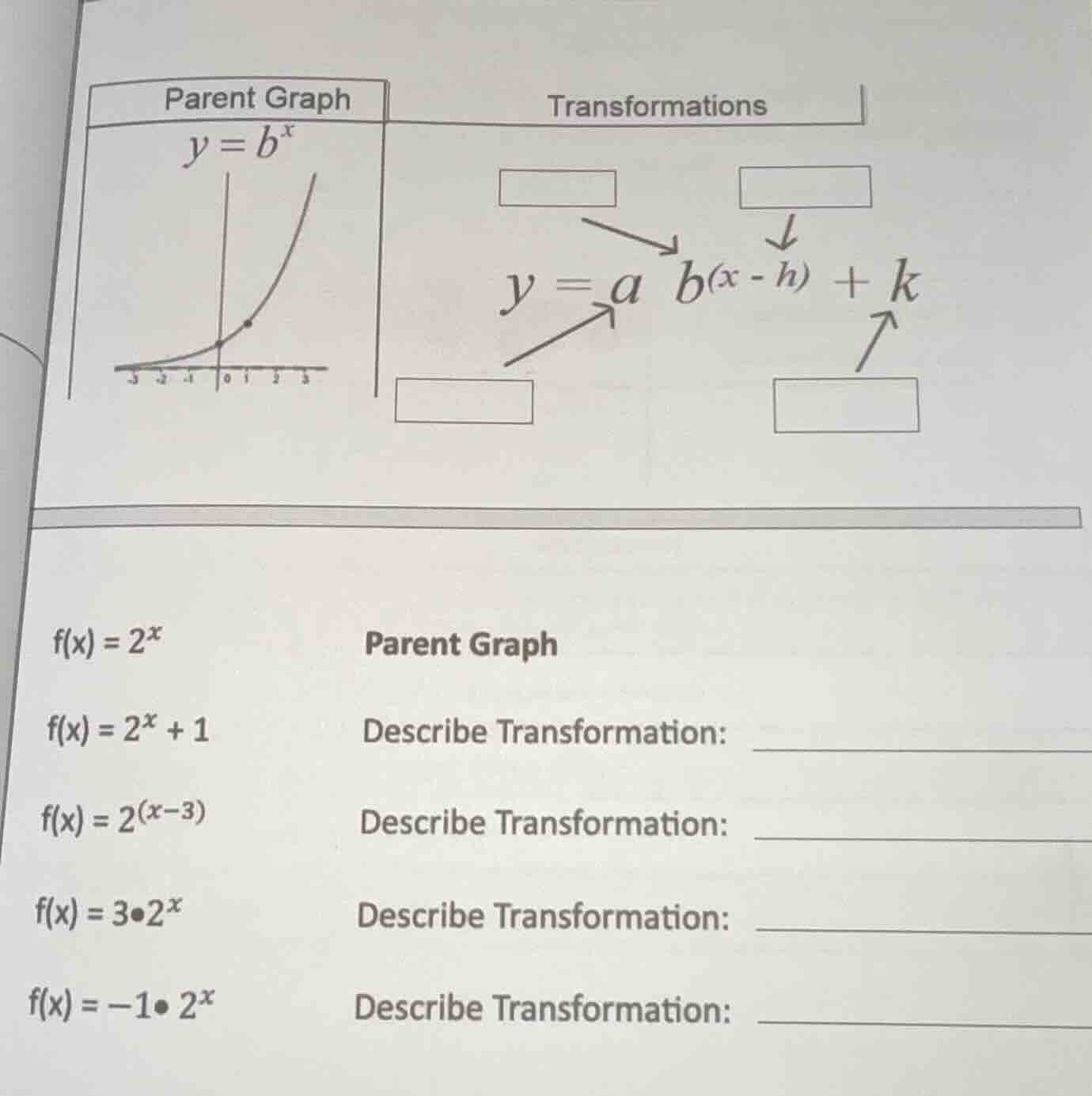
parent graph\
y = b^x\
transformations\
y = a b^(x - h) + k\
f(x) = 2^x\\t\tparent graph\
f(x) = 2^x + 1\tdescribe transformation: \underline{\qquad}\
f(x) = 2^(x - 3)\tdescribe transformation: \underline{\qquad}\
f(x) = 3\bullet 2^x\tdescribe transformation: \underline{\qquad}\
f(x) = -1\bullet 2^x\tdescribe transformation: \underline{\qquad}
For the transformation formula \( y = a \cdot b^{(x - h)} + k \):
- The box above \( b^{(x - h)} \) corresponds to Horizontal Shift (h units), because the \( (x - h) \) inside the exponent affects the horizontal movement (right if \( h>0 \), left if \( h<0 \)).
- The box above \( +k \) corresponds to Vertical Shift (k units), because adding \( k \) outside the exponential function moves the graph up (if \( k>0 \)) or down (if \( k<0 \)).
- The box below \( a \) corresponds to Vertical Stretch/Reflection (a times), because the coefficient \( a \) affects the vertical scaling (stretch if \( |a|>1 \), compression if \( 0<|a|<1 \)) and reflection over the x - axis if \( a<0 \).
- The box below \( k \) also corresponds to Vertical Shift (k units) (same as the one above \( +k \), just emphasizing the vertical shift from the \( +k \) term).
For each function transformation:
- \( f(x)=2^{x}+1 \):
Step1: Recall vertical shift rule
For a function \( y = f(x)+k \), if \( k>0 \), the graph shifts up by \( k \) units. Here, \( f(x)=2^{x} \) and the new function is \( f(x)=2^{x}+1 \), so we compare with \( y = f(x)+k \) where \( k = 1 \).
Step1: Recall horizontal shift rule
For a function \( y = f(x - h) \), if \( h>0 \), the graph shifts right by \( h \) units. Here, \( f(x)=2^{x} \) and the new function is \( f(x)=2^{(x - 3)} \), so we compare with \( y = f(x - h) \) where \( h = 3 \).
Step1: Recall vertical stretch rule
For a function \( y = a\cdot f(x) \), if \( |a|>1 \), the graph is vertically stretched by a factor of \( |a| \). Here, \( f(x)=2^{x} \) and the new function is \( f(x)=3\cdot2^{x} \), so we compare with \( y = a\cdot f(x) \) where \( a = 3 \) and \( |3|>1 \).

Snap & solve any problem in the app
Get step-by-step solutions on Sovi AI
Photo-based solutions with guided steps
Explore more problems and detailed explanations
Vertical shift up by 1 unit.
- \( f(x)=2^{(x - 3)} \):