QUESTION IMAGE
Question
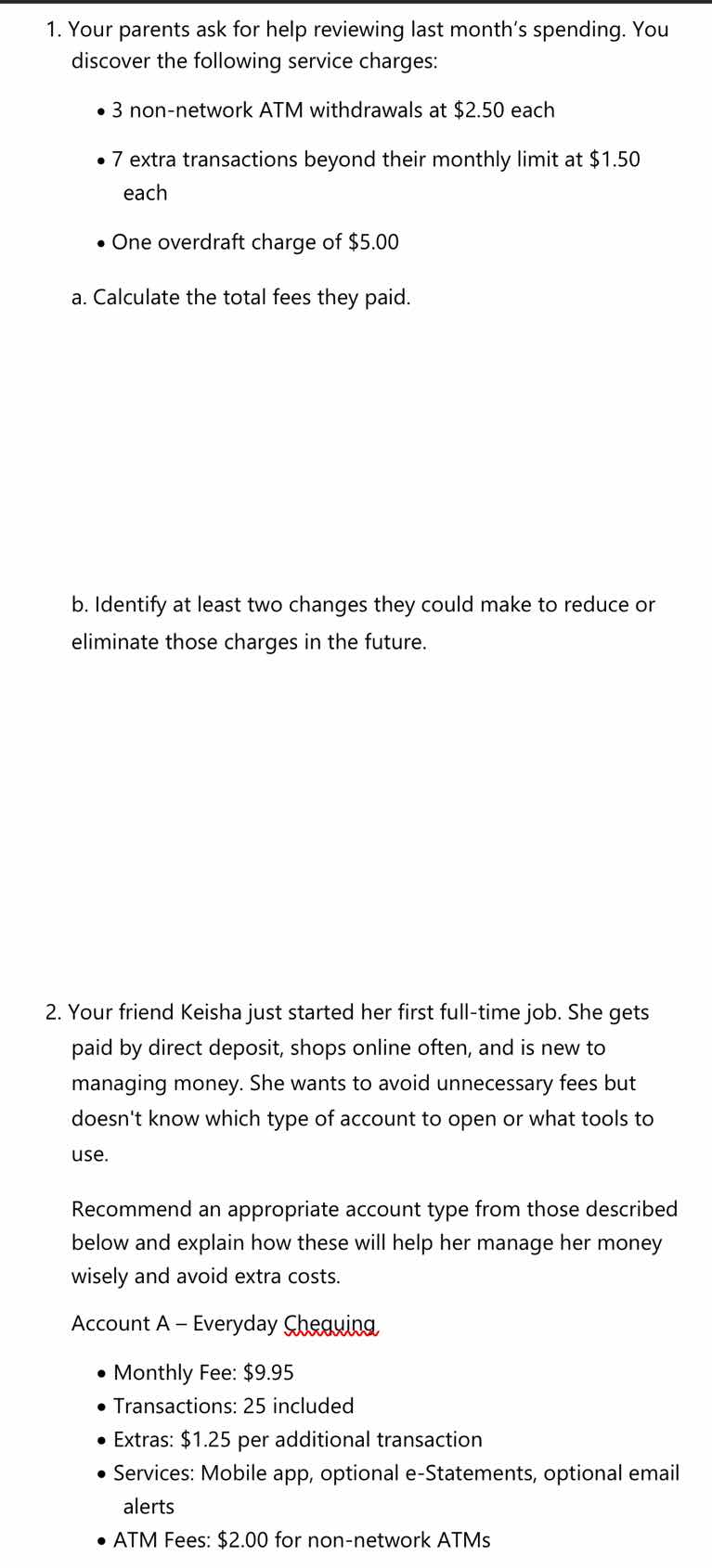
- your parents ask for help reviewing last month’s spending. you discover the following service charges: - 3 non - network atm withdrawals at $2.50 each - 7 extra transactions beyond their monthly limit at $1.50 each - one overdraft charge of $5.00 a. calculate the total fees they paid. b. identify at least two changes they could make to reduce or eliminate those charges in the future. 2. your friend keisha just started her first full - time job. she gets paid by direct deposit, shops online often, and is new to managing money. she wants to avoid unnecessary fees but doesnt know which type of account to open or what tools to use. recommend an appropriate account type from those described below and explain how these will help her manage her money wisely and avoid extra costs. account a – everyday chequing - monthly fee: $9.95 - transactions: 25 included - extras: $1.25 per additional transaction - services: mobile app, optional e - statements, optional email alerts - atm fees: $2.00 for non - network atms
Step1: Calculate ATM withdrawal fees
$3 \times 2.50 = 7.50$
Step2: Calculate extra transaction fees
$7 \times 1.50 = 10.50$
Step3: Sum all fees
$7.50 + 10.50 + 5.00 = 23.00$
Keisha is new to money management, uses direct deposit, and shops online often. The Everyday Chequing account fits her needs: it includes 25 monthly transactions (sufficient for regular online shopping and direct deposit), offers a mobile app for easy tracking of spending to avoid extra transaction fees, and optional alerts to help her monitor her balance and avoid overdrafts. Non-network ATM fees can be avoided by using in-network machines, and e-statements help her stay organized without extra costs.

Snap & solve any problem in the app
Get step-by-step solutions on Sovi AI
Photo-based solutions with guided steps
Explore more problems and detailed explanations
a. $\$23.00$
b. 1. Use only in-network ATMs to avoid non-network withdrawal fees.
- Track monthly transactions to stay under the limit and avoid extra transaction charges; maintain a buffer in the account to prevent overdraft fees.
---