QUESTION IMAGE
Question
part b
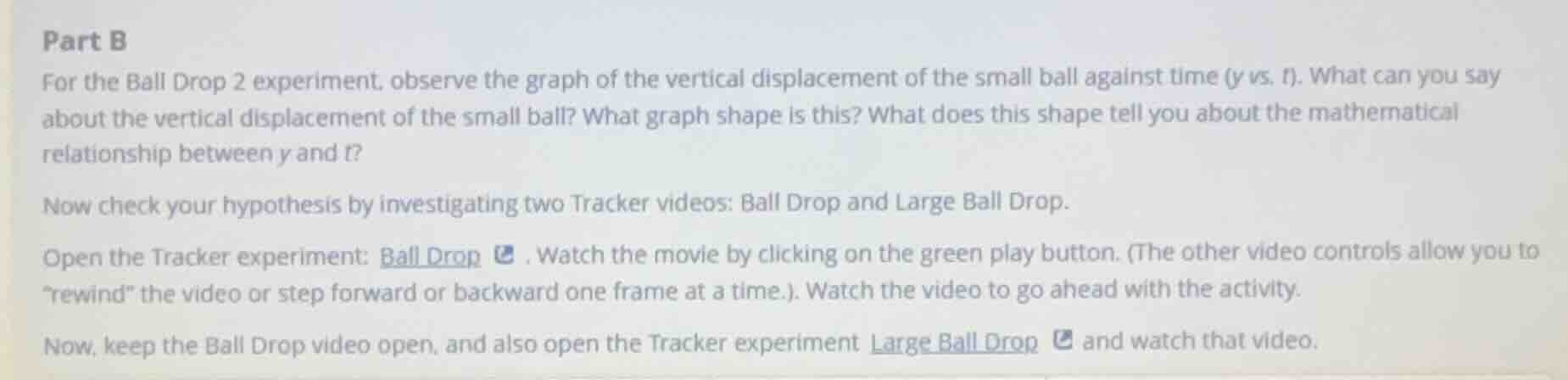
for the ball drop 2 experiment, observe the graph of the vertical displacement of the small ball against time (y vs. t). what can you say about the vertical displacement of the small ball? what graph shape is this? what does this shape tell you about the mathematical relationship between y and t?
now check your hypothesis by investigating two tracker videos: ball drop and large ball drop.
open the tracker experiment: ball drop. watch the movie by clicking on the green play button. (the other video controls allow you to “rewind” the video or step forward or backward one frame at a time.). watch the video to go ahead with the activity.
now, keep the ball drop video open, and also open the tracker experiment large ball drop and watch that video.
- Vertical Displacement of the Small Ball: In a free - fall (ball drop) experiment, the ball is accelerating downwards due to gravity (assuming negligible air resistance). So, the vertical displacement \(y\) (measured from the initial position, with downward as positive or negative depending on the coordinate system) increases (or becomes more negative) at an increasing rate as time \(t\) increases.
- Graph Shape: The graph of vertical displacement (\(y\)) versus time (\(t\)) for a freely falling object is a parabola. This is because the kinematic equation for vertical displacement in free - fall is \(y = y_0+v_0t+\frac{1}{2}at^2\). If the ball is dropped from rest (\(v_0 = 0\)) and we take \(y_0 = 0\) (initial position) and \(a=-g\) (acceleration due to gravity, negative if upward is positive) or \(a = g\) (positive if downward is positive), the equation becomes \(y=\frac{1}{2}gt^2\) (or \(y =-\frac{1}{2}gt^2\) depending on the coordinate system), which is the equation of a parabola.
- Mathematical Relationship between \(y\) and \(t\): The relationship between \(y\) and \(t\) is a quadratic relationship. From the equation of motion for free - fall, \(y\) is proportional to the square of \(t\) (i.e., \(y\propto t^{2}\)) when the initial velocity \(v_0 = 0\). This is because the equation \(y=\frac{1}{2}at^{2}\) (for \(v_0 = 0\)) is a second - degree polynomial in \(t\).
When we check the Tracker videos (Ball Drop and Large Ball Drop), we should observe that regardless of the mass of the ball (assuming air resistance is still negligible, which is a good approximation for relatively small and dense balls over short distances), the graph of \(y\) vs. \(t\) is a parabola, confirming the quadratic relationship between displacement and time in free - fall.

Snap & solve any problem in the app
Get step-by-step solutions on Sovi AI
Photo-based solutions with guided steps
Explore more problems and detailed explanations
- Vertical Displacement: Increases (or changes in magnitude) at an increasing rate as time increases (due to gravitational acceleration).
- Graph Shape: Parabola.
- Mathematical Relationship: Quadratic relationship (\(y\) is proportional to \(t^{2}\), e.g., \(y=\frac{1}{2}gt^{2}\) for free - fall from rest).