QUESTION IMAGE
Question
part b
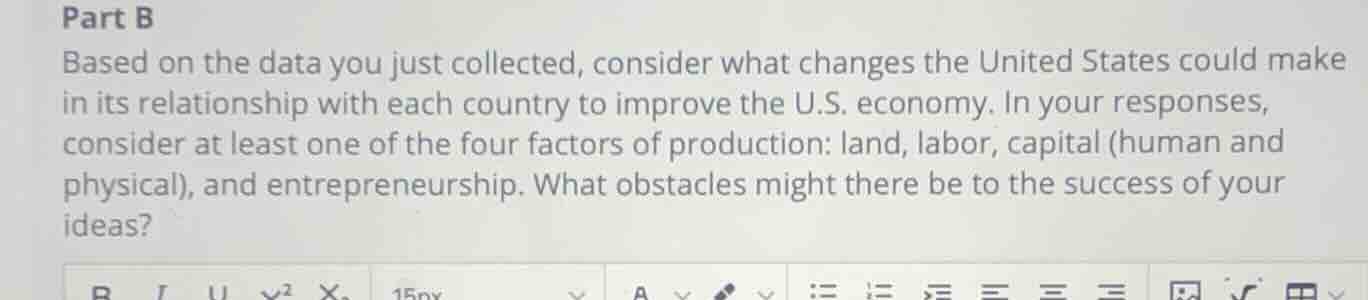
based on the data you just collected, consider what changes the united states could make in its relationship with each country to improve the u.s. economy. in your responses, consider at least one of the four factors of production: land, labor, capital (human and physical), and entrepreneurship. what obstacles might there be to the success of your ideas?
To answer this, we can take a country like China (a major trading partner of the US) as an example:
Step 1: Identify a change to improve the US economy (focus on a factor of production)
Let's focus on the "capital (physical)" factor. The US could increase imports of affordable manufactured goods (like electronics components, machinery parts) from China. This would reduce production costs for US businesses (as they can get cheaper inputs), freeing up capital to invest in other areas like research and development (which boosts entrepreneurship and human capital in the long run).
Step 2: Analyze obstacles to this idea
- Trade Policy Obstacles: The US - China trade relationship has been strained by tariffs. If the US imposes tariffs on Chinese goods, the cost of imports increases, negating the benefit of cheaper inputs. For example, if the US places a 25% tariff on Chinese machinery parts, US manufacturers will have to pay more, reducing the cost - saving advantage.
- Geopolitical Tensions: Geopolitical issues (like disputes over technology, territorial claims) can lead to restrictions on trade. China might limit exports of certain high - tech components to the US, which would disrupt the US's supply chain and make it hard to get the needed physical capital.
- Domestic Political Resistance: Domestic industries that compete with Chinese imports (like some manufacturing sectors in the US) might lobby against increased imports, fearing job losses. Politicians may be reluctant to support policies that seem to hurt domestic industries, even if they benefit the economy overall in the long term.
If we take another country, say Mexico (focus on labor factor):
Step 1: Identify a change
The US could strengthen cross - border labor cooperation programs with Mexico. For example, create more programs that allow Mexican workers with specialized skills (like in agriculture, construction) to work temporarily in the US. This would address labor shortages in the US (improving the labor factor of production) and also provide remittance income to Mexico, which can be used to improve Mexico's education system (boosting human capital there, which can lead to better - skilled workers for future US - Mexico collaborations).
Step 2: Analyze obstacles
- Immigration Policy Issues: US immigration policies are often politically charged. There may be resistance from groups that oppose increased immigration (even temporary) due to concerns about job displacement for US workers (even if the jobs are in sectors with shortages) and cultural differences.
- Border Security Concerns: There are concerns about illegal immigration being mixed with legal temporary worker programs. Ensuring proper border security while facilitating legal labor movement is a complex task, and mismanagement could lead to public backlash.
- Mexican Labor Regulations: Mexico may have its own labor laws and union regulations that make it difficult to quickly mobilize and send workers to the US. Also, there could be concerns in Mexico about brain drain if too many skilled workers leave for the US, which might lead to restrictions on such programs.

Snap & solve any problem in the app
Get step-by-step solutions on Sovi AI
Photo-based solutions with guided steps
Explore more problems and detailed explanations
To answer this, we can take a country like China (a major trading partner of the US) as an example:
Step 1: Identify a change to improve the US economy (focus on a factor of production)
Let's focus on the "capital (physical)" factor. The US could increase imports of affordable manufactured goods (like electronics components, machinery parts) from China. This would reduce production costs for US businesses (as they can get cheaper inputs), freeing up capital to invest in other areas like research and development (which boosts entrepreneurship and human capital in the long run).
Step 2: Analyze obstacles to this idea
- Trade Policy Obstacles: The US - China trade relationship has been strained by tariffs. If the US imposes tariffs on Chinese goods, the cost of imports increases, negating the benefit of cheaper inputs. For example, if the US places a 25% tariff on Chinese machinery parts, US manufacturers will have to pay more, reducing the cost - saving advantage.
- Geopolitical Tensions: Geopolitical issues (like disputes over technology, territorial claims) can lead to restrictions on trade. China might limit exports of certain high - tech components to the US, which would disrupt the US's supply chain and make it hard to get the needed physical capital.
- Domestic Political Resistance: Domestic industries that compete with Chinese imports (like some manufacturing sectors in the US) might lobby against increased imports, fearing job losses. Politicians may be reluctant to support policies that seem to hurt domestic industries, even if they benefit the economy overall in the long term.
If we take another country, say Mexico (focus on labor factor):
Step 1: Identify a change
The US could strengthen cross - border labor cooperation programs with Mexico. For example, create more programs that allow Mexican workers with specialized skills (like in agriculture, construction) to work temporarily in the US. This would address labor shortages in the US (improving the labor factor of production) and also provide remittance income to Mexico, which can be used to improve Mexico's education system (boosting human capital there, which can lead to better - skilled workers for future US - Mexico collaborations).
Step 2: Analyze obstacles
- Immigration Policy Issues: US immigration policies are often politically charged. There may be resistance from groups that oppose increased immigration (even temporary) due to concerns about job displacement for US workers (even if the jobs are in sectors with shortages) and cultural differences.
- Border Security Concerns: There are concerns about illegal immigration being mixed with legal temporary worker programs. Ensuring proper border security while facilitating legal labor movement is a complex task, and mismanagement could lead to public backlash.
- Mexican Labor Regulations: Mexico may have its own labor laws and union regulations that make it difficult to quickly mobilize and send workers to the US. Also, there could be concerns in Mexico about brain drain if too many skilled workers leave for the US, which might lead to restrictions on such programs.