QUESTION IMAGE
Question
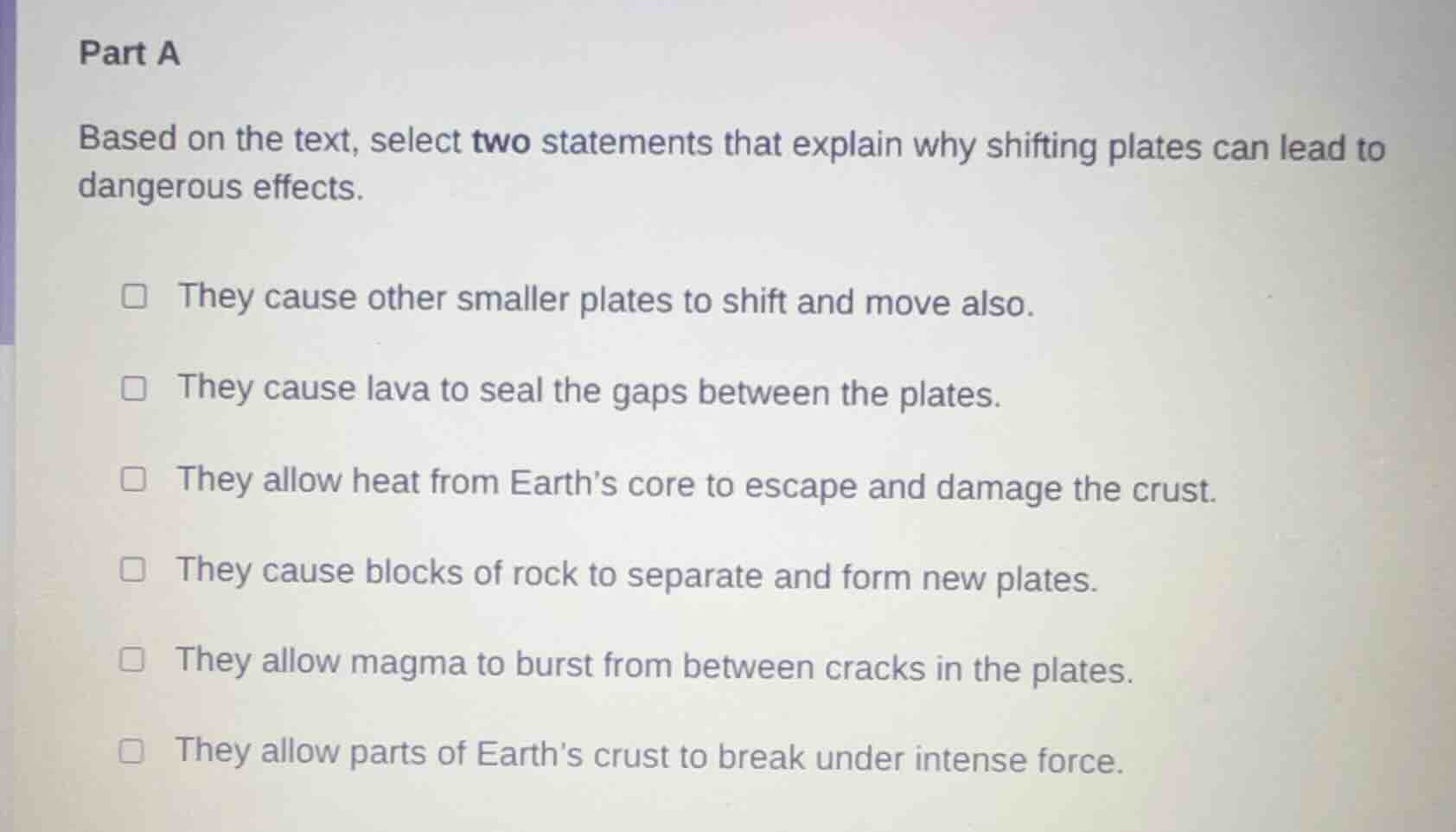
part a
based on the text, select two statements that explain why shifting plates can lead to dangerous effects.
□ they cause other smaller plates to shift and move also.
□ they cause lava to seal the gaps between the plates.
□ they allow heat from earth’s core to escape and damage the crust.
□ they cause blocks of rock to separate and form new plates.
□ they allow magma to burst from between cracks in the plates.
□ they allow parts of earth’s crust to break under intense force.
To solve this, we analyze each option:
- "They cause other smaller plates to shift and move also": Shifting of one plate causing others to shift can lead to cumulative dangerous movements (like triggering more seismic activity).
- "They cause lava to seal the gaps between the plates": Sealing gaps is not a dangerous effect, so eliminate.
- "They allow heat from Earth’s core to escape and damage the crust": Heat escaping damaging the crust is a dangerous effect.
- "They cause blocks of rock to separate and form new plates": Forming new plates isn't inherently dangerous, eliminate.
- "They allow magma to burst from between cracks in the plates": Magma bursting (volcanic activity) is dangerous.
- "They allow parts of Earth’s crust to break under intense force": Crust breaking (earthquakes) is dangerous.
Now, we need to pick two that explain dangerous effects. Common dangerous effects from plate shifting are volcanic eruptions (magma bursting) and earthquakes (crust breaking), or the heat damage and plate - triggering. But let's check the logical cause - effect for danger:
- "They allow magma to burst from between cracks in the plates": Magma bursting causes volcanic eruptions, which are dangerous.
- "They allow parts of Earth’s crust to break under intense force": Crust breaking causes earthquakes, which are dangerous.
Or another pair: "They allow heat from Earth’s core to escape and damage the crust" (heat damage) and "They allow parts of Earth’s crust to break under intense force" (earthquakes). But the most direct and common dangerous effects from plate tectonics are volcanic eruptions (magma burst) and earthquakes (crust break), or the heat damage and crust break. However, let's re - evaluate:
The key is to find statements that directly link plate shifting to dangerous effects.
- "They allow magma to burst from between cracks in the plates": Magma bursting is a dangerous effect (volcanoes).
- "They allow parts of Earth’s crust to break under intense force": Crust breaking is a dangerous effect (earthquakes).
Another possible pair: "They allow heat from Earth’s core to escape and damage the crust" (damage to crust is dangerous) and "They allow parts of Earth’s crust to break under intense force" (earthquakes). But let's see the options again.
Wait, the problem says "based on the text" (even though text is not provided, we use general plate tectonics knowledge). In general, two correct ones (among the valid dangerous - causing ones) are:
- They allow magma to burst from between cracks in the plates (causes volcanoes).
- They allow parts of Earth’s crust to break under intense force (causes earthquakes).
Or:
- They allow heat from Earth’s core to escape and damage the crust (heat damage to crust).
- They allow parts of Earth’s crust to break under intense force (earthquakes).
But let's check the options for the most appropriate two. Let's assume the text - based context (even without text, using scientific knowledge):
Plate shifting can cause:
- Earthquakes: "They allow parts of Earth’s crust to break under intense force" (correct, as plate movement creates stress that breaks the crust).
- Volcanic eruptions: "They allow magma to burst from between cracks in the plates" (correct, as plate movement creates cracks where magma can rise).
So these two are valid.

Snap & solve any problem in the app
Get step-by-step solutions on Sovi AI
Photo-based solutions with guided steps
Explore more problems and detailed explanations
- They allow magma to burst from between cracks in the plates.
- They allow parts of Earth’s crust to break under intense force.