QUESTION IMAGE
Question
part f
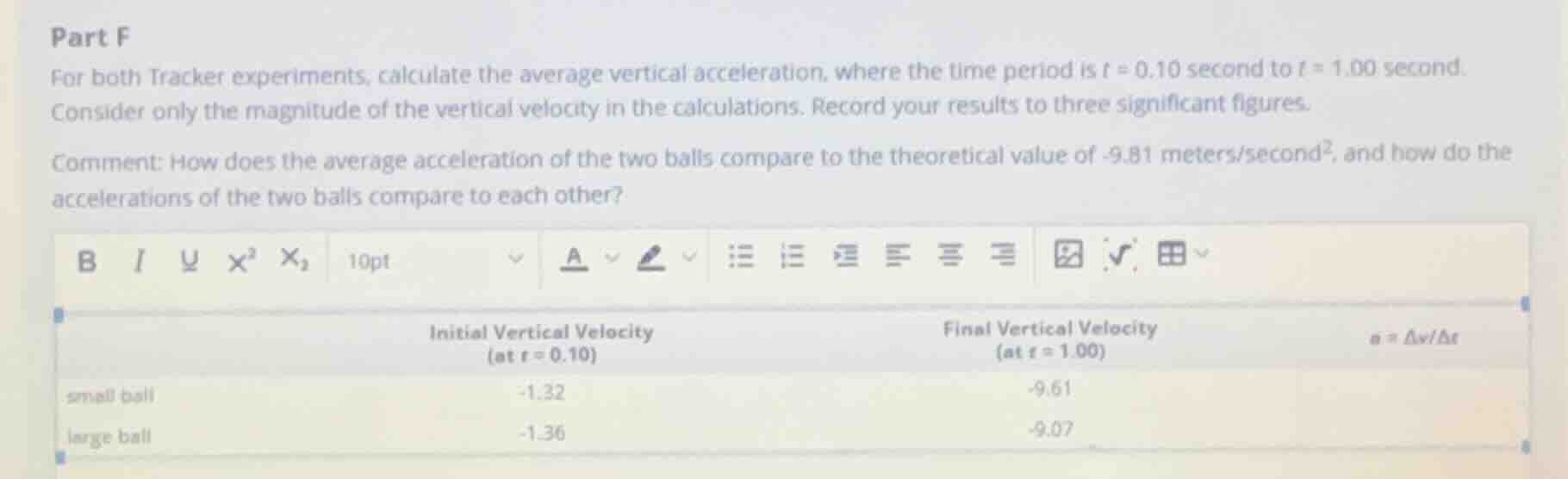
for both tracker experiments, calculate the average vertical acceleration, where the time period is t = 0.10 second to t = 1.00 second.
consider only the magnitude of the vertical velocity in the calculations. record your results to three significant figures.
comment: how does the average acceleration of the two balls compare to the theoretical value of -9.81 meters/second², and how do the
accelerations of the two balls compare to each other?
initial vertical velocity
(at t = 0.10)
final vertical velocity
(at t = 1.00)
a = δv/δt
small ball
-1.32
-9.61
large ball
-1.36
-9.07
Step1: Calculate time interval
The time period is from \( t = 0.10 \) s to \( t = 1.00 \) s. So, \( \Delta t=1.00 - 0.10 = 0.90 \) s.
Step2: Calculate average acceleration for small ball
The formula for acceleration is \( a=\frac{\Delta v}{\Delta t}=\frac{v_{final}-v_{initial}}{\Delta t} \). For small ball, \( v_{initial}=- 1.32 \) m/s, \( v_{final}=-9.61 \) m/s.
\( \Delta v=-9.61-(-1.32)=-9.61 + 1.32=-8.29 \) m/s.
\( a_{small}=\frac{-8.29}{0.90}\approx - 9.21 \) m/s² (magnitude is 9.21 m/s²).
Step3: Calculate average acceleration for large ball
For large ball, \( v_{initial}=-1.36 \) m/s, \( v_{final}=-9.07 \) m/s.
\( \Delta v=-9.07-(-1.36)=-9.07 + 1.36=-7.71 \) m/s.
\( a_{large}=\frac{-7.71}{0.90}\approx - 8.57 \) m/s² (magnitude is 8.57 m/s²).
Step4: Compare with theoretical value and between balls
The theoretical value of acceleration due to gravity is \( - 9.81 \) m/s² (magnitude 9.81 m/s²). Both average accelerations (magnitudes 9.21 and 8.57 m/s²) are less than the theoretical value. The small ball's average acceleration (magnitude 9.21 m/s²) is closer to the theoretical value than the large ball's (magnitude 8.57 m/s²), and the small ball has a greater average acceleration magnitude than the large ball.

Snap & solve any problem in the app
Get step-by-step solutions on Sovi AI
Photo-based solutions with guided steps
Explore more problems and detailed explanations
Average acceleration (magnitude) for small ball: \( 9.21 \) m/s², for large ball: \( 8.57 \) m/s². Both are less than \( 9.81 \) m/s²; small ball's acceleration is closer to \( 9.81 \) m/s² and greater than large ball's.