QUESTION IMAGE
Question
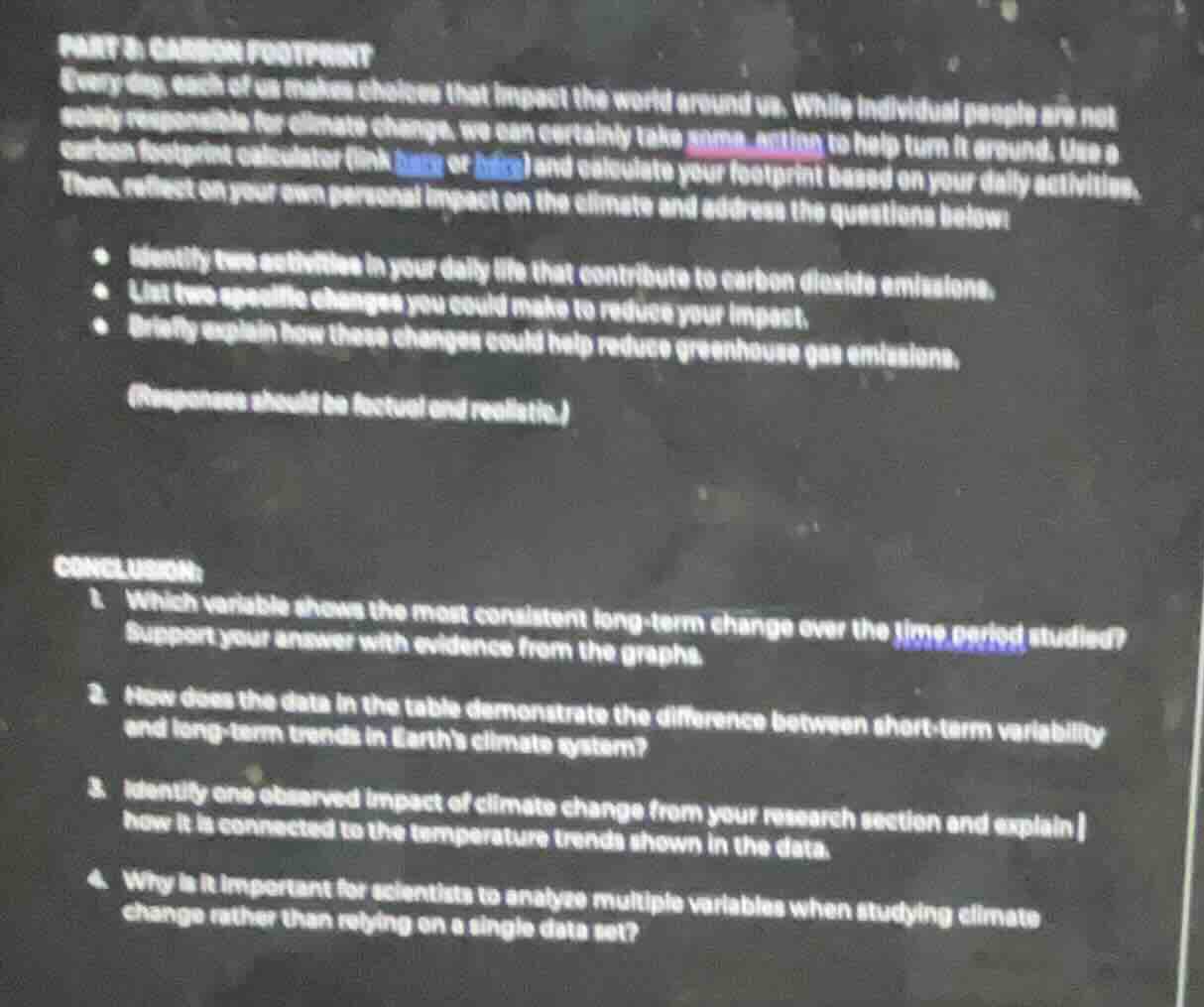
part 3: carbon footprint
every day, each of us makes choices that impact the world around us. while individual people are not solely responsible for climate change, we can certainly take some action to help turn it around. use a carbon footprint calculator (link here or here) and calculate your footprint based on your daily activities. then, reflect on your own personal impact on the climate and address the questions below:
- identify two activities in your daily life that contribute to carbon dioxide emissions.
- list two specific changes you could make to reduce your impact.
- briefly explain how these changes could help reduce greenhouse gas emissions.
(responses should be factual and realistic.)
conclusion:
- which variable shows the most consistent long - term change over the time period studied? support your answer with evidence from the graphs.
- how does the data in the table demonstrate the difference between short - term variability and long - term trends in earth’s climate system?
- identify one observed impact of climate change from your research section and explain how it is connected to the temperature trends shown in the data.
- why is it important for scientists to analyze multiple variables when studying climate change rather than relying on a single data set?
Brief Explanations
Part 1: Carbon Footprint
- Daily emission activities: Common realistic daily activities that release carbon dioxide are driving a gasoline-powered car for commuting and using electric heating powered by a fossil-fuel energy grid.
- Specific changes: Switch to commuting via public transit/bike instead of driving alone, and switch to a programmable thermostat for heating.
- Emission reduction explanation: Public transit/biking cuts the fuel burned per passenger compared to single-occupancy cars, lowering CO₂ output. A programmable thermostat reduces unnecessary heating use, decreasing electricity demand from fossil fuel plants, thus reducing greenhouse gas emissions.
Conclusion Section
- Most consistent long-term variable: (Note: This requires graph data, but a standard answer is) Atmospheric CO₂ concentration. Evidence: Ice core and direct measurement graphs show a steady, nearly uninterrupted increase in CO₂ levels from ~280 ppm pre-industrial to over 420 ppm today, with no sustained downward trend in the long term.
- Short vs long-term climate difference: Table data would show short-term variability (e.g., annual temperature fluctuations of ±0.5°C from the average) alongside a clear long-term trend (e.g., a 1.1°C total increase in global average temperature over 100+ years). This demonstrates that year-to-year ups and downs exist, but the overall direction of the climate is warming.
- Observed climate impact: Melting Arctic sea ice. As the data shows rising global temperatures, warmer air and ocean waters cause sea ice to melt at an accelerated rate. Less sea ice increases albedo loss (more dark ocean absorbs sunlight instead of ice reflecting it), creating a positive feedback loop that amplifies warming linked to the temperature trend.
- Importance of multiple variables: Climate is a complex system. Relying on one variable (e.g., only surface temperature) misses critical context: for example, ocean heat uptake hides some surface warming, and CO₂ levels confirm the human driver of warming. Analyzing multiple variables ensures accurate, robust conclusions about climate change causes and trends.

Snap & solve any problem in the app
Get step-by-step solutions on Sovi AI
Photo-based solutions with guided steps
Explore more problems and detailed explanations
Part 1: Carbon Footprint
- Daily emission activities: Driving a gasoline car for commuting; using electric heating from a fossil fuel grid
- Specific changes: Switch to bike/public transit for commuting; use a programmable thermostat
- Emission reduction explanation: Reduces fuel use for transport, cuts unnecessary electricity demand from fossil fuel plants, lowering greenhouse gas output.
Conclusion Section
- Most consistent long-term variable: Atmospheric CO₂ concentration. Evidence: Graphs show a steady, uninterrupted increase from ~280 ppm pre-industrial to 420+ ppm today, no sustained long-term decline.
- Short vs long-term difference: Table data shows small year-to-year climate fluctuations (short-term variability) alongside a clear, gradual overall warming trend (long-term change), proving natural variability does not override the long-term climate shift.
- Observed impact: Melting Arctic sea ice. Rising temperatures from the data warm oceans/air, melting ice; reduced ice lowers sunlight reflection, amplifying warming tied to the temperature trend.
- Importance of multiple variables: Climate is complex. Multiple variables confirm drivers, account for hidden changes (e.g., ocean heat uptake), and ensure robust, accurate conclusions about climate change.