QUESTION IMAGE
Question
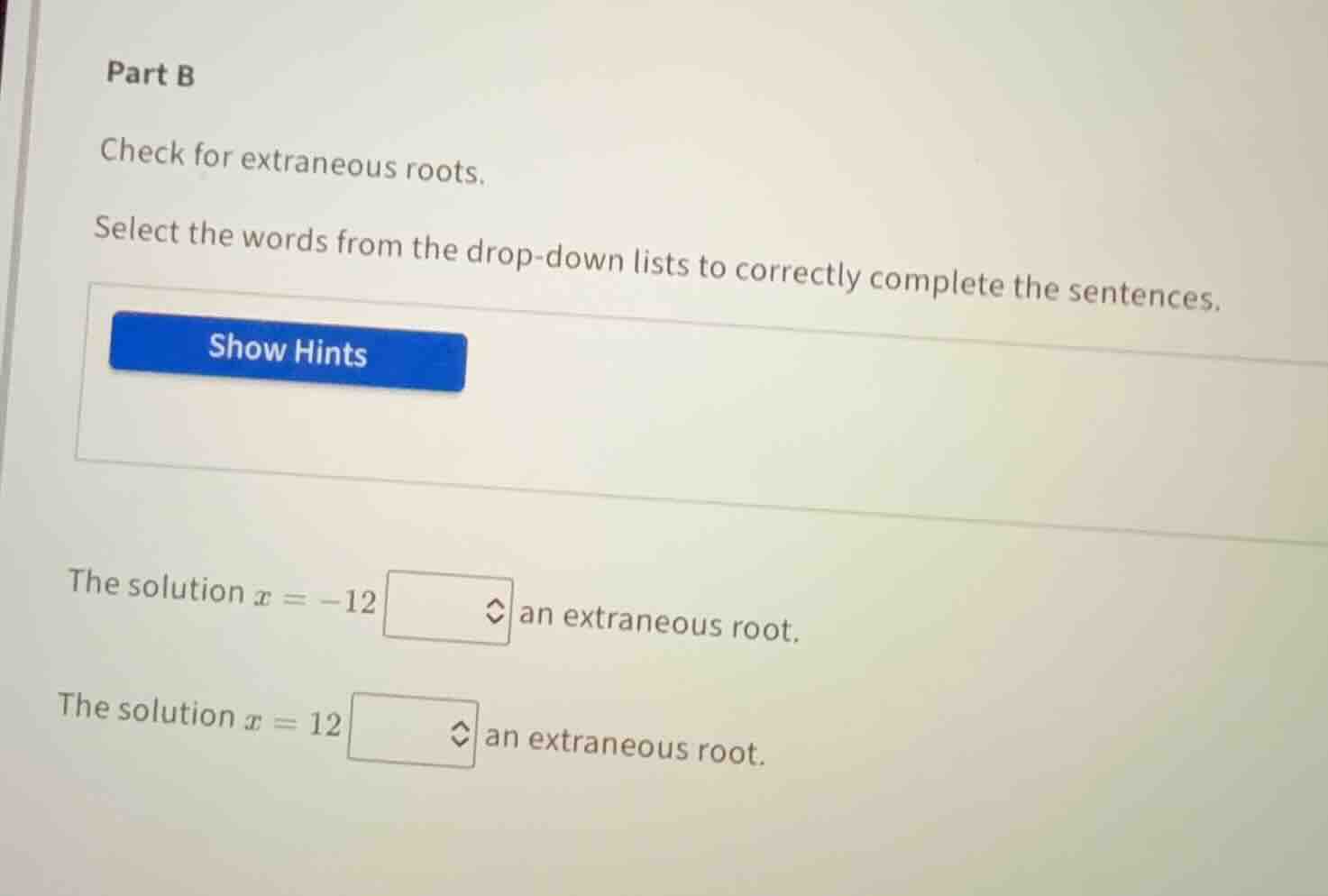
part b
check for extraneous roots.
select the words from the drop - down lists to correctly complete the sentences.
show hints
the solution ( x = - 12 ) (\boldsymbol{\text{drop - down}}) an extraneous root.
the solution ( x = 12 ) (\boldsymbol{\text{drop - down}}) an extraneous root.
To determine if a root is extraneous, we substitute it back into the original equation (which is not fully provided here, but typically for equations involving square roots or denominators, we check domain restrictions). For \( x = -12 \), if the original equation has a square root of \( x \) (or a denominator with \( x \)), \( x=-12 \) might be invalid (e.g., square root of a negative or division by zero). For \( x = 12 \), it's likely valid. So:
- For \( x = -12 \): If the original equation (e.g., with square roots or denominators) restricts \( x \geq 0 \) (or similar), \( x=-12 \) would not satisfy the original equation’s domain, so it is an extraneous root.
- For \( x = 12 \): It would satisfy the original equation’s domain and equation, so it is not an extraneous root.

Snap & solve any problem in the app
Get step-by-step solutions on Sovi AI
Photo-based solutions with guided steps
Explore more problems and detailed explanations
The solution \( x = -12 \) is an extraneous root.
The solution \( x = 12 \) is not an extraneous root.
(If the drop - down options are "is" and "is not", then:
The solution \( x = -12 \) \(\boldsymbol{\text{is}}\) an extraneous root.
The solution \( x = 12 \) \(\boldsymbol{\text{is not}}\) an extraneous root.)