QUESTION IMAGE
Question
part a: choose transformation $g(x) = f(x + 6)$ or $h(x) = f(x - 6)$. state which transformation you chose and explain what type of transformation it is. include the value of $k$ in your explanation (4 points)
part b: identify the vertices of both $f(x)$ and the transformed function from part a. what effect did the transformation have on the vertex? (6 points)
part c: for the transformed function in part a, on which interval is the function increasing? on which interval is the function decreasing? (8 points)
Part A
Let's choose \( g(x) = f(x + 6) \). This is a horizontal shift transformation. For a function \( y = f(x + k) \), when \( k>0 \), it represents a horizontal shift to the left by \( k \) units. Here, \( k = 6 \), so \( g(x) \) is \( f(x) \) shifted 6 units to the left. Alternatively, if we choose \( h(x)=f(x - 6) \), for \( y = f(x - k) \) with \( k = 6>0 \), it is a horizontal shift to the right by 6 units. Let's proceed with \( g(x)=f(x + 6) \) for illustration.
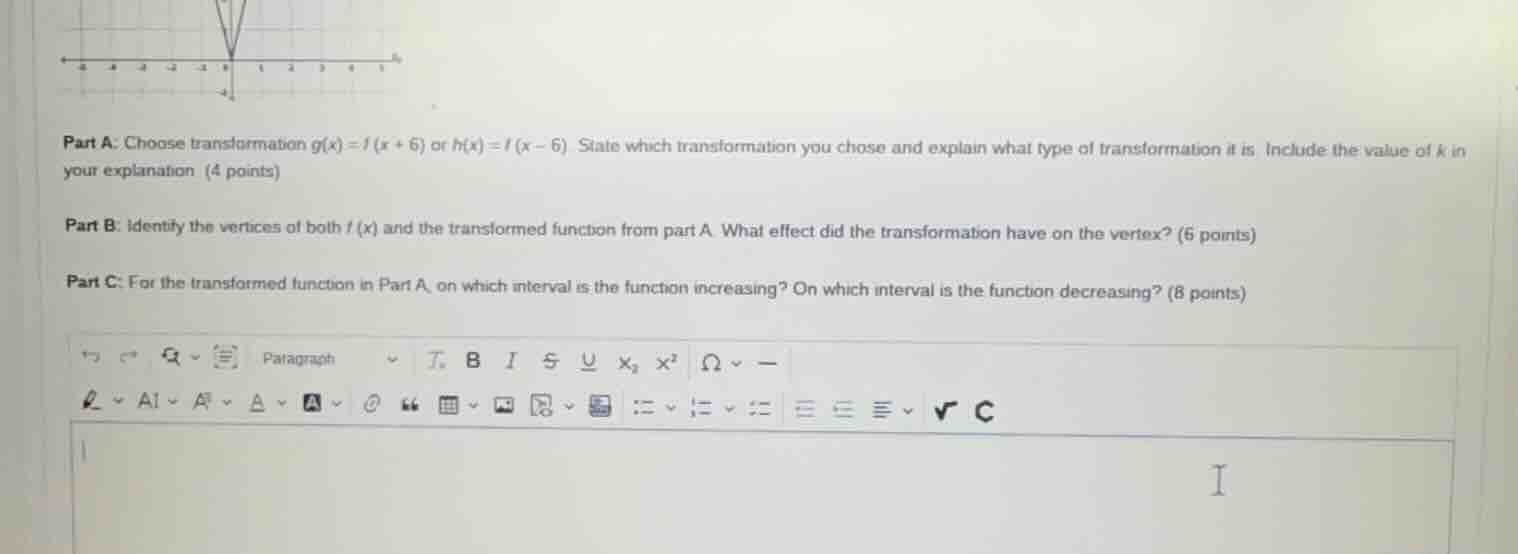
From the graph, the vertex of \( f(x) \) (assuming it's a V - shaped graph, like an absolute value function) is at \( (0,- 4) \). If we take \( g(x)=f(x + 6) \), using the rule for horizontal shifts, the vertex of \( g(x) \) will be at \( (0 - 6,-4)=(-6,-4) \). If we took \( h(x)=f(x - 6) \), the vertex would be at \( (0 + 6,-4)=(6,-4) \). The transformation (horizontal shift) moves the vertex horizontally by 6 units (left for \( g(x) \), right for \( h(x) \)) while the y - coordinate of the vertex remains the same.
Assuming \( f(x) \) is an absolute value function (since it has a vertex and a V - shape), the original function \( f(x) \) is increasing on \( (0,\infty) \) and decreasing on \( (-\infty,0) \). For \( g(x)=f(x + 6) \) (shifted 6 units left), the axis of symmetry (the line that divides the V - shape) is \( x=-6 \). So, the function \( g(x) \) is increasing on \( (-6,\infty) \) and decreasing on \( (-\infty,-6) \). If we had chosen \( h(x)=f(x - 6) \), the axis of symmetry is \( x = 6 \), so \( h(x) \) is increasing on \( (6,\infty) \) and decreasing on \( (-\infty,6) \).

Snap & solve any problem in the app
Get step-by-step solutions on Sovi AI
Photo-based solutions with guided steps
Explore more problems and detailed explanations
Chose \( g(x)=f(x + 6) \). It is a horizontal shift (left shift) transformation. For the form \( y = f(x + k) \), here \( k = 6 \), so the graph of \( f(x) \) is shifted 6 units to the left. (Or chose \( h(x)=f(x - 6) \), horizontal shift right, \( k = 6 \), shifted 6 units right)