QUESTION IMAGE
Question
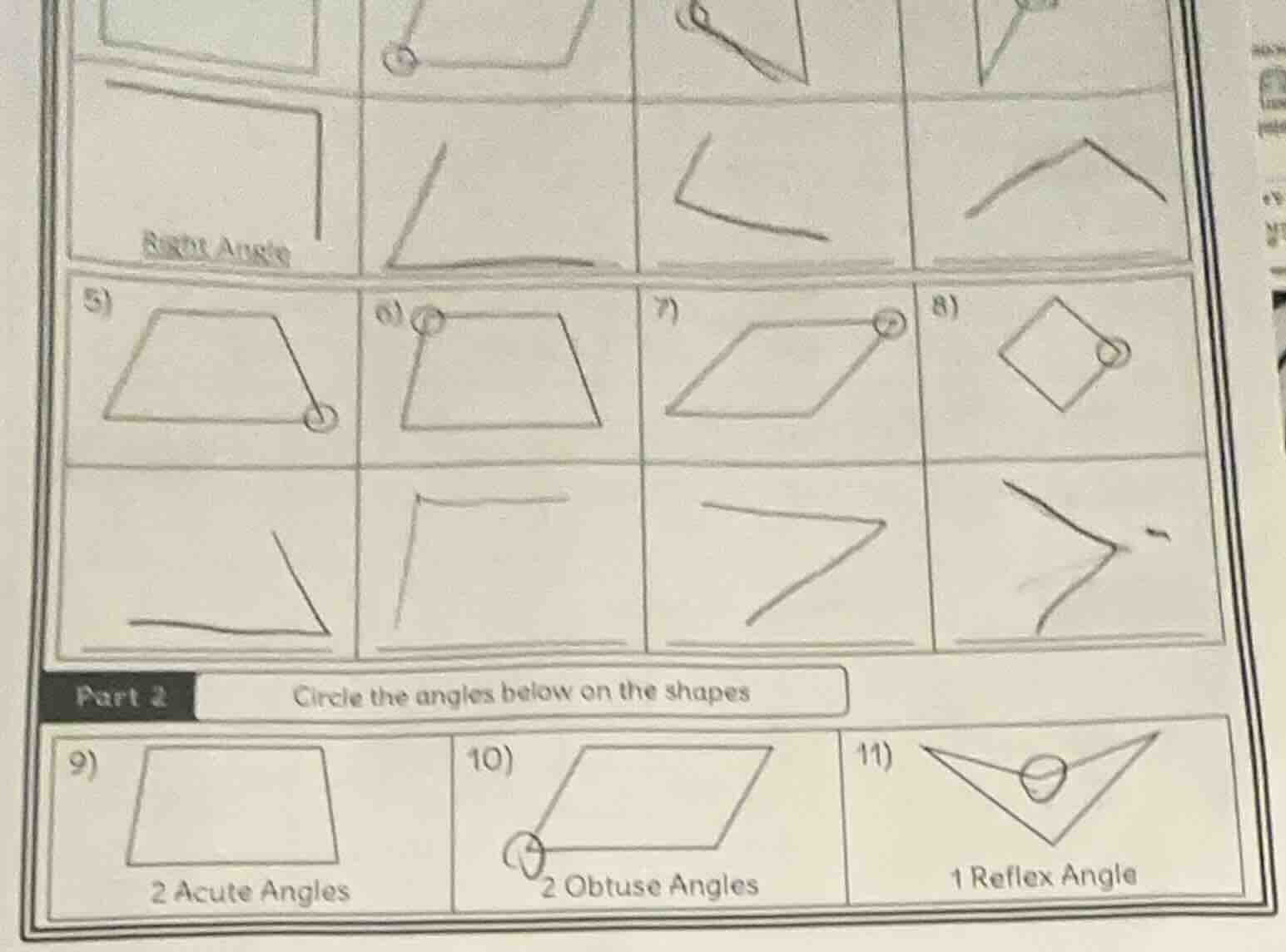
part 2 circle the angles below on the shapes
9)
2 acute angles
10)
2 obtuse angles
11)
1 reflex angle
Response
To solve the problem of identifying and circling the specified angles in the shapes, we follow these steps:
Step 1: Recall Angle Definitions
- Acute Angle: An angle less than \( 90^\circ \).
- Obtuse Angle: An angle greater than \( 90^\circ \) but less than \( 180^\circ \).
- Reflex Angle: An angle greater than \( 180^\circ \) but less than \( 360^\circ \).
Step 2: Analyze Each Shape
9) 2 Acute Angles in the Trapezoid
- A trapezoid has two parallel sides. In a typical trapezoid (isosceles or not), the two angles adjacent to the non - parallel sides:
- The angles formed with the shorter base (if applicable) or the non - parallel sides can be acute. We look for the two angles that are less than \( 90^\circ \) in the trapezoid and circle them.
10) 2 Obtuse Angles in the Parallelogram
- In a parallelogram, opposite angles are equal. Also, consecutive angles are supplementary (sum to \( 180^\circ \)).
- If we consider a parallelogram that is not a rectangle, two of the angles will be greater than \( 90^\circ \) (obtuse) and two will be less than \( 90^\circ \) (acute). We identify the two angles that are greater than \( 90^\circ \) and circle them.
11) 1 Reflex Angle in the Triangle - like Figure
- A reflex angle is formed around a point. In the given figure with a triangle and a circular arc, the reflex angle is the angle that is greater than \( 180^\circ \) and less than \( 360^\circ \) formed at the vertex where the circular arc is present. We circle this reflex angle.
For the purpose of providing a general answer about how to approach this problem:
Brief Explanations
To solve the problem of circling the specified angles:
- Recall the definitions of acute (\(<90^\circ\)), obtuse (\(90^\circ<\theta < 180^\circ\)) and reflex (\(180^\circ<\theta < 360^\circ\)) angles.
- For each shape:
- In the trapezoid (9), find two angles less than \(90^\circ\) and circle them.
- In the parallelogram (10), find two angles greater than \(90^\circ\) and circle them.
- In the triangle - like figure (11), find the angle greater than \(180^\circ\) and less than \(360^\circ\) and circle it.

Snap & solve any problem in the app
Get step-by-step solutions on Sovi AI
Photo-based solutions with guided steps
Explore more problems and detailed explanations
- For 9: Circle the two angles in the trapezoid that are less than \(90^\circ\).
- For 10: Circle the two angles in the parallelogram that are greater than \(90^\circ\) (and less than \(180^\circ\)).
- For 11: Circle the angle in the triangle - like figure that is greater than \(180^\circ\) (and less than \(360^\circ\)).