QUESTION IMAGE
Question
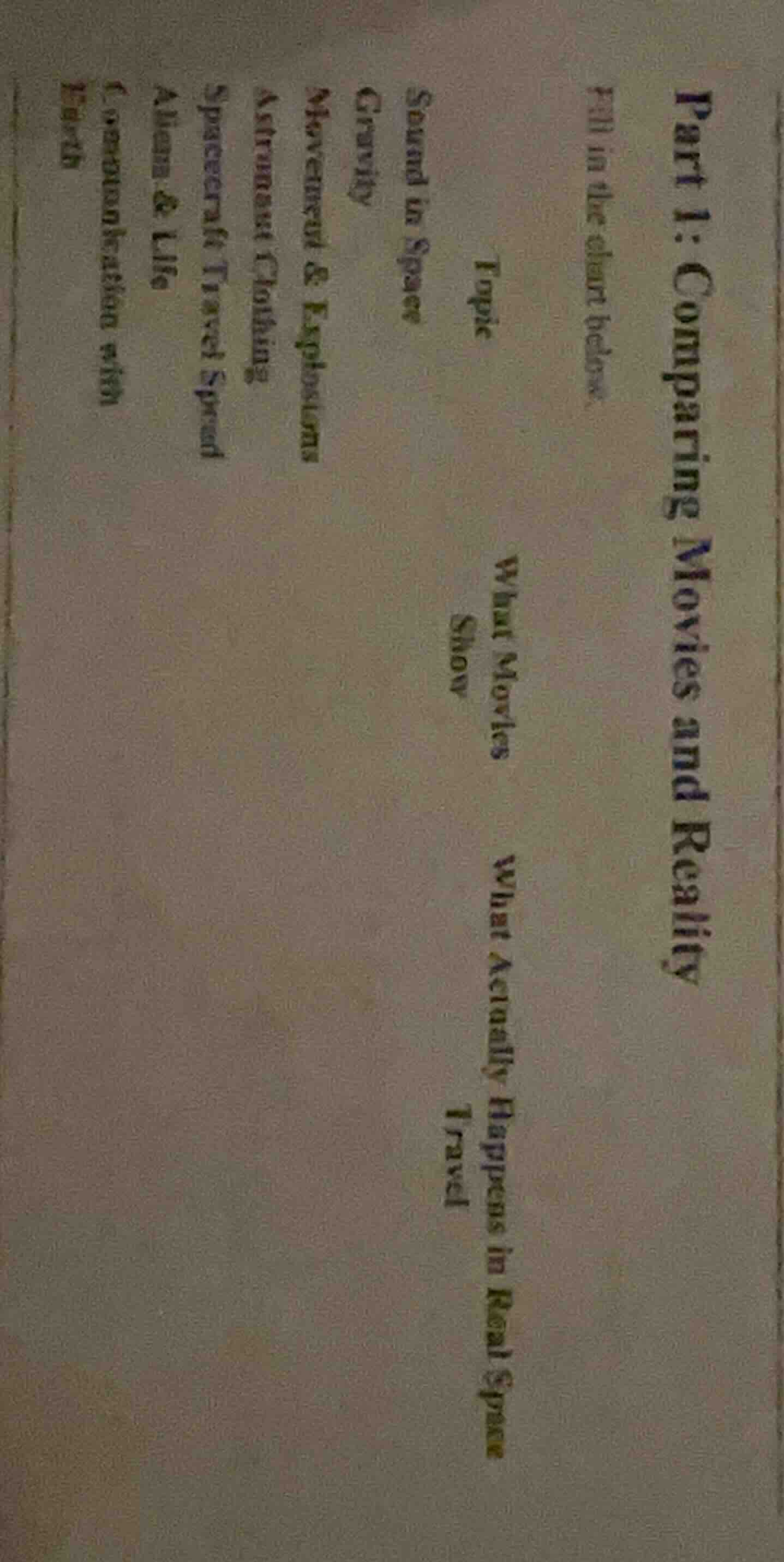
part 1: comparing movies and reality
fill in the chart below.
topic\twhat movies show\twhat actually happens in real space travel
sound in space\t\t
gravity\t\t
asteroids & explosions\t\t
astronaut clothing\t\t
spacecraft travel speed\t\t
aliens & life\t\t
communication with earth\t\t
Response
To fill in the chart, we analyze each topic:
1. Sound in Space
- What Movies/Shows: Often depict sound (e.g., explosions, voices) propagating in space (e.g., Star Wars, Interstellar).
- What Actually Happens in Real Space Travel: Space is a vacuum; sound waves need a medium (like air) to travel. No sound propagates in space.
2. Gravity
- What Movies/Shows: May show artificial gravity (e.g., 2001: A Space Odyssey) or inconsistent gravity (e.g., characters floating/unfloating unrealistically).
- What Actually Happens in Real Space Travel: In orbit, astronauts experience microgravity (free - fall). On celestial bodies (e.g., Moon, Mars), gravity depends on the body’s mass (Moon: ~1/6 Earth’s gravity; Mars: ~3/8 Earth’s gravity).
3. Adventure & Explorations
- What Movies/Shows: Depict dramatic, fast - paced explorations (e.g., The Martian has intense, condensed exploration).
- What Actually Happens in Real Space Travel: Real space exploration (e.g., ISS, Mars rovers) is slow, methodical, and highly planned (e.g., years of preparation, strict protocols).
4. Astronaut Clothing
- What Movies/Shows: Suits may look stylized (e.g., The Expanse has futuristic, sometimes less - realistic suits).
- What Actually Happens in Real Space Travel: Spacesuits (e.g., EMU for ISS) are complex, designed for life support, mobility, and protection (from radiation, vacuum, temperature extremes).
5. Spacecraft Travel Speed
- What Movies/Shows: Depict faster - than - light travel (e.g., Star Trek’s warp drive) or unrealistic acceleration/deceleration.
- What Actually Happens in Real Space Travel: Real spacecraft (e.g., Voyager, SpaceX) use chemical/ion propulsion; speeds are limited by physics (e.g., ~25,000 mph for orbital velocity, much slower for interplanetary travel).
6. Alien & Life
- What Movies/Shows: Depict intelligent, humanoid aliens (e.g., Star Wars species) or aggressive alien life (e.g., Alien franchise).
- What Actually Happens in Real Space Travel: No confirmed alien life yet. Search (e.g., SETI, exoplanet studies) focuses on microbial life or habitable conditions, not humanoid/aggressive aliens.
7. Communication with Earth
- What Movies/Shows: May show instant communication (e.g., The Martian has near - real - time comms for drama).
- What Actually Happens in Real Space Travel: Communication has delays (e.g., ~12 minutes one - way to Mars) due to distance and signal speed (speed of light).
8. Birth
- What Movies/Shows: May show births in space with minimal issues (e.g., fictional space colonies with easy births).
- What Actually Happens in Real Space Travel: No human births in space yet. Microgravity, radiation, and medical risks make it untested and extremely complex.
You can organize this information into the chart rows for each topic.
| Topic | What Movies/Shows | What Actually Happens in Real Space Travel |
|---|
| Gravity | Artificial…

Snap & solve any problem in the app
Get step-by-step solutions on Sovi AI
Photo-based solutions with guided steps
Explore more problems and detailed explanations
To fill in the chart, we analyze each topic:
1. Sound in Space
- What Movies/Shows: Often depict sound (e.g., explosions, voices) propagating in space (e.g., Star Wars, Interstellar).
- What Actually Happens in Real Space Travel: Space is a vacuum; sound waves need a medium (like air) to travel. No sound propagates in space.
2. Gravity
- What Movies/Shows: May show artificial gravity (e.g., 2001: A Space Odyssey) or inconsistent gravity (e.g., characters floating/unfloating unrealistically).
- What Actually Happens in Real Space Travel: In orbit, astronauts experience microgravity (free - fall). On celestial bodies (e.g., Moon, Mars), gravity depends on the body’s mass (Moon: ~1/6 Earth’s gravity; Mars: ~3/8 Earth’s gravity).
3. Adventure & Explorations
- What Movies/Shows: Depict dramatic, fast - paced explorations (e.g., The Martian has intense, condensed exploration).
- What Actually Happens in Real Space Travel: Real space exploration (e.g., ISS, Mars rovers) is slow, methodical, and highly planned (e.g., years of preparation, strict protocols).
4. Astronaut Clothing
- What Movies/Shows: Suits may look stylized (e.g., The Expanse has futuristic, sometimes less - realistic suits).
- What Actually Happens in Real Space Travel: Spacesuits (e.g., EMU for ISS) are complex, designed for life support, mobility, and protection (from radiation, vacuum, temperature extremes).
5. Spacecraft Travel Speed
- What Movies/Shows: Depict faster - than - light travel (e.g., Star Trek’s warp drive) or unrealistic acceleration/deceleration.
- What Actually Happens in Real Space Travel: Real spacecraft (e.g., Voyager, SpaceX) use chemical/ion propulsion; speeds are limited by physics (e.g., ~25,000 mph for orbital velocity, much slower for interplanetary travel).
6. Alien & Life
- What Movies/Shows: Depict intelligent, humanoid aliens (e.g., Star Wars species) or aggressive alien life (e.g., Alien franchise).
- What Actually Happens in Real Space Travel: No confirmed alien life yet. Search (e.g., SETI, exoplanet studies) focuses on microbial life or habitable conditions, not humanoid/aggressive aliens.
7. Communication with Earth
- What Movies/Shows: May show instant communication (e.g., The Martian has near - real - time comms for drama).
- What Actually Happens in Real Space Travel: Communication has delays (e.g., ~12 minutes one - way to Mars) due to distance and signal speed (speed of light).
8. Birth
- What Movies/Shows: May show births in space with minimal issues (e.g., fictional space colonies with easy births).
- What Actually Happens in Real Space Travel: No human births in space yet. Microgravity, radiation, and medical risks make it untested and extremely complex.
You can organize this information into the chart rows for each topic.
| Topic | What Movies/Shows | What Actually Happens in Real Space Travel |
|---|---|---|
| Gravity | Artificial gravity or inconsistent gravity (e.g., 2001: A Space Odyssey). | Microgravity in orbit; gravity depends on celestial body mass (e.g., Moon: 1/6 Earth’s gravity). |
| Adventure & Explorations | Dramatic, fast - paced (e.g., The Martian). | Slow, methodical, highly planned (e.g., ISS, Mars rovers). |
| Astronaut Clothing | Stylized, less realistic (e.g., The Expanse). | Complex, life - support - focused (e.g., EMU for ISS). |
| Spacecraft Travel Speed | Faster - than - light, unrealistic acceleration (e.g., Star Trek). | Limited by physics (e.g., ~25,000 mph orbital speed, slow interplanetary travel). |
| Alien & Life | Intelligent/humanoid/aggressive aliens (e.g., Star Wars, Alien). | No confirmed alien life; search for microbial life/habitable conditions. |
| Communication with Earth | Instant communication (e.g., The Martian). | Delays (e.g., ~12 minutes to Mars) due to distance/signal speed (speed of light). |
| Birth | Easy births in space (fictional colonies). | No human births in space yet; high risks (microgravity, radiation, medical complexity). |