QUESTION IMAGE
Question
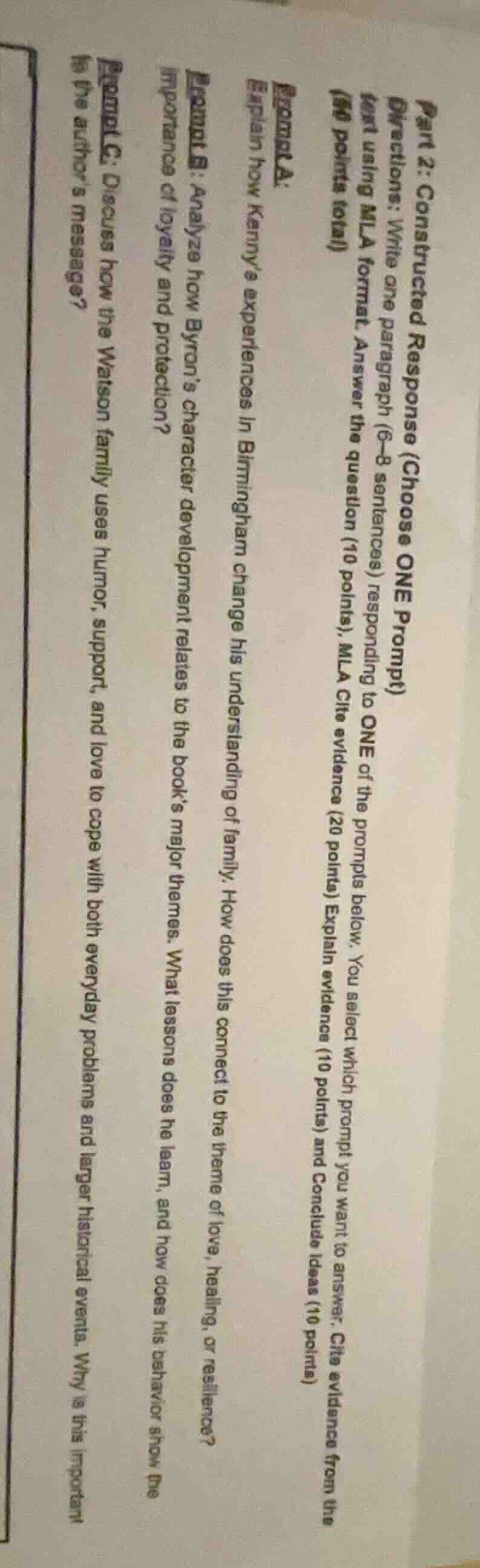
part 2: constructed response (choose one prompt)
directions: write one paragraph (6–8 sentences) responding to one of the prompts below. use mla format. answer the question (10 points). cite evidence from the text (20 points total). mla cite evidence (20 points) explain evidence (10 points) and conclude ideas (10 points)
prompt a:
explain how kenny’s experiences in birmingham change his understanding of family. how does this connect to the theme of love, healing, or resilience?
prompt b:
analyze how byron’s character development relates to the book’s major themes. what lessons does he learn, and how does his behavior show the importance of loyalty and protection?
prompt c:
discuss how the watson family uses humor, support, and love to cope with both everyday problems and larger historical events. why is this the author’s message?
To answer one of these prompts (e.g., Prompt C about the Watson family in The Watsons Go to Birmingham – 1963):
- Identify the Family’s Coping Mechanisms: The Watson family (from Christopher Paul Curtis’ novel) uses humor (e.g., Dad’s “Brown Bomber” car jokes), support (sibling bonds, parental care), and love to navigate daily issues (like Byron’s misbehavior) and historical trauma (the Birmingham church bombing).
- Connect to Everyday/Historical Context: Humor lightens tension (e.g., Kenny’s sarcasm), support (Mom’s planning, Dad’s protection) stabilizes them, and love fuels resilience. Historical events (Birmingham) test their unity, while humor/support help them heal.
- Author’s Message: Curtis emphasizes that family bonds and positive coping (humor, support, love) empower resilience against both personal and systemic challenges, highlighting the need for unity in adversity.

Snap & solve any problem in the app
Get step-by-step solutions on Sovi AI
Photo-based solutions with guided steps
Explore more problems and detailed explanations
(Sample Response for Prompt C):
In The Watsons Go to Birmingham – 1963, the Watson family uses humor, support, and love to cope with everyday problems (e.g., Byron’s misbehavior) and historical trauma (the Birmingham church bombing). Humor—like Dad’s “Brown Bomber” jokes or Kenny’s sarcastic observations—lightens tension, while support (e.g., Mom’s care for Joetta, Dad’s protection) strengthens their bond. Love fuels their resilience: when Kenny faces trauma, family comfort (Byron’s apology, Mom’s embrace) helps him heal. This coping mirrors the novel’s theme of resilience: humor defuses stress, support builds unity, and love fosters healing. Curtis’ message is that family bonds and positive coping mechanisms empower people to endure both personal and systemic hardships, showing how love and laughter can sustain hope even in crisis.