QUESTION IMAGE
Question
part d
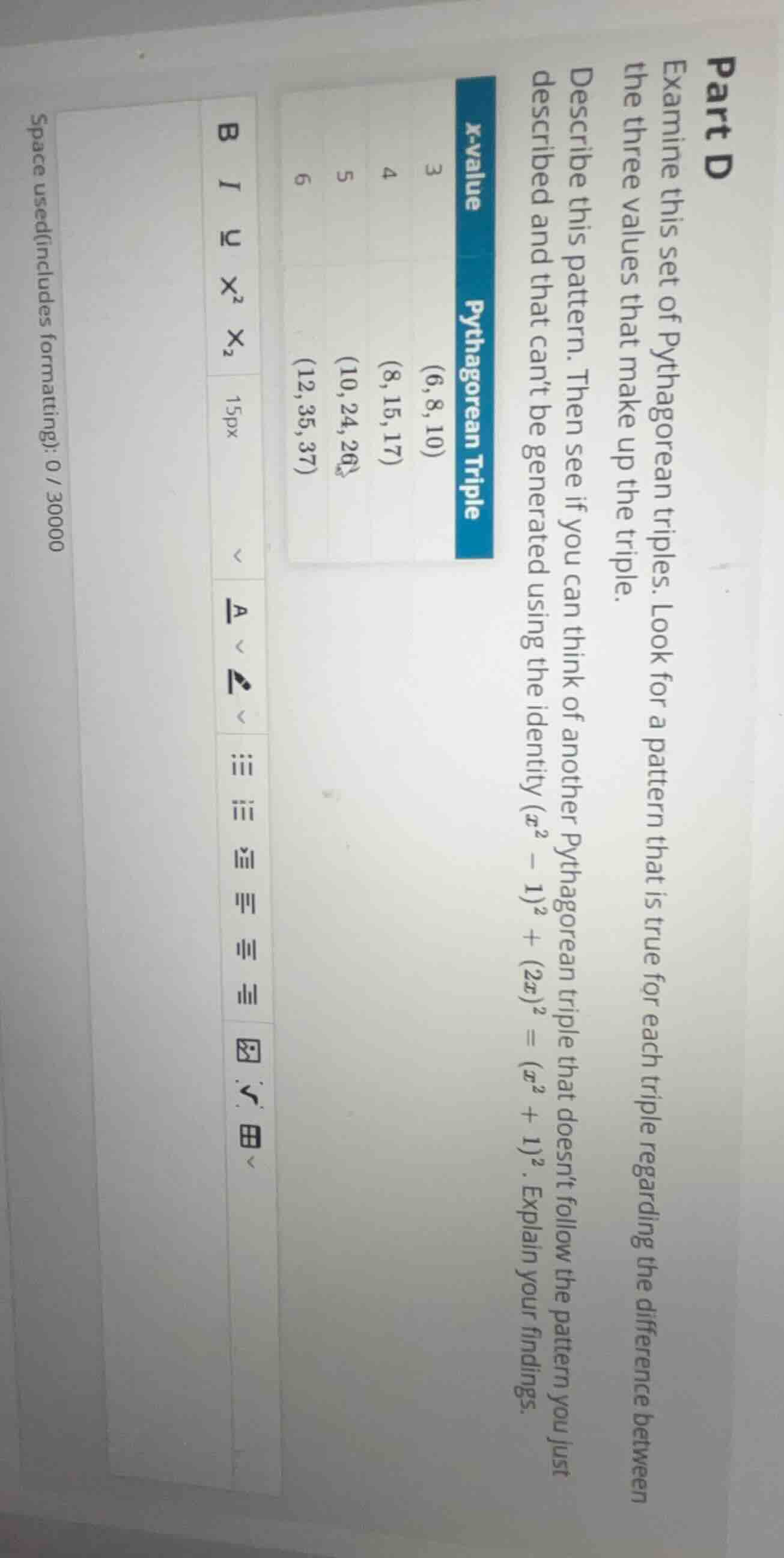
examine this set of pythagorean triples. look for a pattern that is true for each triple regarding the difference between the three values that make up the triple.
describe this pattern. then see if you can think of another pythagorean triple that doesn’t follow the pattern you just described and that can’t be generated using the identity ((x^2 - 1)^2 + (2x)^2 = (x^2 + 1)^2). explain your findings.
x - value | pythagorean triple
3 | (6, 8, 10)
4 | (8, 15, 17)
5 | (10, 24, 26)
6 | (12, 35, 37)
Step1: Analyze the given triples
For the triple \((6, 8, 10)\): Let's check the identity \((x^{2}-1)^{2}+(2x)^{2}=(x^{2}+1)^{2}\). If we assume the middle term is \(2x\), then \(2x = 8\), so \(x = 4\). Now check \((4^{2}-1)^{2}+(2\times4)^{2}=(16 - 1)^{2}+8^{2}=15^{2}+8^{2}=225 + 64 = 289\) and \((4^{2}+1)^{2}=(16 + 1)^{2}=17^{2}=289\)? Wait, no, the triple is \((6,8,10)\). Wait, maybe the first term is \(x^{2}-1\), second is \(2x\), third is \(x^{2}+1\). For \(x = 3\): \(x^{2}-1=9 - 1 = 8\)? No, wait the triple \((6,8,10)\): Let's see \(x = 3\): \(2x=6\)? No, maybe I mixed up. Wait the triple \((6,8,10)\): Let's check the identity with \(x = 3\): \((3^{2}-1)^{2}+(2\times3)^{2}=(9 - 1)^{2}+6^{2}=8^{2}+6^{2}=64 + 36 = 100\) and \((3^{2}+1)^{2}=(9 + 1)^{2}=10^{2}=100\). Oh! So here, the first term is \(2x = 6\) (so \(x = 3\)), the second term is \(x^{2}-1=9 - 1 = 8\), and the third term is \(x^{2}+1=9 + 1 = 10\). Wait, so the triple is \((2x,x^{2}-1,x^{2}+1)\) when \(x = 3\): \((6,8,10)\). For \(x = 4\): \((2\times4,4^{2}-1,4^{2}+1)=(8,15,17)\), which matches the triple \((8,15,17)\). For \(x = 5\): \((2\times5,5^{2}-1,5^{2}+1)=(10,24,26)\), which matches \((10,24,26)\). For \(x = 6\): \((2\times6,6^{2}-1,6^{2}+1)=(12,35,37)\), which matches \((12,35,37)\). So the pattern is that for \(x\geq3\) (integer), the Pythagorean triple is \((2x,x^{2}-1,x^{2}+1)\) since \((2x)^{2}+(x^{2}-1)^{2}=4x^{2}+x^{4}-2x^{2}+1=x^{4}+2x^{2}+1=(x^{2}+1)^{2}\), which is the Pythagorean theorem.
Step2: Find a triple not following this pattern
A common Pythagorean triple that doesn't follow this pattern is \((3,4,5)\). Let's check if it can be written as \((2x,x^{2}-1,x^{2}+1)\). Suppose \(2x = 3\), then \(x = 1.5\), not an integer. If \(x^{2}-1 = 3\), then \(x^{2}=4\), \(x = 2\). Then \(2x = 4\), \(x^{2}+1 = 5\). So the triple would be \((4,3,5)\), but the standard \((3,4,5)\) has the first term as 3, which is not \(2x\) when \(x = 2\) (since \(2x = 4\)). So \((3,4,5)\) doesn't follow the pattern \((2x,x^{2}-1,x^{2}+1)\) because for \(x = 2\), the triple would be \((4,3,5)\) (swapped first two terms), but the pattern we observed earlier has the first term as \(2x\) (even number), second as \(x^{2}-1\) (odd number when \(x\) is odd, even when \(x\) is even? Wait \(x = 3\): \(2x = 6\) (even), \(x^{2}-1 = 8\) (even? No, 8 is even. Wait \(x = 3\): \(x^{2}-1 = 8\) (even), \(x = 4\): \(x^{2}-1 = 15\) (odd). Wait, maybe the pattern is for \(x\) integer \(\geq3\), the triple is \((2x,x^{2}-1,x^{2}+1)\) with \(2x\) as the even leg, \(x^{2}-1\) as the other leg, and \(x^{2}+1\) as the hypotenuse. The triple \((3,4,5)\) has the even leg as 4, which would be \(2x\) when \(x = 2\), but \(x = 2\) gives \(x^{2}-1 = 3\), so the triple \((4,3,5)\), but \((3,4,5)\) is a permutation, but the pattern we saw earlier has the first term as \(2x\) (the even leg) in the order \((2x,x^{2}-1,x^{2}+1)\), so \((3,4,5)\) doesn't fit because if we take \(x = 2\), the triple is \((4,3,5)\), not \((3,4,5)\) in the order of our pattern. Another example: \((5,12,13)\). Let's check the pattern: If we try to fit into \((2x,x^{2}-1,x^{2}+1)\), \(2x = 5\) gives \(x = 2.5\), not integer. \(x^{2}-1 = 5\) gives \(x^{2}=6\), not a perfect square. \(x^{2}+1 = 13\) gives \(x^{2}=12\), not a perfect square. So \((5,12,13)\) also doesn't follow the pattern. Let's verify with the identity: \((5)^{2}+(12)^{2}=25 + 144 = 169=(13)^{2}\), so it's a Pythagorean triple, but it can't be generated by \((2x,x^{2}-1,x^{2}+1)\) because solving for \(x\) in any of the terms doesn't give an integer \(x\) that fi…

Snap & solve any problem in the app
Get step-by-step solutions on Sovi AI
Photo-based solutions with guided steps
Explore more problems and detailed explanations
The pattern is that for integer \(x\geq3\), the Pythagorean triple is \((2x, x^{2}-1, x^{2}+1)\) (verified by the Pythagorean theorem: \((2x)^{2}+(x^{2}-1)^{2}=(x^{2}+1)^{2}\)). A triple not following this pattern is \((3, 4, 5)\) (or \((5, 12, 13)\) etc.), as it cannot be expressed in the form \((2x, x^{2}-1, x^{2}+1)\) with an integer \(x\geq3\) (or the form doesn't match the term order/values for integer \(x\)).