QUESTION IMAGE
Question
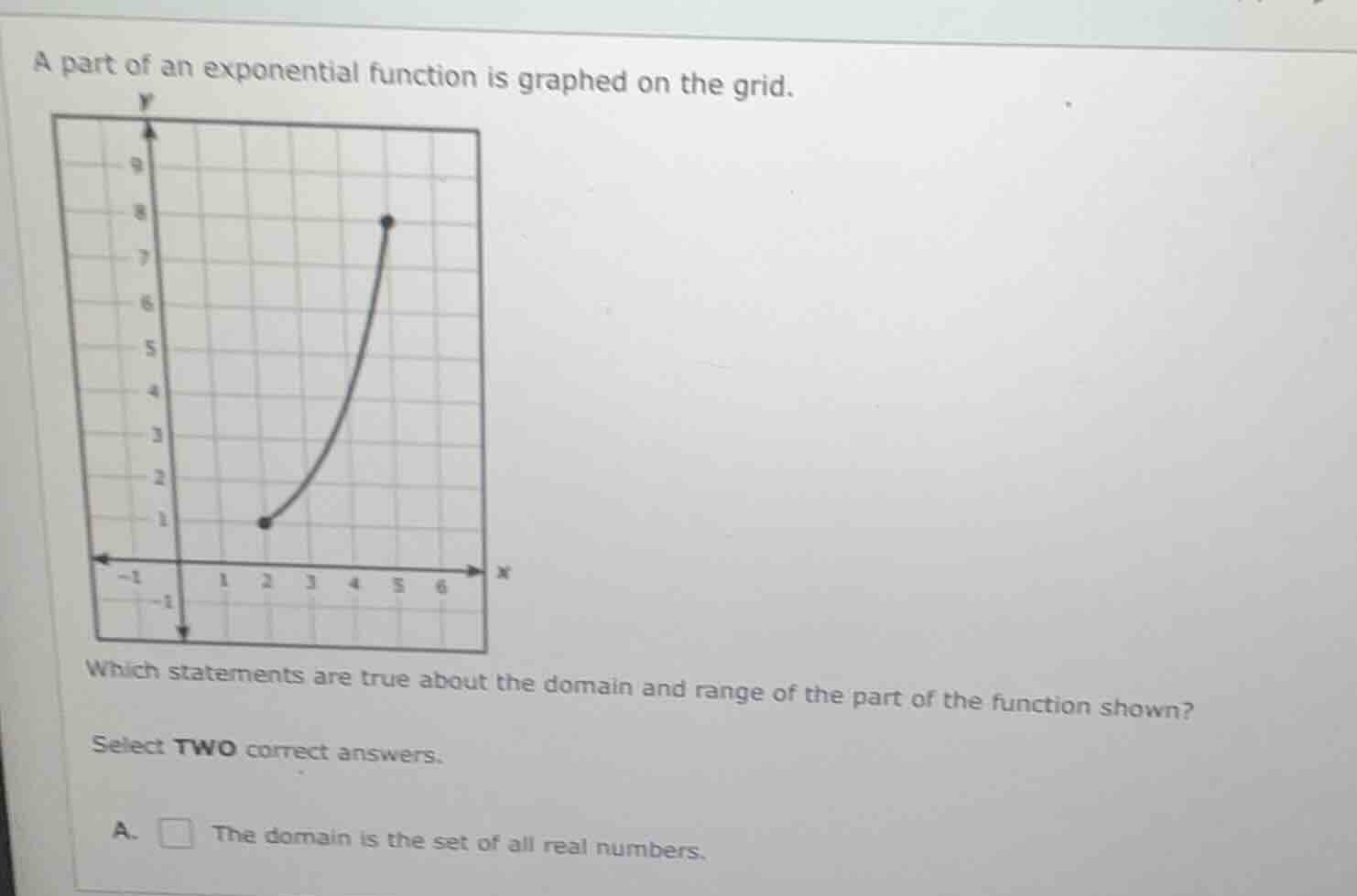
a part of an exponential function is graphed on the grid. which statements are true about the domain and range of the part of the function shown? select two correct answers. a. the domain is the set of all real numbers.
To solve this, we analyze the domain and range from the graphed exponential function:
Step 1: Identify the domain
The domain of a function is the set of all \( x \)-values it covers. From the graph, the \( x \)-values start at \( x = 2 \) (the leftmost point) and go to \( x = 5 \) (the rightmost point). So the domain is \( 2 \leq x \leq 5 \), not all real numbers. Thus, option A is false.
Step 2: Analyze the range (and other potential statements, though the full options aren’t shown)
The range is the set of \( y \)-values. The graph starts at \( y = 1 \) (at \( x = 2 \)) and rises to \( y = 8 \) (at \( x = 5 \)). So the range is \( 1 \leq y \leq 8 \).
Since the full options aren’t provided, we can infer that correct statements would relate to the domain being \( 2 \leq x \leq 5 \) (not all real numbers) and the range being \( 1 \leq y \leq 8 \). For example, if another option stated “The domain is \( 2 \leq x \leq 5 \)” or “The range is \( 1 \leq y \leq 8 \)”, those would be true.
(Note: If the original problem had specific options, we’d evaluate each. For the given partial info, the key is that the domain is not all real numbers, and the range is between 1 and 8.)

Snap & solve any problem in the app
Get step-by-step solutions on Sovi AI
Photo-based solutions with guided steps
Explore more problems and detailed explanations
To solve this, we analyze the domain and range from the graphed exponential function:
Step 1: Identify the domain
The domain of a function is the set of all \( x \)-values it covers. From the graph, the \( x \)-values start at \( x = 2 \) (the leftmost point) and go to \( x = 5 \) (the rightmost point). So the domain is \( 2 \leq x \leq 5 \), not all real numbers. Thus, option A is false.
Step 2: Analyze the range (and other potential statements, though the full options aren’t shown)
The range is the set of \( y \)-values. The graph starts at \( y = 1 \) (at \( x = 2 \)) and rises to \( y = 8 \) (at \( x = 5 \)). So the range is \( 1 \leq y \leq 8 \).
Since the full options aren’t provided, we can infer that correct statements would relate to the domain being \( 2 \leq x \leq 5 \) (not all real numbers) and the range being \( 1 \leq y \leq 8 \). For example, if another option stated “The domain is \( 2 \leq x \leq 5 \)” or “The range is \( 1 \leq y \leq 8 \)”, those would be true.
(Note: If the original problem had specific options, we’d evaluate each. For the given partial info, the key is that the domain is not all real numbers, and the range is between 1 and 8.)