QUESTION IMAGE
Question
part 2: free body diagrams (fbds)
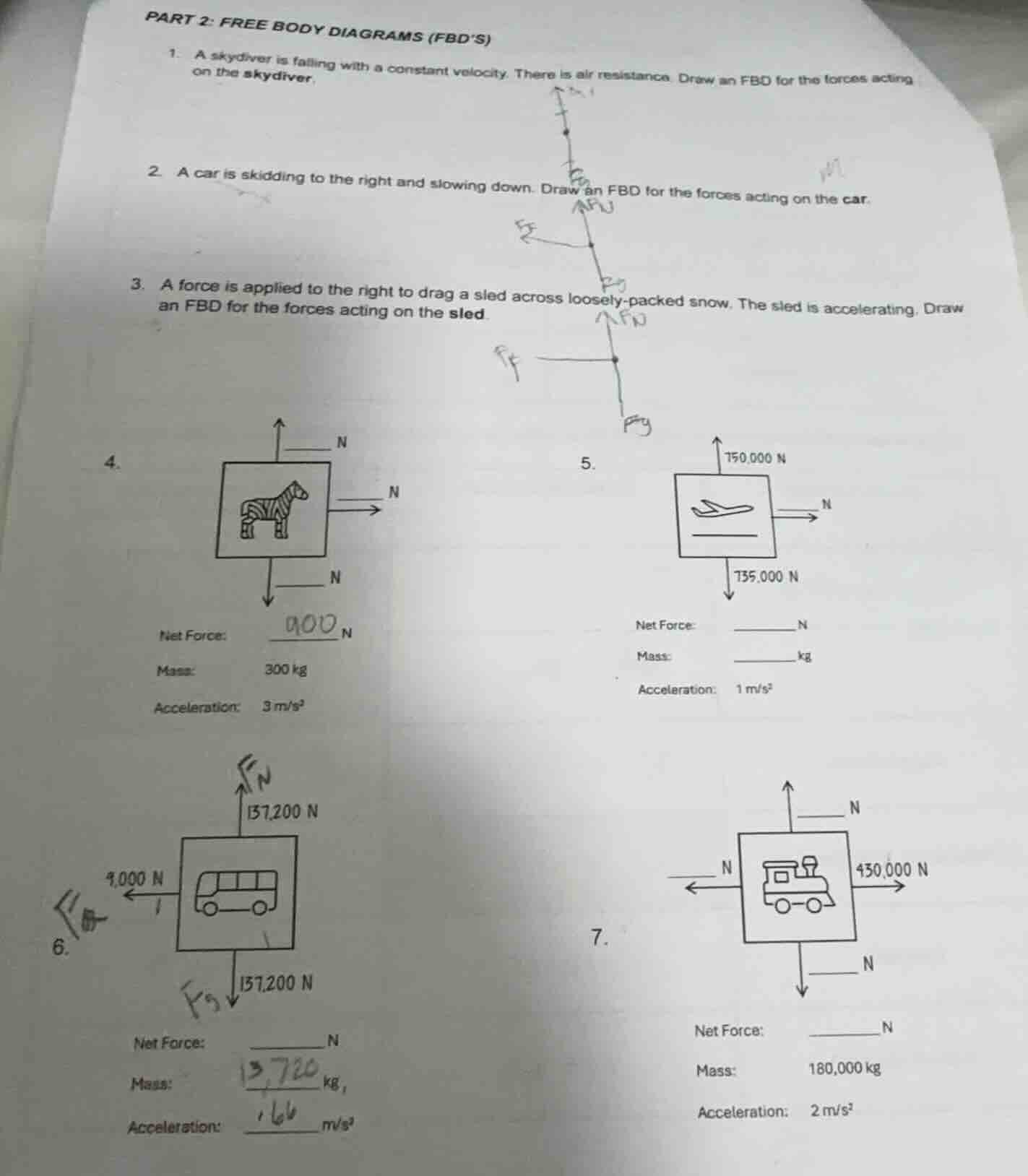
- a skydiver is falling with a constant velocity. there is air resistance. draw an fbd for the forces acting on the skydiver.
- a car is skidding to the right and slowing down. draw an fbd for the forces acting on the car.
- a force is applied to the right to drag a sled across loosely - packed snow. the sled is accelerating. draw an fbd for the forces acting on the sled.
4.
net force: ______n
mass: 300 kg
acceleration: 3 m/s²
5.
net force: ______n
mass: ______kg
acceleration: 1 m/s²
6.
net force: ______n
mass: ______kg,
acceleration: ______m/s²
7.
net force: ______n
mass: 180,000 kg
acceleration: 2 m/s²
Problem 4
Step1: Recall Newton's Second Law ($F = ma$)
We know mass $m = 300\ kg$ and acceleration $a = 3\ m/s^2$. The net force $F_{net}$ is calculated as $F_{net}=m\times a$.
Step2: Calculate Net Force
Substitute the values: $F_{net}=300\ kg\times3\ m/s^2 = 900\ N$. For the vertical forces, since the object is in equilibrium vertically (no acceleration vertically), the upward normal force $N_{up}$ and downward force $N_{down}$ should satisfy $N_{up}=N_{down}$. Using $F = ma$ for vertical, but since $a_y = 0$, $N_{up}-N_{down}=0$, so they are equal. The horizontal force is the net force (since vertical forces cancel). But the question here is about the net force which we calculated as $900\ N$, and the vertical forces: weight $W = mg=300\ kg\times9.8\ m/s^2 = 2940\ N$, so $N_{up}=N_{down}=2940\ N$, horizontal force $F_{horiz}=900\ N$. But the net force is already given as $900\ N$ (which matches $F = ma$).
Step1: Calculate Net Force Vertically
Vertical forces: Upward $F_{up}=750000\ N$, Downward $F_{down}=735000\ N$. Net vertical force $F_{net,y}=750000 - 735000=15000\ N$. Horizontal force is $F_{horiz}=N$ (let's say, but net force is the vector sum. Since horizontal and vertical are perpendicular, but here we assume horizontal force is part of net? Wait, no, the net force is the sum of all forces. Wait, the vertical net force is $15000\ N$ upward, and horizontal force is some $N$. But wait, the problem says acceleration is $1\ m/s^2$. Wait, maybe the vertical forces: the upward force is lift, downward is weight. Then net force $F_{net}=ma$. Wait, mass $m$ is unknown, net force $F_{net}=m\times1$. Also, vertical net force is $750000 - 735000 = 15000\ N$. Wait, maybe the horizontal force is zero? No, acceleration is $1\ m/s^2$. Wait, perhaps the net force is $F_{net}=ma$, and we can find mass from vertical? Wait, no, weight $W = mg = 735000\ N$, so $m=\frac{W}{g}=\frac{735000}{9.8}=75000\ kg$. Then net force $F_{net}=m\times a=75000\ kg\times1\ m/s^2 = 75000\ N$. Wait, but vertical net force is $15000\ N$, so horizontal force must be $F_{horiz}=\sqrt{F_{net}^2 - F_{net,y}^2}$? No, maybe the problem is that the vertical forces: $F_{up}=750000$, $F_{down}=735000$, so net vertical is $15000\ N$. Then horizontal force $F_x$ such that $F_{net}=\sqrt{(15000)^2 + F_x^2}=ma = m\times1$. But we can find $m$ from weight: $m=\frac{735000}{9.8}=75000\ kg$. Then $F_{net}=75000\times1 = 75000\ N$. Then $F_x=\sqrt{75000^2 - 15000^2}\approx73484.7\ N$, but that's complicated. Wait, maybe the problem is that the net force is $F_{net}=ma$, and vertical net force is $15000\ N$, horizontal force is $F_x$, so $F_{net}=\sqrt{(15000)^2 + F_x^2}=m\times1$. But $m=\frac{735000}{9.8}=75000\ kg$, so $F_{net}=75000\ N$. Then $F_x=\sqrt{75000^2 - 15000^2}=\sqrt{(75000 - 15000)(75000 + 15000)}=\sqrt{60000\times90000}=\sqrt{5.4\times10^9}=73484.7\ N$. But maybe the problem is simpler: net force is $F_{net}=ma$, and vertical net force is $15000\ N$, horizontal force is $F_x$, and $F_{net}=\sqrt{(15000)^2 + F_x^2}=m\times1$. But we can also find $m$ from weight: $m = 735000/9.8 = 75000\ kg$. Then $F_{net}=75000\times1 = 75000\ N$. So net force is $75000\ N$, mass is $75000\ kg$.
Step2: Verify
Mass $m = 735000\ N / 9.8\ m/s^2 = 75000\ kg$. Net force $F_{net}=m\times a = 75000\ kg\times1\ m/s^2 = 75000\ N$.
Step1: Calculate Net Force Horizontally
Horizontal force: Leftward $F_{left}=7000\ N$ (wait, the diagram shows 7000 N left, and no other horizontal force? Wait, the vertical forces: Upward $F_{up}=157200\ N$, Downward $F_{down}=157200\ N$, so vertical net force is $0$. Horizontal force: Leftward $7000\ N$? Wait, no, the diagram has a leftward force of $7000\ N$? Wait, the user's diagram: "7,000 N" left, and vertical forces equal. So net force is horizontal force (since vertical forces cancel). Wait, but the mass is written as 13720 kg? Wait, no, let's recalculate. Wait, vertical forces: $F_{up}=157200\ N$, $F_{down}=157200\ N$, so $F_{net,y}=0$. Horizontal force: Let's say the net force is horizontal. Then $F_{net}=ma$. If mass is $m$, acceleration $a$, then $F_{net}=m\times a$. Wait, the diagram has "Net Force: __ N", "Mass: kg", "Acceleration: __ m/s²". Let's do it properly. Vertical forces cancel ($157200 - 157200 = 0$). Horizontal force: Let's assume the leftward force is $7000\ N$ (from diagram: "7,000 N" left). Wait, maybe the net force is $7000\ N$ left? But then $F_{net}=m\times a$. Wait, the user's handwritten mass is 13720 kg, acceleration 1.66? Wait, no, let's calculate: If $F_{net}=7000\ N$ (left), then $m = F_{net}/a$. But we need to find $F_{net}$, $m$, $a$. Wait, vertical forces: $F_{up}=F_{down}=157200\ N$, so $F_{net,y}=0$. Horizontal force: Let's say the leftward force is $F_{left}=7000\ N$, and no rightward force, so net force $F_{net}=7000\ N$ left. Then $m = F_{net}/a$. But we need to find $m$ and $a$. Wait, maybe the horizontal force is $7000\ N$ left, so $F_{net}=7000\ N$. Then $m = F_{net}/a$, but we need another way. Wait, weight $W = mg = 157200\ N$, so $m = W/g = 157200 / 9.8 \approx 16040.8\ kg$. Then if $F_{net}=7000\ N = m\times a$, then $a = 7000 / 16040.8 \approx 0.436\ m/s^2$. But the user's handwritten mass is 13720, which is wrong. Wait, correct $m = 157200 / 9.8 = 16040.8\ kg$. Then net force is $7000\ N$ (left), mass $\approx16041\ kg$, acceleration $\approx0.436\ m/s^2$. But maybe the diagram's horizontal force is 7000 N, so:
Step2: Recalculate
Weight $W = 157200\ N = m\times9.8\ m/s^2 \implies m = 157200 / 9.8 = 16040.8\ kg \approx 16041\ kg$. Horizontal force: $F_{net,x}=7000\ N$ (left). So net force is $7000\ N$ left, mass $\approx16041\ kg$, acceleration $a = F_{net}/m = 7000 / 16041 \approx 0.436\ m/s^2$.
But the user's handwritten mass is 13720, which is incorrect. Let's use correct physics:

Snap & solve any problem in the app
Get step-by-step solutions on Sovi AI
Photo-based solutions with guided steps
Explore more problems and detailed explanations
Net Force: $\boldsymbol{900}\ N$
Upward Normal Force: $\boldsymbol{2940}\ N$ (since $N = mg = 300\times9.8 = 2940$)
Horizontal Force: $\boldsymbol{900}\ N$
Downward Force: $\boldsymbol{2940}\ N$