QUESTION IMAGE
Question
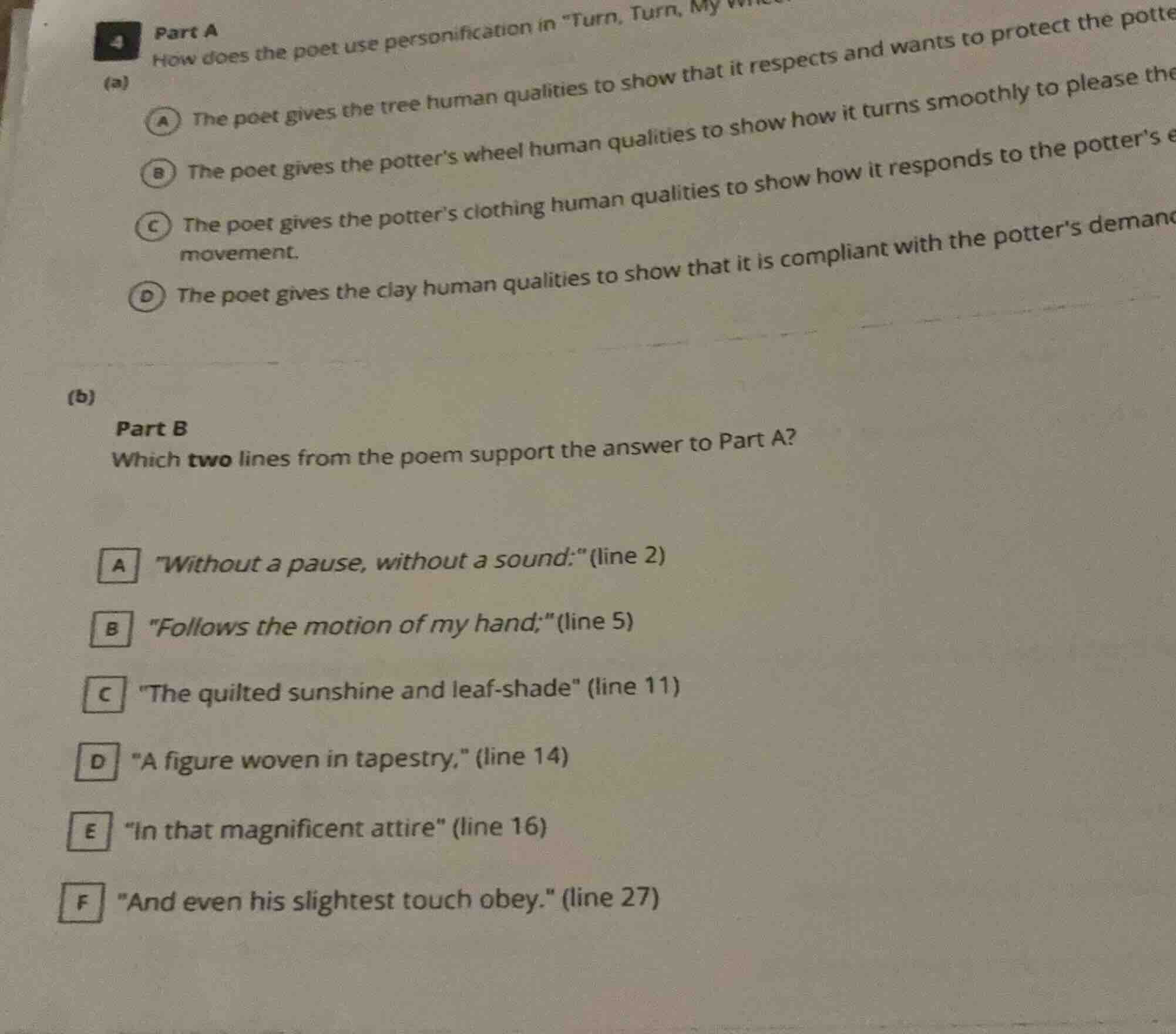
4 part a how does the poet use personification in \turn, turn, my (a) a the poet gives the tree human qualities to show that it respects and wants to protect the potte b the poet gives the potter’s wheel human qualities to show how it turns smoothly to please the c the poet gives the potter’s clothing human qualities to show how it responds to the potter’s movement. d the poet gives the clay human qualities to show that it is compliant with the potter’s demand (b) part b which two lines from the poem support the answer to part a? a \without a pause, without a sound:\ (line 2) b \follows the motion of my hand;\ (line 5) c \the quilted sunshine and leaf - shade\ (line 11) d \a figure woven in tapestry,\ (line 14) e \in that magnificent attire\ (line 16) f \and even his slightest touch obey.\ (line 27)
Part A:
Personification here applies to the clay, as the poem focuses on the clay responding to the potter's actions with compliance, a human-like trait. The other options focus on unrelated objects (tree, wheel, clothing) not central to the poem's core personification of the material being shaped.
Part B:
Line 5 shows the clay (the object of the potter's work) following human movement, a human-like action. Line 27 uses "obey," a human behavior, to describe the clay's compliance with the potter's touch, directly supporting the personification of the clay from Part A. The other lines describe sound, imagery, or attire, not the clay's human-like responsiveness.

Snap & solve any problem in the app
Get step-by-step solutions on Sovi AI
Photo-based solutions with guided steps
Explore more problems and detailed explanations
Part A:
D. The poet gives the clay human qualities to show that it is compliant with the potter's demands
Part B:
B. "Follows the motion of my hand;" (line 5)
F. "And even his slightest touch obey." (line 27)