QUESTION IMAGE
Question
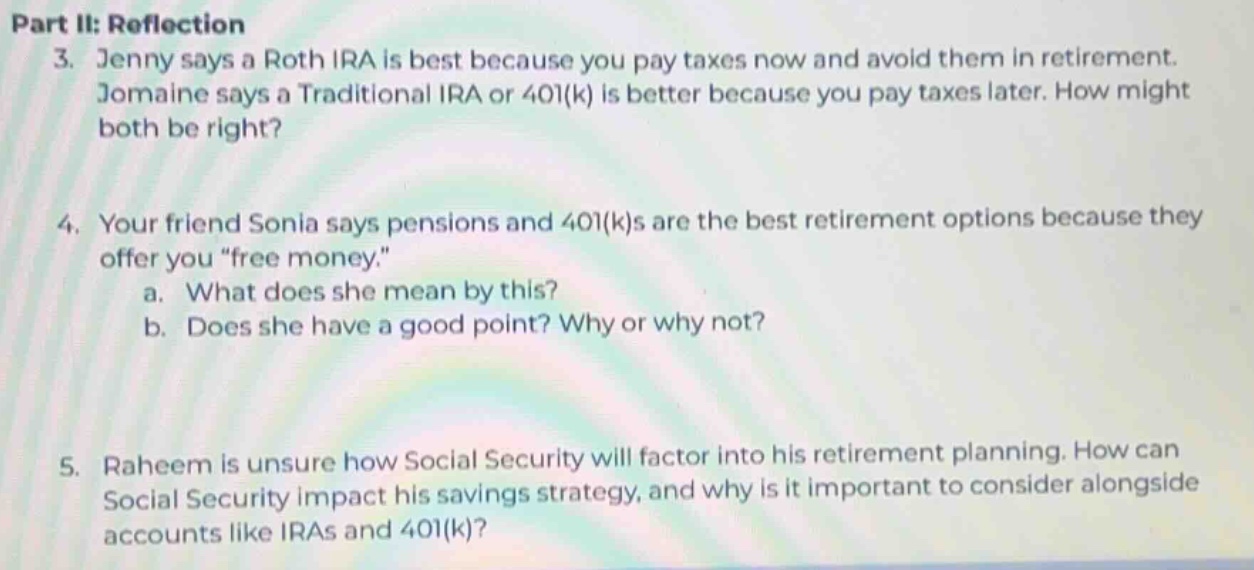
part ii: reflection
- jenny says a roth ira is best because you pay taxes now and avoid them in retirement.
jomaine says a traditional ira or 401(k) is better because you pay taxes later. how might
both be right?
- your friend sonia says pensions and 401(k)s are the best retirement options because they
offer you \free money.\
a. what does she mean by this?
b. does she have a good point? why or why not?
- raheem is unsure how social security will factor into his retirement planning. how can
social security impact his savings strategy, and why is it important to consider alongside
accounts like iras and 401(k)?
For Question 3:
Jenny and Jomaine can both be right because the optimal retirement account depends on an individual's current vs. expected future tax bracket. If someone is in a lower tax bracket now and expects to be in a higher one in retirement, a Roth IRA (pay taxes now at a lower rate) is better. If someone is in a higher tax bracket now and expects to be in a lower one later, a Traditional IRA/401(k) (defer taxes to a lower rate) is better. Other factors like eligibility for tax deductions and desired flexibility in withdrawals also play a role.
For Question 4a:
When Sonia says "free money," she is referring to employer matching contributions. Many employers will match a portion of an employee's 401(k) contributions (e.g., match 50% of contributions up to 6% of salary), and pensions often provide guaranteed retirement income funded in part by employer contributions, which is essentially "free" additional retirement funds the employee does not have to earn through their own direct contributions alone.
For Question 4b:
She has a good point. Employer matching contributions to 401(k)s are essentially additional compensation that requires no extra work from the employee, leaving "free" retirement funds on the table if not claimed. Pensions also provide a reliable, employer-supported income stream in retirement that reduces reliance on personal savings. However, these options have limitations: 401(k)s may have high fees or limited investment choices, and pensions are becoming less common, often with strict vesting rules that require an employee to stay with a company for a set period to claim full benefits.
For Question 5:
Social Security can impact savings strategy by reducing the amount of personal savings needed in retirement: the higher the expected Social Security benefit, the less an individual may need to save in IRAs/401(k)s. It also acts as a safety net for those who cannot save enough through other means. It is important to consider alongside IRAs and 401(k)s because Social Security benefits alone are typically not enough to cover all retirement expenses (they replace about 40% of average pre-retirement income for most people). Combining Social Security with personal retirement accounts ensures a more stable, sufficient income stream in retirement, and planning for both helps individuals avoid underestimating or overestimating their required savings targets.

Snap & solve any problem in the app
Get step-by-step solutions on Sovi AI
Photo-based solutions with guided steps
Explore more problems and detailed explanations
- Both are right because the optimal account depends on current vs. future tax brackets, eligibility for deductions, and withdrawal flexibility: those in lower current tax brackets benefit from Roth IRAs, while those in higher current brackets benefit from Traditional IRAs/401(k)s.
4a. She means employer matching contributions to 401(k)s and employer-funded pension benefits, which are additional retirement funds employees get without extra direct personal contributions.
4b. She has a good point: employer matches are "free" retirement funds, and pensions provide reliable employer-supported income. However, these options have limitations like 401(k) fees/limited investments and pension vesting rules or declining availability.
- Social Security reduces the required personal savings amount by providing a baseline retirement income, acting as a safety net for those with limited savings. It must be considered alongside IRAs/401(k)s because its benefits alone are insufficient to cover most retirement expenses, so combining it with personal accounts ensures a stable, adequate retirement income stream.